The benchmark S&P 500 (^GSPC +0.56%) is hovering near a record high, but the risk of a sell-off might be rising due to the ongoing geopolitical tensions in the Middle East, the stubbornly high inflation rate, and the growing chance of an interest rate hike before the end of 2026.
The S&P 500 currently has a Shiller cyclically adjusted price-to-earnings (CAPE) ratio of 41.6, its highest valuation since the dot-com bubble in 2000. That makes the index especially vulnerable to downside, and if it were to enter a bear market by experiencing a 20% decline, many stocks with elevated valuations would likely also suffer sharp corrections.
The S&P 500 last traded in bear territory during 2022 and 2023, which sent Tesla (TSLA +2.17%) stock plummeting by 75% to just $100. The electric vehicle (EV) giant recovered to set a new record high of $489 last year, but it's currently on the back foot once again. Here's why I predict it will fall below $100 if the S&P enters another bear market.
Image source: Tesla.
Tesla stock is trading at a sky-high valuation
Tesla used to be the undisputed global leader of the EV industry, but over the last couple of years, the company has struggled to compete with the onslaught of low-cost manufacturers from China. Brands like BYD, Geely, and Zeekr sell EVs at lower starting prices than Tesla in key markets like Europe, while offering comparable features.
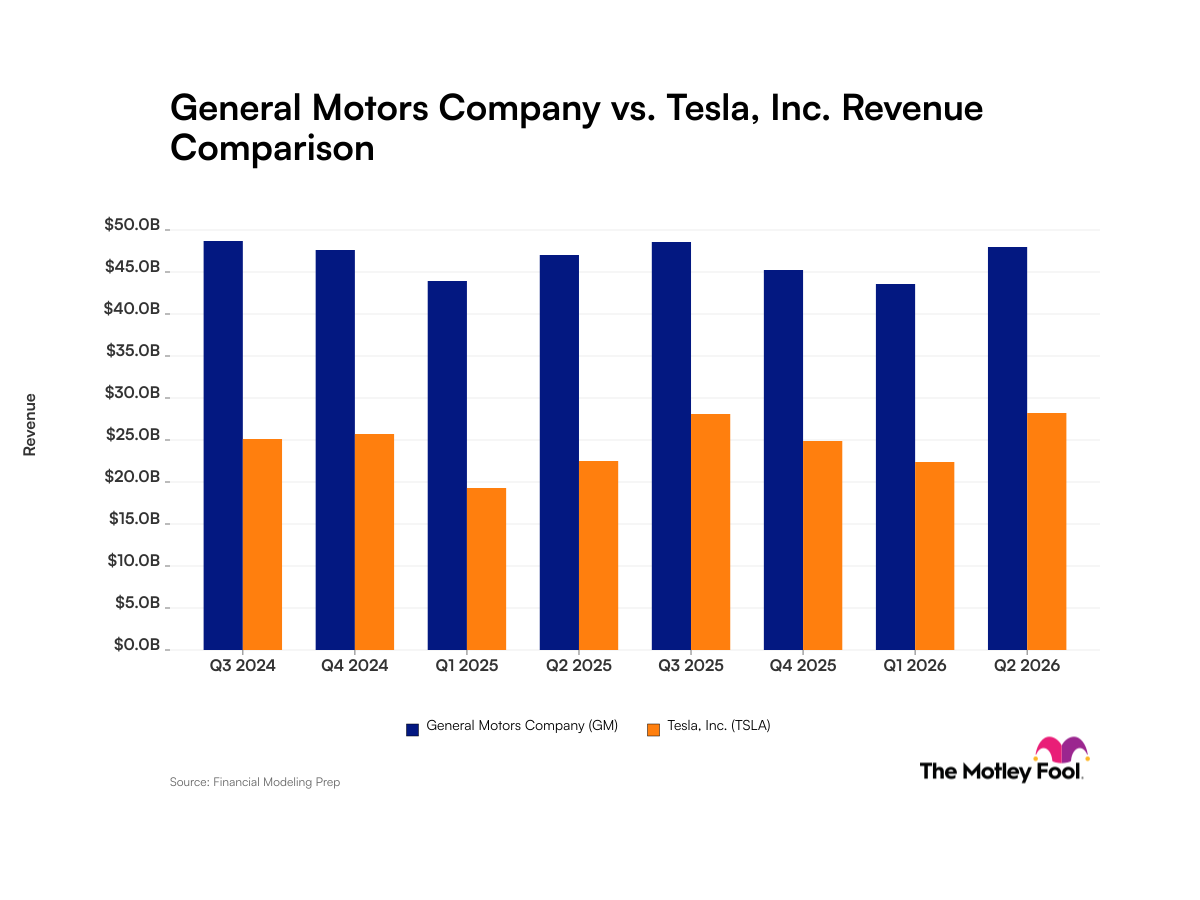
As a result, Tesla's EV sales declined in both 2024 and 2025. Fortunately, they are recovering in 2026, with the company's first-half deliveries growing by 16% year over year to 838,149 vehicles. However, that growth is relative to a horrible 2025, and it comes with a lower average selling price and a shrinking gross margin, suggesting Tesla is slashing prices for its EVs to attract buyers. While that strategy is good for generating sales, it's terrible for the company's bottom line.
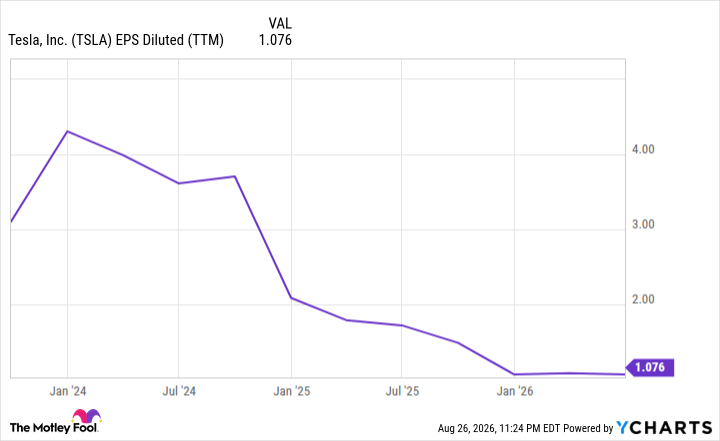
In fact, Tesla's trailing-12-month earnings have plummeted to $1.08 per share over the last two years.
Data by YCharts.
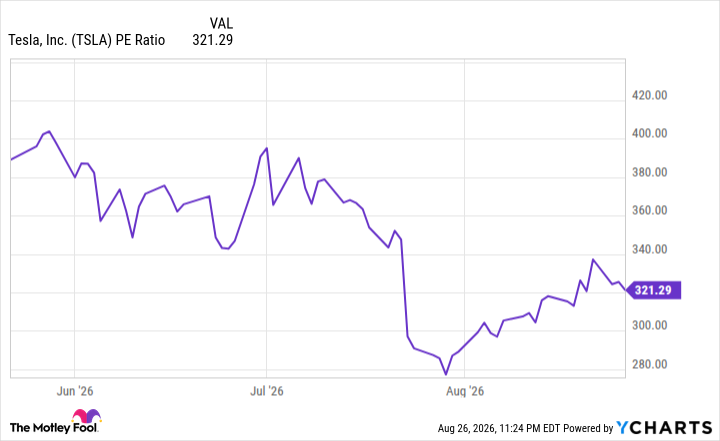
Due to Tesla's declining earnings, its stock now trades at a sky-high price-to-earnings (P/E) ratio of 321, making it 12 times as expensive as the S&P 500 index. In other words, the EV giant appears heavily overvalued compared to the broader market.
Data by YCharts.
Investors often de-risk during bear markets by trimming their most vulnerable stocks, and those with unreasonably high valuations are usually first on the chopping block. Tesla's P/E actually plunged below 30 in 2023, during the last bear market in the S&P 500. If history were to repeat, its stock would have to fall by 90% to $35 in order to achieve a similar P/E today. I'm not suggesting that will happen, but it's clear that a trip below $100 certainly isn't unrealistic.
Many investors will say they currently own Tesla stock not for its EV business, but for its future product platforms, like the Cybercab autonomous robotaxi and Optimus humanoid robot. Those are still a long way from mass commercialization, but they are packed with potential, which is why I don't think Tesla stock will sink by 90% even in a bear market.
Tesla is falling behind in the autonomous vehicle business
Tesla's chief executive, Elon Musk, thinks humanoid robots could outnumber actual humans by 2040, so Optimus could be the company's most valuable product ever. But it won't be produced in any meaningful volume until 2027 at the earliest, because Tesla is still building out the supply chain and trying to overcome complex engineering challenges, such as designing the most dexterous hands.
The Cybercab robotaxi is much easier to bring to market because of Tesla's experience in the EV business. But the biggest hurdle to commercializing this product is winning widespread regulatory approval for the company's unsupervised full self-driving (FSD) software.

NASDAQ: TSLA
Key Data Points
Tesla's vice president of artificial intelligence software, Ashok Elluswamy, said its robotaxi program had completed only about 380,000 miles of fully driverless operation across six U.S. states as of June 30, placing it significantly behind the competition. In fact, Alphabet's Waymo is already completing over 500,000 paid, fully autonomous trips every single week across 11 major U.S. cities.
The Cybercab can't operate at scale until FSD is more widely approved by regulators, and the timeline is still uncertain. As a result, investors paying a hefty premium for Tesla stock today might be exposing themselves to significant downside if the company is still generating most of its revenue from passenger EV sales when the next bear market arrives.
For that reason, it might be best to steer clear of Tesla stock until it trades at a more reasonable valuation.