For years, the U.S. Air Force has had a dream: To marry full-size but unpiloted stealthy Collaborative Combat Aircraft drone fighters with piloted fighter jets. The piloted fighters would control the drones and send them on riskier missions, thus keeping the pilots safe.
That dream got a little closer to becoming reality last week.
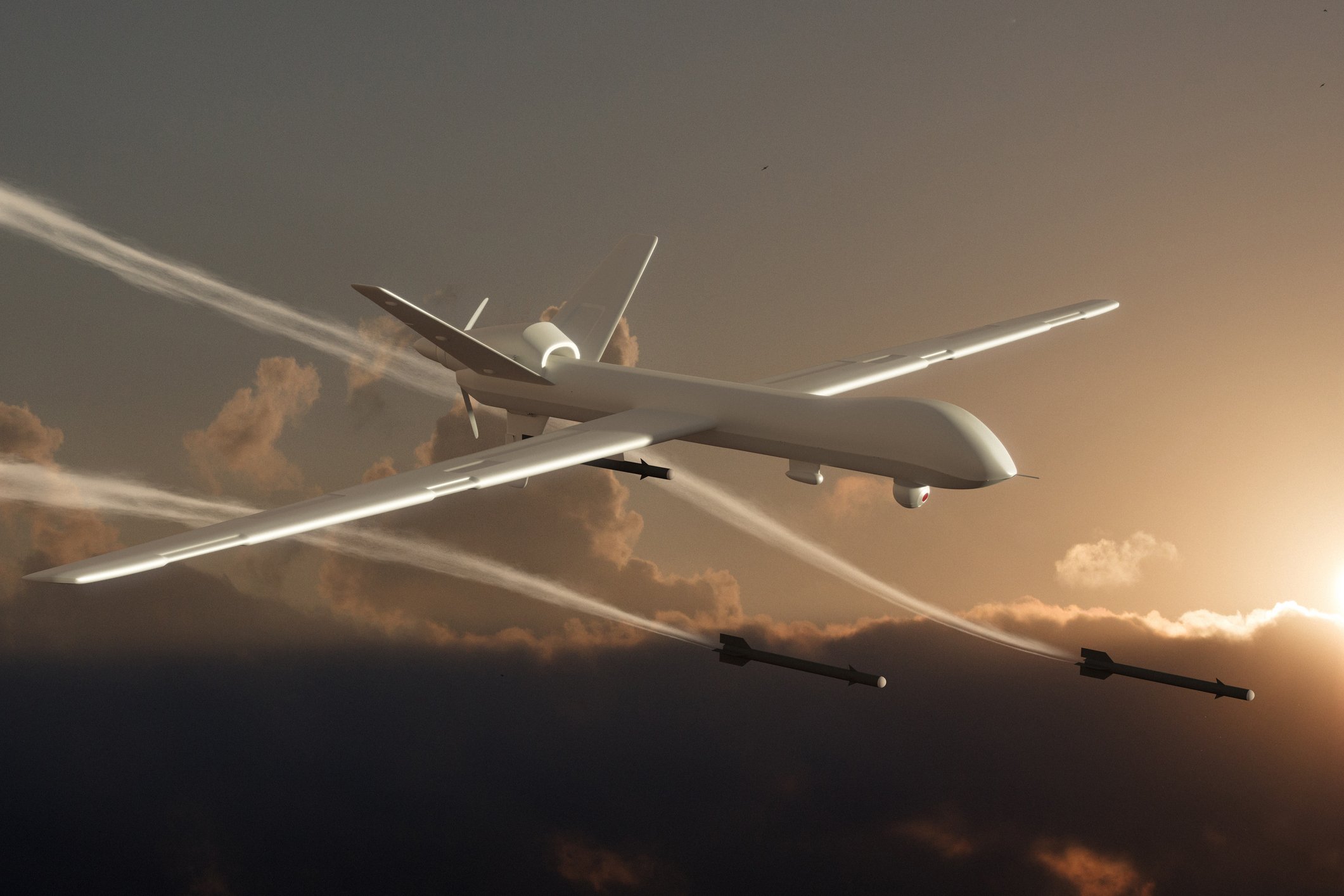
Image source: Getty Images.
Introducing the General Atomics FQ-42A Vengeance and Anduril FQ-44A Fury
Three months ago, if you recall, the U.S. Air Force awarded General Atomics and Anduril Industries contracts to build prototypes of its first two Collaborative Combat Aircraft, or CCA, drone fighters. At the time, each drone was given a designation: FQ-42 for GA's drone and FQ-44 for Anduril's.
Now the drones have names in addition to numbers.
Secretary of the Air Force Troy Meink announced last Monday that the Air Force is naming General Atomics' FQ-42A the "Vengeance" and Anduril's FQ-44A CCA the "Fury." Meink also gave us a glimpse at the Air Force's plans for moving past the prototype stage and into production.
What to expect from Vengeance and Fury
Specifically, the Air Force will buy a total of 150 Vengeance and Fury drones in "Increment 1" of the program. By 2032, this number should rise to 500 -- not necessarily 250 of each, but for now, let's assume that's the case.
Reportedly, the Air Force has asked both GA and Anduril to build its drones for an average of $20 million per unit. Times 500 drones total, that works out to a $10 billion cost for the total CCA fleet -- and assuming a 50-50 split, it means $5 billion in revenue for General Atomics and $5 billion for Anduril.
What it means for Anduril
But $5 billion could be just the start of the good news for Anduril. As I explained last week, the Air Force is breaking CCA into two parts. The contract for producing the drone hardware, discussed above, is just the first part. Additional funds will be awarded for the software that allows the drones to fly autonomously, as well as for other software (presumably to operate sensors, communications, and weapons).
Anduril has already been awarded a separate contract (of unspecified value) for the autonomy software and was named to a shortlist of six companies bidding on other software work.
Exactly how much money all of this will end up being worth to Anduril remains to be seen. Worst case, the company's Fury prototype may not pan out, and General Atomics may win the bulk of the production contracts. But best case, Anduril could claim $5 billion or more in hardware winnings, plus additional billions in software contracts, plus even more billions if the program is a smashing success and the Air Force ends up buying more than 500 units.
The bigger these contracts get, the stronger the case for Anduril conducting a successful IPO.