While the stock market has plowed higher for much of the past decade, all eyes have turned to the bond market in recent years.
Following the Great Recession, the Federal Reserve cut interest rates to zero for roughly a decade to stimulate the economy after trillions in wealth got wiped out. But high inflation following the COVID-19 pandemic forced the Fed to raise interest rates.
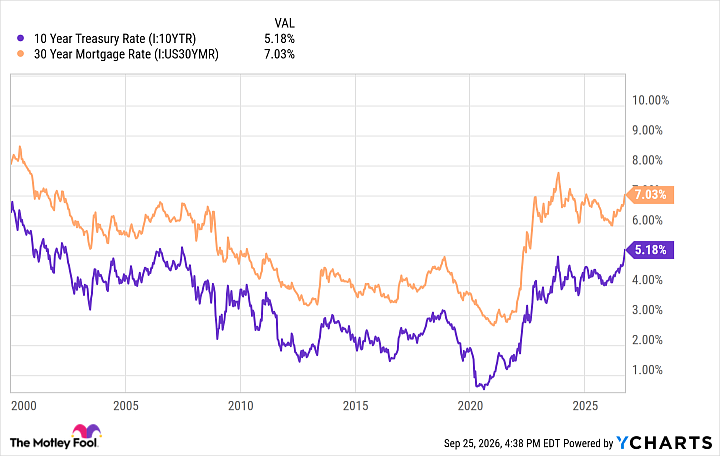
This year, surging oil prices as a result of the Iran war and a renewed focus on mounting U.S. debt sent longer-dated bond yields soaring. The yield on the 10-year U.S. Treasury note is now 5.18%, while the yield on the 30-year is around 5.5%.
Yields haven't been this high since right before the Great Recession. Here's what history says comes next.

Image source: Getty Images.
High interest rates contributed to the housing market collapse
At the center of the Great Recession was the collapse of the housing market. Banks and other mortgage lenders made too many subprime mortgage loans, believing that the housing market would never decline in value.
As such, lenders granted loans to borrowers who didn't have the means, many of which were made with no money down or without verifying the borrowers' income or assets. Banks would package the loans into mortgage-backed securities (MBS) and then repackage them into collateralized debt obligations (CDOs), so lenders could keep lending.
Many of these borrowers also took out adjustable-rate mortgages (ARMs), which began with low teaser rates and then reset to much higher rates after a few years, significantly increasing their mortgage payments. These ingredients became an explosive combination during the Great Recession, when the housing bubble finally burst, and many borrowers lost their homes.
Large banks and lenders holding these MBS and CDOs were sitting on enormous losses, and some, like Lehman Brothers, even collapsed or were acquired in emergency deals organized by the U.S. Treasury Department.
While the main issue behind the crisis was bad mortgage loans, rising rates and yields contributed to the collapse. For one, the 10-year note is directly correlated to mortgage rates.
10 Year Treasury Rate data by YCharts
The Fed raised its benchmark overnight lending rate, the federal funds rate, multiple times in 2006 to cool the economy, a move that also influences longer-term yields. This, in turn, raised ARM rates, making it difficult for subprime borrowers to make their mortgage payments.
Higher yields can also dry up capital markets, raising the cost of capital and therefore requiring higher return thresholds for investors. This reduced interest in MBS and CDOs, essentially stopping the music and creating the perfect storm that would ensue.
What history says happens next
If you look at history, rising bond yields have often spelled trouble and may lead investors to worry about another housing market crash. However, a closer look will clearly show that the current conditions are not the same as in 2006-2008.
Banks took a massive reputational hit from the Great Recession that they arguably never really recovered from. This has led to safer lending practices, including requiring borrowers to verify their financial credentials and put money down on loans upfront, so they have more equity in their homes.
Loans made without verifying a borrower's income, employment, or assets hardly exist today. Furthermore, according to Fortune, 92% of U.S. mortgages have fixed rates rather than being ARMs.And some housing markets have seen prices cool off since the pandemic, when they soared.
It's possible that the housing market will continue to cool, and we may see some losses. But many borrowers have home equity and favorable mortgage rates, so the housing market is in far better shape than it was before the Great Recession.
All that said, high yields could wreak havoc in other lending categories, whether in commercial real estate or private credit, where many investors have expressed concerns about riskier loans being made to borrowers. And we've already seen private credit defaults hit their highest level in five years earlier this year.
Since the Great Recession, which now formally began 18 years ago, low rates and stimulus have prevented another credit cycle in which losses rise. History tells us this can't go on forever, and it likely won't.
It's hard to know if another credit crisis has quietly begun, but investors should expect credit to normalize, especially as yields mechanically pressure all sorts of different loans.