Quantum computing has the potential to be the next big technological breakthrough after artificial intelligence (AI). Companies in the field are pursuing the technology in various ways, so a basket approach (a collection of small positions across several stocks) may be the best investment option.
While it's unlikely that all of them pan out, if one or two do, they could help fuel a millionaire-making portfolio. Let's look at the stocks I'd put in this quantum computing basket.
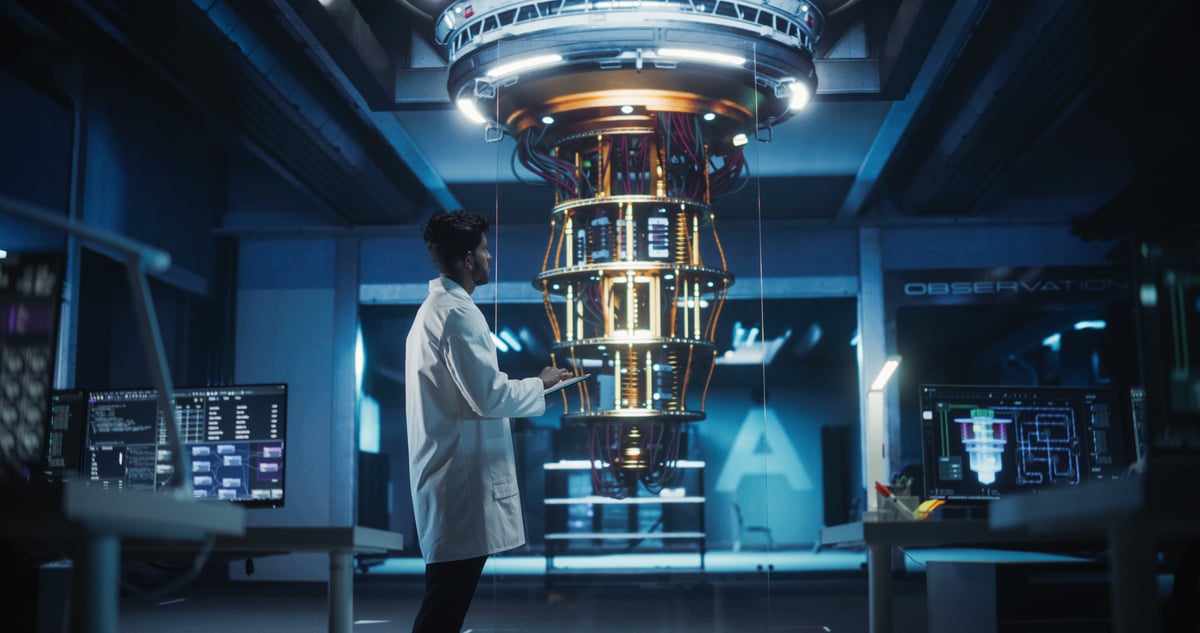
Image source: Getty Images
IonQ
The first stock I'd add to a quantum basket is IonQ (IONQ -1.98%). The company uses the trapped-ion method with the added twist of embedding microwave antennas directly into its chips. This also resulted in the company achieving the best accuracy in the space, with 99.99% two-qubit gate fidelity. It also recently demonstrated what it called "the industry's first end-to-end real-time quantum error correction decoder," a significant milestone as it pushes to create a fault-tolerant quantum system.

NYSE: IONQ
Key Data Points
In addition to its accuracy lead, the company has made a variety of acquisitions across different areas of the quantum ecosystem. It even acquired a quantum foundry that will help it advance prototypes more quickly and scale more easily.
Quantinuum
Another top quantum stock in terms of accuracy is Quantinuum (QNT -0.85%). It also uses the trapped-ion approach and has recorded 99.92% 2-qubit gate fidelity. With its new Sol system, meanwhile, it expects to hit 99.999% logical fidelity in 2027.
Quantinuum is also known to have one of the best quantum software stacks. It has developed an open-source quantum computing language called Guppy that corrects errors directly in the code. It has also created a quantum software development kit that acts as a universal quantum code translator. Its software tools are then all tied together by its Nexus all-in-one quantum computing platform.
D-Wave
A third quantum computing stock I'd add to my quantum basket is D-Wave Quantum (QBTS -3.62%). The company is a leader in quantum annealing, which is a niche optimization technique already used in commercial applications. However, it is looking to take the principles of that technology and apply it to a gate-based system.

NASDAQ: QBTS
Key Data Points
It plans to use fluxonium qubits, which are a type of superconducting qubit that show characteristics comparable to its annealing technology. It also acquired Quantum Circuits to provide it with dual-rail gate-model processor that has built-in error detection. The goal is to create a system with the accuracy of the trapped-ion approach but the speed of superconducting qubits.
Infleqtion
Infleqtion (INFQ -2.62%) has carved out a niche in quantum sensing and precision tools, but its neutral-atom approach is what makes it interesting. The approach is similar to that used with trapped ions in that it suspends individual atoms in a vacuum. However, it uses uncharged atoms rather than charged ions, which allows for higher qubit density because they don't repel each other.
The objective of the neutral-atom technique is, once again, to achieve accuracy levels comparable to the trapped-ion method while increasing speed. Infleqtion reached 99.73% 2-gate fidelity in 2024 and expects to attain 99.9% this year.
IBM
Unlike the others in this basket, IBM (IBM -2.15%) is a mature company and not a start-up. However, the company is investing heavily in quantum computing, and its long-term future is very tied to the technology. The company is using a classical superconducting qubit approach, which, while currently less accurate, is exponentially faster than the trapped-ion modality.

NYSE: IBM
Key Data Points
The one big advantage that IBM has in the space is that it can throw a lot more resources into the technology than money-losing start-ups. It plans to invest more than $10 billion in quantum technology over the next five years. Its latest innovation, meanwhile, is a quantum fridge that it believes will be a key to error reduction and scaling quantum systems. Its goal remains to introduce the world's first fault-tolerant quantum computer in 2029.