You're almost certainly aware that Elon Musk's Tesla is developing autonomous AI humanoid robots called Optimus. In fact, Musk contends the company will begin commercializing them en masse before the end of next year.
Given his belief that these robots could be "the biggest product ever of any kind," all eyes are understandably now on Tesla. Expectations are that the electric vehicle maker could deliver big things on this new front, which Morgan Stanley suggests could be worth $5 trillion by 2050.
The iconic company isn't the only way to invest in the robotics revolution, though. Indeed, while Tesla may be the biggest and best-known name in the nascent business, veteran investors know that sometimes the best investment opportunities are often less obvious players.
In this vein, here's a closer look at three other robotics stocks besides Tesla to consider for your risk-tolerant growth portfolio.
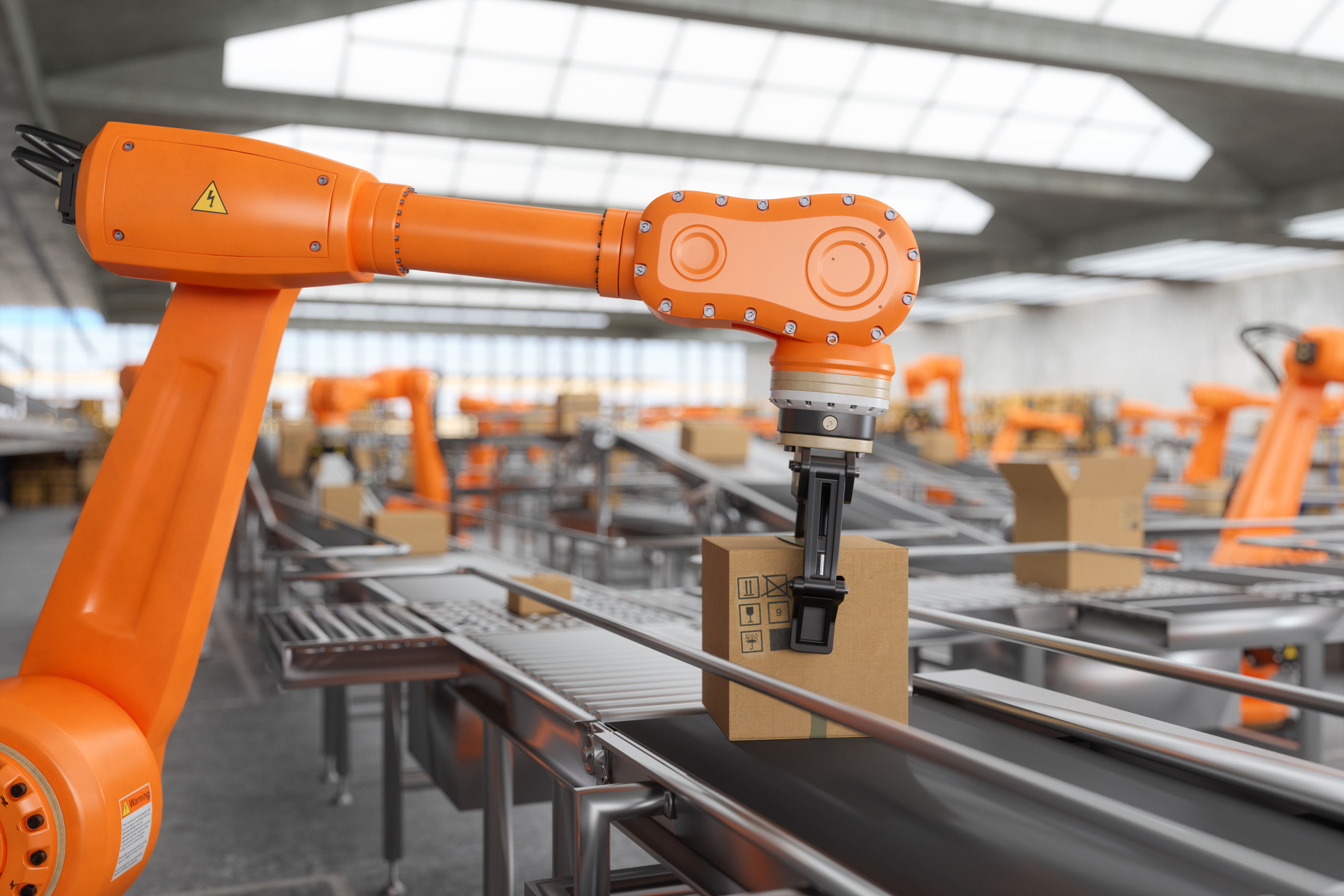
Image source: Getty Images.
1. Teradyne
Not all robots are shaped and sized like the human body and intended to handle the same tasks humans do. Indeed, most of them aren't. That doesn't make them any less of a robot, though.
Enter Teradyne (TER +3.71%). Teradyne makes robots for two specific purposes. One is transporting materials and products within a warehouse or manufacturing environment. Capable of autonomously delivering loads of up to 10,000, these robotic assistants make their human users more efficient and lower the chance of injury.
Teradyne also manufactures what are called collaborative robots, or cobots. Rather than transporting materials and products, cobots are usually robotic arms that can be trained to handle repetitive physical tasks that a person would otherwise complete. Think of an articulated mechanical arm on an assembly line.
That's not all Teradyne is, to be clear. It also offers a range of electronics and testing solutions. Robotics are its smallest business, in fact, accounting for less than one-tenth of its year-to-date revenue. This actually works to the advantage of interested investors, however, in that it leaves the company's robotics arm a great deal of room to make a bigger impact on its top and bottom lines for the foreseeable future.

NASDAQ: TER
Key Data Points
To this end, a Global Market Insights report suggests the worldwide industrial robotics market is set to grow at an average annualized rate of 13.3% through 2034, reaching $60 billion annually. For perspective on that figure, Teradyne did $3.9 billion worth of business last year, only $308 million of which was robotics. There's enormous potential net upside here.
2. Symbotic
If the name Symbotic (SYM +2.62%) rings a bell, it might be because brick-and-mortar retailer Walmart is not only its biggest customer -- by far -- but is also a major investor, effectively holding 40% of the robotics company's shares. That's roughly $10 billion worth of the $25 billion outfit.
Its partnership-driven interest isn't too tough to figure out either. As the world's biggest retailer (nope, it's not Amazon) and now a major e-commerce player, Walmart handles a massive amount of merchandise spread across a network of a couple of hundred warehouses and distribution centers. It needs to manage all this inventory as efficiently as possible to keep its costs down and prices low. At this scale, automating as much of it as possible is the only viable solution.
Walmart is a big reason Symbotic's revenue improved by nearly 22% year over year during the three months ending in June, in fact, just as the mega-retailer accounts for the lion's share of Symbotic's backlog of $23 billion worth of business. For comparison, the company is on pace to report revenue of $2.8 billion for the fiscal year ending in September, up 25% from the year-earlier figure.

NASDAQ: SYM
Key Data Points
Concerns that Symbotic is too dependent on Walmart are understandable. Just don't lose perspective on the matter. It's not that the company is unwilling or unable to sell warehouse automation solutions to other retailers. It's just that demand from Walmart has been so strong, boosted by the fact that the world's biggest retailer also has deeper pockets to fund such capital investments. If it helps, though, Walmart rivals Target and Albertsons are customers as well, along with others.
Also, keep in mind that Walmart is a major stakeholder, so it still has a strong vested interest in Symbotic's continued growth and the stock's continued bullish performance. It will gladly allow Symbotic to sell its wares to competing retailers, which aren't actually much of a threat to Walmart itself.
3. Vishay Precision Group
Finally, add Vishay Precision Group (VPG +3.23%) to your list of robotics stocks, alongside Tesla, that might have a place in your portfolio.
Vishay doesn't make robots. It makes several specialized sensors that allow robots to perform as needed. For instance, its pressure/force sensors allow a robotic arm to recognize how tightly it's squeezing an object, ensuring it's grasping it firmly enough to not drop it but not squeezing it so tightly that it might damage the object it's handling.
Its tech also facilitates high-precision weighing, laser-optical inspection solutions, and more. You'll find its solutions in everything from AI data centers to surgical robots to packaged food plants to fighter jets, just to name a few, including humanoid robots, specifically Tesla's Optimus.

NYSE: VPG
Key Data Points
With a market capitalization of less than $5 billion and last year's revenue of $307 million, Vishay Precision isn't a particularly big outfit. This lack of scale is arguably a contributing factor to its paper-thin profit margins, as well as its occasional slip back into the red. Owning this stock isn't for the faint of heart. Its relatively small size and largely unimpressive results are also a key reason its stock has attracted very little analyst coverage.
It's coming, though. Recognizing its long-term prospects, a couple of analytics firms -- B. Riley and Lake Street -- have recently come on board, both of which rate VPG a strong buy with a consensus price target of $93.33 that's 35% above the ticker's present price. That's not a bad way to start an admittedly speculative trade.