Shares of Dell Technologies (DELL +0.91%) have skyrocketed over the past three years, rising almost 8x during this period and outpacing the 103% jump in the tech-laden Nasdaq Composite index.
A big chunk of Dell's gains has arrived over the past year and a half, once it became clear that the company is becoming a major beneficiary of the global artificial intelligence (AI) data center boom. Investors, however, may be wondering if it is a good idea to invest in this high-flying technology giant following its stunning rally.
That's why we will closely examine Dell's prospects and valuation in this article and decide whether it is a good time to buy this growth stock in anticipation of more gains over the next three years.
Image source: The Motley Fool.
Dell is sitting on a couple of terrific catalysts
Dell gets its revenue from two segments -- the client solutions group (CSG) and the infrastructure solutions group (ISG). Both segments have been clocking healthy growth, and the good news is that their long-term prospects remain solid amid growing AI adoption.

NYSE: DELL
Key Data Points
Dell's CSG business includes sales of personal computers (PC), notebooks, workstations, and peripherals to both consumers and enterprise customers. This segment's revenue increased 20% year over year in fiscal Q2 to $15 billion, driven by a 22% year-over-year increase in commercial client revenue to $13.2 billion. Meanwhile, Dell recorded a 7% year-over-year increase in consumer PC sales last quarter.
The double-digit growth in the CSG business is impressive considering that the global PC market is expected to shrink by 11.3% in 2026, according to market research firm IDC. Dell's resilient performance during this tough period suggests that the company has a strong clientele that's helping it defy the downturn. Moreover, Dell management indicated on the recent earnings call that cost-sensitive customers who aren't upgrading their devices right now are expanding the company's long-term addressable opportunity.
Given that the PC market is expected to return to growth from 2027 and sustain solid growth levels through 2030, according to IDC, I won't be surprised to see Dell's CSG business step on the gas over the next three years.
Dell's ISG business, meanwhile, has been supercharged by the booming demand for AI servers. The company is a key player in the global server market with an estimated share of 16.5%. Its AI server revenue share was 17% in the first quarter of 2026, up over 3x from the year-ago period's 5%.
Market research firm TrendForce expects a 31% increase in AI server shipments this year, driven by a 90% increase in the combined capital expenditure of the top nine cloud service providers across the globe. Notably, the server market's value is increasing at a much faster pace than unit shipments, primarily due to higher average selling prices (ASPs).
IDC, for instance, expects a 43% spike in the global server market's revenue this year to nearly $647 billion. Even better, the growth rate is anticipated to accelerate to 44% in 2027, with the global server market generating $930.5 billion in revenue. Goldman Sachs expects the AI server market alone to hit $1.24 trillion in revenue in 2030, while traditional server sales could reach $160 billion.
So, Dell's addressable opportunity in the global server market could stand at a whopping $1.4 trillion in 2030. Even a 20% share of the server market in 2030 will catapult Dell's ISG revenue to $280 billion, well above the segment's fiscal 2026 (which ended on Feb. 26) revenue of $60.8 billion. The good news for investors is that management has already indicated that its AI server business could take off big time.
The company booked $60.9 billion in AI server orders last quarter, suggesting a significant acceleration in order intake, considering its trailing-twelve-month AI server orders stand at $131.7 billion. Dell ended the second quarter of fiscal 2027 with a $95 billion AI order backlog, and management noted that its pipeline is in the multiples of that backlog.
As a result, I won't be surprised to see Dell easily outpacing Wall Street's revenue growth estimates over the next three years.
Wall Street is underestimating Dell's potential
Dell trades at just 2.4 times sales, well below the Nasdaq Composite index's sales multiple of 5.3. The company expects its fiscal 2027 revenue to increase by 69% to $192 billion, which is why it should ideally trade at a premium valuation.
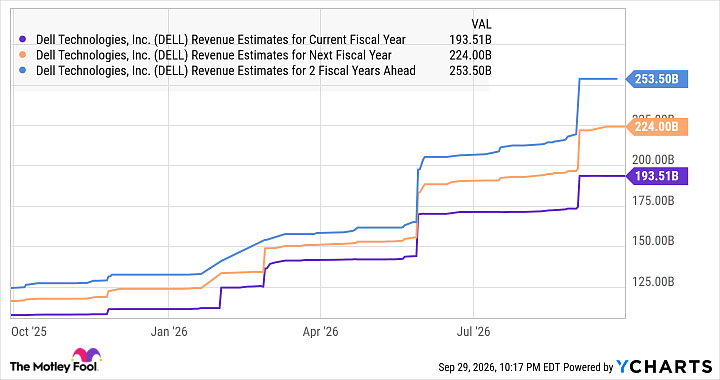
Interestingly, analysts expect Dell's growth rate to slow over the next couple of years.
Data by YCharts
However, the company's AI server business could help it easily defy analysts' expectations. But even if Dell's overall revenue increases at a conservative pace and reaches $253.5 billion in fiscal 2029 (which will end in February 2029), its market cap could jump to $1.37 trillion (assuming it trades at 5.4 times sales at that time, in line with the Nasdaq Composite index's multiple).
That's almost 4x Dell's market cap right now. So, Dell stock has the potential to make investors significantly richer over the next three years, and buying it now could be a smart move given its attractive valuation.