Broadcom (AVGO +3.35%) launched its IPO on Aug. 6, 2009. Known at the time as Avago Technologies, its strategy of building semiconductors for other businesses resonated with customers and investors alike. The company's success also spurred a move into software that has brought support and balance to Broadcom.
Image source: The Motley Fool.
The chip stock debuted at a split-adjusted price of $1.50 per share. If one had invested $1,005 at that time (after adjusting for whole shares), the 670 shares would be worth about $220,000 today.
However, investors should not forget about the dividend. It debuted in December 2010 at a split-adjusted quarterly payout of $0.007 per share. Today, shareholders earn $0.65 per share quarterly ($2.60 per share annually). That adds $90,000 to the total return, bringing it to around $310,000.
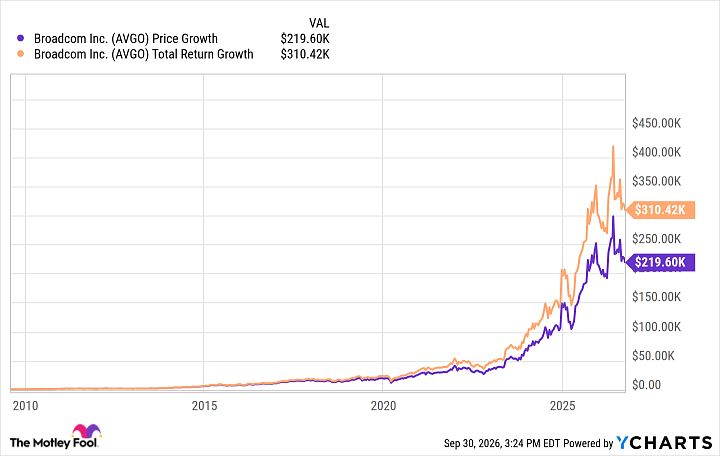
Data by YCharts
In 2026, that would mean an IPO investor would receive $1,742 in cash payouts for the year, an amount 74% higher than the original investment.
Today, Broadcom's market cap is almost $1.7 trillion. That likely means that another 310-fold return is unlikely, even though AI revenue grew 221% last quarter.
Moreover, Broadcom was fortunate to launch its IPO after the financial crisis, likely averting the massive sell-offs that affected its peers. Consequently, its largest decline came in 2020 when it fell by as much as 53% during the brief but severe COVID-19 stock market crash.

NASDAQ: AVGO
Key Data Points
Nonetheless, Broadcom's history shows how finding the right investment early and staying with it through bear markets can ultimately pay off for investors.
Furthermore, even though earning back one's original investment in dividends annually is rare, Broadcom demonstrates how the right dividend stock can become a significant cash generator.
Hence, while small investors are unlikely to get rich from Broadcom now, they may be able to apply Broadcom's lessons to find higher-returning dividend and growth stocks in the future.