Ideally, the instances are limited, but people do occasionally say things they don't mean. It's one of the flaws of being, well, human.
Perhaps it was a case of voicing something into the universe that wasn't meant when, at the White House earlier this year, ExxonMobil (XOM +0.26%) CEO Darren Woods labeled Venezuela "uninvestable." Not surprisingly, that remark invited a rebuke from President Donald Trump, who threatened to block ExxonMobil from participating in any potential opportunities in Venezuela if it didn't soften its stance.
ExxonMobil's plans in Venezuela are unlikely to mean much for the energy patch in the near term. Image source: Getty Images.
It appears cooler heads are prevailing. ExxonMobil, one of the largest energy companies by market cap, is reportedly in talks to invest in several oilfields in Venezuela nearly two decades after the oil giant departed the country amid then-President Hugo Chavez's nationalization of the petroleum industry. Still, the company's previous warning about Venezuela is on some investors' minds.
Why ExxonMobil's Venezuela stance matters to energy investors
Due in part to the war in Iran and the lingering conflict in Ukraine, oil prices are elevated, helping energy rank 2026's best-performing sector. Said another way, constrained supply is fostering an environment in which oil prices and the related equities, including ExxonMobil, are soaring.
The other side of that coin is that if the oil market suddenly becomes awash in fresh supply, prices could slump. That'd be a relief to consumers, but it's not a desirable situation for energy investors. Don't bank on Venezuela imminently being a source of new supply to force oil prices lower while weighing on stocks such as ExxonMobil.
Daily output in the South American nation reached 1.2 million barrels in August, well ahead of the levels seen prior to U.S. forces capturing former President Nicolas Maduro, but that's barely more than a third of the all-time high of 3.5 million barrels per day seen in December 1997.

NYSE: XOM
Key Data Points
Following years of Venezuela allowing energy infrastructure to languish, it will take years and sizable investments by Western oil majors before the country's production levels get anywhere close to their lost glory. In simple terms, Exxon and its peers could invest billions of dollars in Venezuela right now, and they still wouldn't be able to lift the country's output to the point where global oil prices materially slide in the near term.
Exxon doesn't need Venezuela
As is the case in life, there's a difference between "need" and "want" for companies, and that's true of ExxonMobil in relation to Venezuela. Take the comparison of ExxonMobil and its most direct rival, Chevron (CVX +0.20%). Chevron remained operational in Venezuela for years after competitors left, but these two energy stocks are moving in lockstep this year.
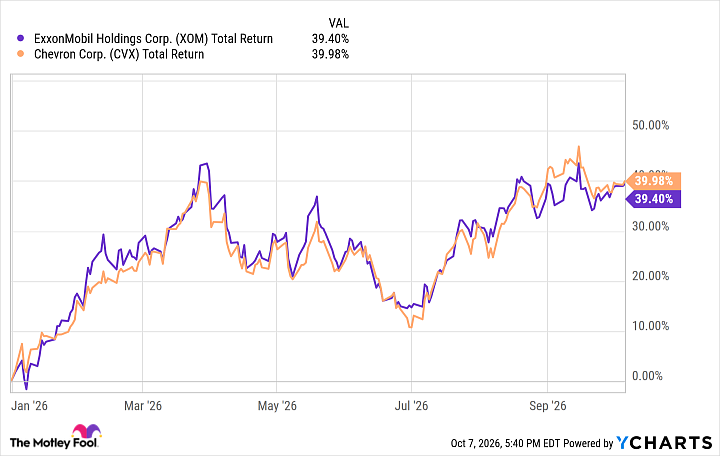
Data by YCharts.
One takeaway from that scenario is that markets are willing to reward ExxonMobil on par with Chevron even without the former possessing a tangible "Venezuela premium." It doesn't need one to generate compelling long-term returns.
ExxonMobil's enviable perches in Guyana and the Permian Basin are the bedrocks of long-term production growth, and the company previously forecast $25 billion in annual earnings growth by 2030, excluding Venezuela. So think of Venezuela as a potential cherry atop the ExxonMobil sundae, not the sundae itself.