The S&P 500 (^GSPC -0.06%) has had a great year so far. The average annual return of the S&P 500 is about 10%, and with it sitting at about 14.5% right now, it has been a good year. There are still a few months left, so the chances of it ending up even higher are quite good.
While the S&P 500 as a whole is doing well, a few individual performers stand out. Sandisk holds the title for best-performing S&P 500 stock this year, rising about 590% in 2026. Intel is another top performer, increasing nearly 200% so far this year. There are a handful of companies that also have had strong runs, including AMD.
So, which stock will lead the S&P 500 higher next year? I think it will be a familiar face, and it won't be one of these three.

Image source: Getty Images.
Some stocks have gotten ahead of themselves
With the returns some stocks are delivering this year, it's pretty easy to guess that next year may not be as kind to these stocks. Many companies have far outgrown their business results and are trading at inflated valuations, such as Intel and AMD. These two trade for 70 and 81 times forward earnings, respectively. This showcases just how expensive they are. Others, like Sandisk, operate in a cyclical market, and the stock market is wary of giving it a standard valuation due to fears of the memory chip industry seeing a cyclical downturn.

NASDAQ: AMD
Key Data Points
Regardless, there are a handful of stocks that were abandoned to pave the way for these to rise, and the most obvious one is Nvidia (NVDA -1.29%). Nvidia led the S&P 500 in performance during 2023 and 2024, and I think it has a strong shot at leading it again in 2027. Why? Its stock has been ignored compared to some of its peers.
Nvidia is dirt cheap compared to its peers
It's hard to say that the largest company in the world by market cap isn't getting a fair shake, but that's exactly what's happening. As mentioned above, AMD trades at over 80 times forward earnings. Nvidia trades at 25.
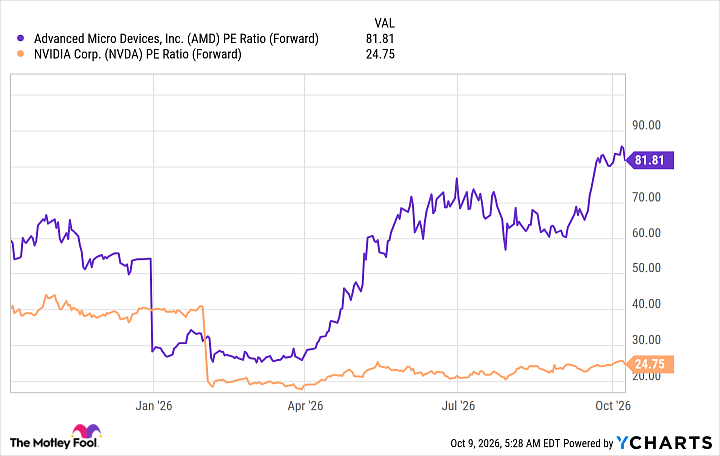
AMD PE Ratio (Forward) data by YCharts
These two companies operate in the same industry (namely, graphics processing units, or GPUs), and Nvidia is growing its data center business (the segment most exposed to artificial intelligence (AI)) at a faster pace. In Q2, Nvidia's data center division grew at a 117% pace to $89 billion. AMD's data center division grew at a 107% pace to $6.7 billion. Nvidia is still winning, and there's no reason to give AMD a ridiculous premium as a result.
Another factor is that the market hasn't priced in practically any of 2027's growth into Nvidia's stock price. The S&P 500 trades for about 20 times forward earnings. The slight premium Nvidia now commands is worth it given its positioning in the AI boom and strong track record of performance. However, Nvidia is also expected to grow its revenue by 70% next year. But Nvidia's current 25 times forward earnings valuation implies that its stock will grow at a market-average pace next year (about 10%).

NASDAQ: NVDA
Key Data Points
That's a major mismatch, and I think it suggests Nvidia is poised for an exceptional year and could lead the S&P 500 in performance. While there could be others that sneak up on investors and outperform Nvidia, Nvidia is one of the few companies that has given investors high visibility into its future growth. Management has undergirded nearly every step along the way, so this 70% growth could also be a major undershoot.
With Nvidia expected to grow revenue by 70% or more next year, I think it's a no-brainer buy right now.