Top 4 ETFs for Beginners in 2026
Below are what we consider some of the top ETFs for beginners, selected for their broad diversification, low fees, straightforward strategies, and large asset bases, which can help reduce the risk of fund closure.
Invest better with The Motley Fool. Get stock recommendations, portfolio guidance, and more from The Motley Fool's premium services.
The best exchange-traded fund (ETF) for beginners is a far more interesting question and answer than just a simple list of funds. A lot of beginner investors chose their initial picks with main the goal of outperforming the market. But what if being average was enough to get started investing in ETFs?
Over the long term, global equities have historically produced nominal returns in the neighborhood of 7% to 9% annually, although future returns can differ considerably. Combining good financial habits and enough time for compounding, simply capturing broad market returns can go a long way toward building wealth.
For beginners, this means that ETF selection may matter less than maximizing tax-advantaged accounts such as a Roth IRA, dollar-cost averaging consistently, maintaining a high savings and contribution rate, reinvesting dividends, and staying invested through periods of market volatility. None of those habits require predicting which sector, country, or investment style will outperform next.
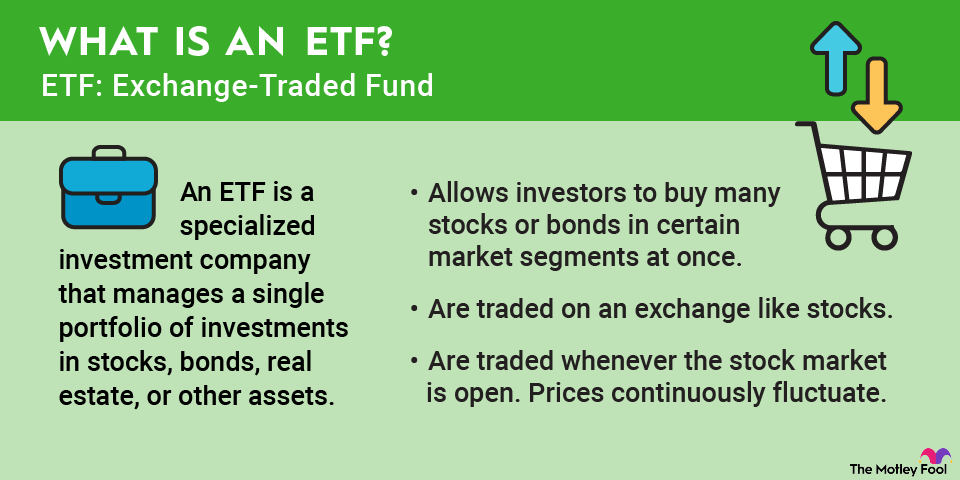
ETF selection still matters, particularly if you don't want to research and manage a portfolio of individual stocks. The ETF industry is filled with increasingly complex products promising enhanced returns, unusually high income, or exposure to the latest theme.
Beginner investors generally don't need product complexity. Some of the best ETFs for beginners stick to the basic building blocks: broad diversification, low fees, tax efficiency, and simple strategies that can reasonably be held for decades.


According to the S&P Indices Versus Active (SPIVA) study, roughly 90% of large-cap active funds underperformed the S&P 500 Index over the trailing 50 years. If professional fund managers have this much difficulty beating the benchmark, beginner investors can put the odds more in their favor by simply tracking it at a low cost through the iShares Core S&P 500 ETF (IVV -0.24%). This ETF charges a 0.03% expense ratio, meaning a $10,000 investment would cost approximately $3 annually in fund expenses, assuming the balance remained unchanged.
The S&P 500's roughly 500 constituent stocks are selected to represent large-cap U.S. equities using criteria that include market capitalization, liquidity, and earnings consistency, with an index committee ultimately determining additions and removals. IVV then weights these companies by market capitalization, meaning a company's share price multiplied by its shares outstanding determines its relative importance in the portfolio. This approach keeps turnover relatively low and allows successful companies to naturally become larger positions as their market values increase.
The tradeoff is that market-cap weighting can produce substantial concentration after prolonged bull markets. As of August 31, 2026, technology stocks represented approximately 38%, leaving the fund increasingly sensitive to the performance of its largest technology holdings. There is also a modest income component, with a 0.94% 30-day SEC yield as of the same date. Beginner investors with long time horizons may benefit from consistently reinvesting those distributions, while those holding this ETF in a taxable brokerage account should remember that dividends can create a current-year tax liability.

The S&P 500 is commonly used as a barometer of U.S. stock market performance, but it does not represent the entire U.S. economy. Its roughly 500 large-cap companies inevitably exclude thousands of mid- and small-cap stocks. For exposure to those companies alongside the large caps already found in the S&P 500, investors can use the Vanguard Morningstar Total Stock Market ETF (VTI -0.28%). VTI charges the same low 0.03% expense ratio as IVV but provides considerably broader diversification, with more than 3,500 holdings.
Investors may notice that VTI's largest holdings still look very similar to IVV's, while technology accounts for roughly 35% of the portfolio. That's because VTI is also market-cap weighted, meaning America's largest companies receive the greatest allocations even though thousands of smaller stocks are included. Those smaller positions can still make a difference. During periods when small- and mid-cap stocks outperform, VTI may pull ahead of an S&P 500 ETF such as IVV. Over the past decade, however, the opposite has generally been true as U.S. mega-cap stocks dominated market returns.

Famous investors, including Warren Buffett, have long warned investors to "never bet against America." Given the country's historical economic growth, it can be tempting to build an entirely U.S.-focused portfolio using ETFs and let it ride. But younger beginner investors may not remember the so-called "lost decade" from roughly 1999 through 2009, when U.S. stocks produced negative returns after inflation. During this period, international stocks were among the assets that performed better than U.S. equities.
For a U.S. investor, international stocks simply refer to companies based outside the United States. They can generally be divided into developed and emerging markets. The developed markets include places like Japan, the United Kingdom, France, Germany, and Canada. Emerging markets, including countries such as China, India, Taiwan, and Brazil. Combining these markets with U.S. stocks can reduce dependence on any one country's economy or stock market remaining dominant indefinitely.
Beginner investors can get U.S., international developed, and emerging-market stocks in a single package through the Vanguard Total World Stock ETF (VT -0.47%). For a competitive 0.06% expense ratio, VT provides exposure to thousands of stocks worldwide and weights them by market capitalization. This means its allocation between the U.S., developed international, and emerging markets changes naturally as their relative market values rise and fall. Following the long period of U.S. outperformance, American stocks currently account for roughly 65% of VT, but that percentage could shift considerably over a beginner investor's multi-decade investment horizon.
For beginners, we prioritized simplicity over specialization. Each ETF needed to be diversified enough to serve as a core portfolio holding on its own, rather than requiring investors to combine numerous sector, factor, or thematic funds. We also favored passive, market-cap-weighted strategies that keep turnover low, allow winning companies and markets to naturally become larger positions, and generally remain tax efficient.
Cost and staying power were equally important. We screened for low expense ratios, large asset bases, strong liquidity, reputable providers, and long track records where available. Finally, the selections deliberately progress from U.S. large caps to the total U.S. market, global equities, and an all-in-one stock-and-bond portfolio. This gives beginners several straightforward choices depending on how much diversification and fixed-income exposure they want without requiring them to actively manage a complicated portfolio.
For most beginner investors, ETFs can be one of the simplest ways to build a diversified portfolio without having to research and manage individual stocks and bonds. A single broad-market ETF can provide exposure to hundreds or thousands of securities at a very low cost, while an asset allocation ETF can combine global stocks and bonds and handle the rebalancing for you.
The bigger decision is determining how much risk you're comfortable taking and choosing an ETF that matches it. A younger investor with a long time horizon may be comfortable with an all-equity portfolio, while someone seeking lower volatility may prefer an ETF that includes bonds. Whichever approach you choose, avoid assuming that more complicated ETFs will produce better results.
Above all, ETF selection is only one part of successful investing. Consistently contributing, maximizing tax-advantaged accounts when appropriate, keeping fees low, reinvesting dividends, and remaining invested through market downturns can matter considerably over a multi-decade horizon. For beginners, a simple ETF that you understand and can stick with may ultimately be more useful than continually searching for the next fund likely to outperform.
International stocks weren't the only asset class to outperform U.S. equities during the lost decade. Bonds also performed better. Whereas a stock represents ownership in a company, a bond is essentially a loan made to a company or government entity. Bonds typically offer less upside than equities but also tend to carry lower risk, while providing regular interest income. As with stocks, investors can diversify their bond exposure across thousands of securities rather than relying on individual issuers.
It's common for investors to size their bond allocation according to their risk tolerance and time horizon. Younger investors with decades until retirement may hold relatively few bonds, while older investors approaching retirement may increase their allocation to reduce portfolio volatility. One all-in-one option for a beginner with a long time horizon and relatively high risk tolerance is the iShares Core 80/20 Aggressive Allocation ETF (AOA -0.46%).
AOA maintains approximately 80% of its portfolio in stocks diversified across the U.S., international developed, and emerging markets, with the remaining 20% allocated to bonds with similarly broad geographic exposure. The ETF handles rebalancing internally, so investors don't have to continually buy and sell funds to maintain the 80/20 target. A beginner can simply purchase shares regularly and reinvest the distributions, with AOA offering a 2.11% 30-day SEC yield as of August 31. Its 0.15% expense ratio is higher than the previous ETFs, but remains reasonable for what is effectively a complete, hands-off portfolio in a single ticker.
| Name and ticker | Current price |
|---|---|
| iShares Core S&P 500 ETF (NYSEMKT:IVV) | $762.21 |
| Vanguard Morningstar Total Stock Market ETF (NYSEMKT:VTI) | $374.33 |
| Vanguard International Equity Index Funds - Vanguard Total World Stock ETF (NYSEMKT:VT) | $158.04 |
| iShares Trust - iShares Core 80/20 Aggressive Allocation ETF (NYSEMKT:AOA) | $97.60 |