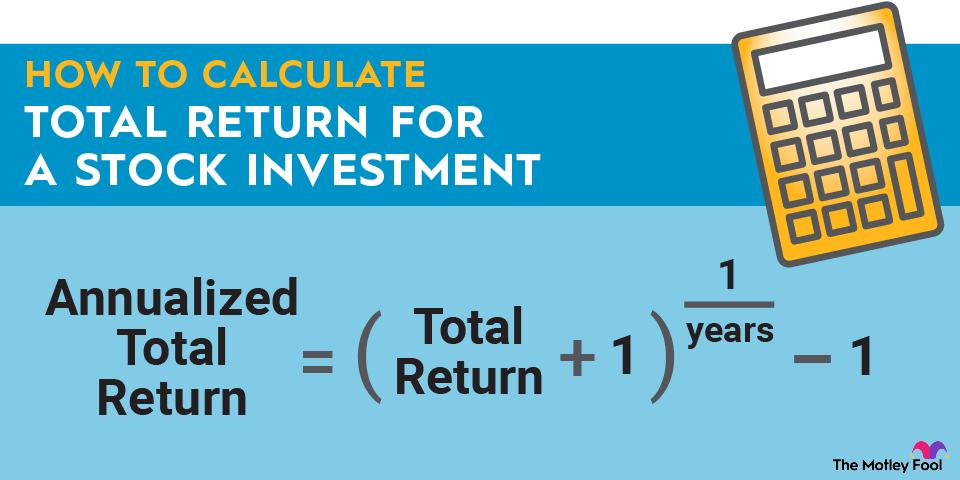
This formula assumes annual compounding, which keeps the calculation as uncomplicated as possible. Other methods, such as continuous or monthly compounding, are also available, but this method is generally sufficient for calculating and comparing investment returns.
A real-world example
That last part may sound a bit confusing, especially when calculating annualized total returns, so let's look at a step-by-step real-world example. Let's say you bought shares of Bank of America (BAC +0.90%) stock on Jan. 2, 2020, and sold them on Jan. 2, 2025. Now, you want to determine your total return on your investment. Before we start, here's the information you need to know:
- You bought shares for $35.50.
- Two years later, you sold those shares for $44.50.
- Over the five-year holding period, Bank of America paid 20 quarterly dividends, which added up to $4.04.
Let's review the three total return calculations I discussed in the last section. First, your overall total return. Your capital gain on each share was $44.50 minus $35.50, or $9.00 per share. Adding the $4.04 in dividends you received shows a total return of $13.04 per share on your investment.
Second, to convert this total return to a percentage, you need to divide the $13.04 total return by the purchase price for each share, or $35.50, and then multiply by 100. This gives you a total return of 36.7% over five years.
Finally, to calculate your annualized total return, you need to use the formula from the last section. When you do, you'll get an annualized total return of about 6.5%.
Total return with reinvested dividends
Now, it's worth mentioning that if you're reinvesting your dividends as you go -- which I absolutely recommend long-term investors do -- the calculation gets a bit more complicated. Essentially, each reinvestment becomes its own return calculation, including the capital gains generated from the newly purchased shares.
Calculating total returns with reinvested dividends is difficult using the previously discussed method. After all, you'll buy new shares at whatever price they're trading for as of the dividend payment date, and you'll end up with more shares than you started with, and then those shares will begin to pay you dividends as well. So, what's the solution?
The total return calculation with reinvested dividends can be simplified by looking at the investment on an overall value (as opposed to a per-share) basis. Consider our Bank of America example from the previous section. Let's say that you invested $10,000 in the stock and that after five years of reinvesting your dividends, your investment is now worth $14,160 -- a 41.6% total return (or 0.416 in decimal form).
Using our formula for annualized total return, we see that your total return with reinvested dividends is about 7.2% per year, which is significantly higher. So, by reinvesting your dividends, you achieved a slightly better total return than you would have by simply collecting the dividends paid by the stock.
How to use total return calculations in your investment strategy
There are a few practical uses for the concept of total return. As I've mentioned, total return is a good way to compare the performance of various investments over time. For example, let's say you own five stocks in your portfolio and have invested $1,000 in each one. Some don't pay dividends at all, and those that do pay varying amounts.
At first glance, it can be difficult to determine which of these stocks was the best performer over any multiyear period, especially if you don't automatically reinvest your dividends and just receive the payments in cash in your brokerage account. This is where total return comes in -- it can give you a single number that sums up the performance of each investment.
From a strategy perspective, evaluating expected total returns from your investments can be useful when making decisions. As a personal example, I'm a big fan of real estate investment trusts (REITs), which are specifically designed to be total-return investments with a nice combination of income and capital gain.
By assessing one of these stocks' track records of total returns and determining whether the company's business composition has changed, I can compare total return potential when screening prospective investments.
Related investing topics