Asset
Liability
Statement of Shareholders’ Equity

About the Author
Matt Frankel has no position in any of the stocks mentioned. The Motley Fool has positions in and recommends Apple. The Motley Fool has a disclosure policy.

Invest better with The Motley Fool. Get stock recommendations, portfolio guidance, and more from The Motley Fool's premium services.
Every publicly traded company issues a series of financial statements on at least a quarterly basis. The balance sheet is perhaps the statement most indicative of a company's financial health.
A company's balance sheet contains important information about its assets, liabilities, and equity. In other words, how much it owns, how much it owes, and the difference between these two amounts. In this article, we'll discuss the basics of balance sheets, how they work, what to focus on as an investor, and a real-world example.
A balance sheet is a financial statement that shows a business's current financial state and calculates the book value, or investors' equity, in the company. A balance sheet has three main components: assets, liabilities, and shareholders' equity. In the next section, we'll get into what information each one includes.
Balance sheets are important for investors to read because they can answer key questions about a company's financial health and flexibility. By knowing how to read a company's balance sheet, you can find the answers to questions such as:
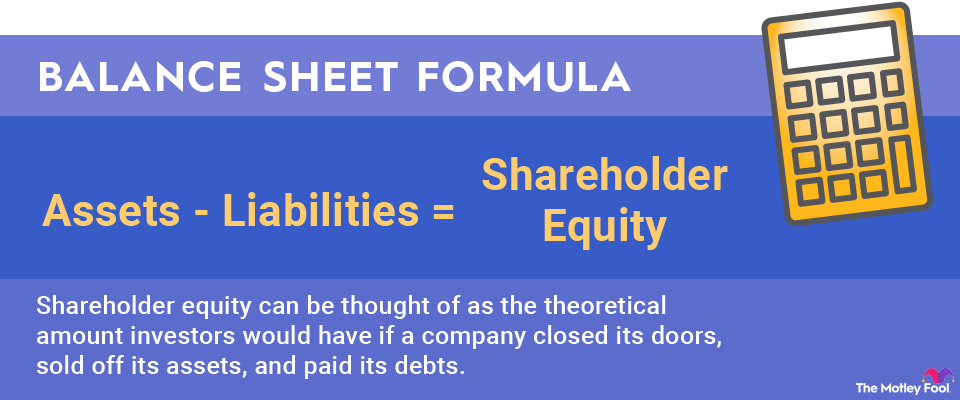
Although a balance sheet itself can be quite complex and difficult to understand for many investors, the central concept is rather simple:
So, assets minus liabilities equals shareholders' equity. Also known as a company's book value, shareholders' equity is the theoretical amount investors would have if a company closed its doors, sold its assets, and paid its debts.
Obviously, a successful company would be unlikely to do that. But this idea is similar to how home equity works. The difference between your home's value (asset) and what you owe on it (liability) is your equity.
As previously mentioned, a balance sheet has three main parts: assets, liabilities, and shareholders' equity. Let's take these one at a time.
Assets: The short explanation is that assets include everything a company owns. Assets are typically broken down into current and non-current assets. Current assets include liquid assets, such as cash and short-term investments. They also include assets expected to become liquid within a year, such as inventory and accounts receivable.
Noncurrent assets include things that won't be readily spendable within the next year. Tangible property, such as a factory, is the most obvious example. However, they also include equipment, long-term investments, and intellectual property.
Liabilities: Most notably, the liabilities category includes a company's debts. Like assets, liabilities are separated into current liabilities (those due within a year) and noncurrent liabilities. Debts coming due soon and accounts payable are examples of current liabilities you'll typically find on a balance sheet, while long-term debt is the most common type of noncurrent liability.
Shareholders' equity: Subtracting the company's liabilities from its assets shows its shareholders' equity. The metric is most useful for evaluating value investments, rather than growth stocks, because it shows what a business is "worth" based solely on what it owns and owes, without regard to its income-generating or growth potential.
Let's start with the assets section. When you hear that a company "has a lot of cash," it typically isn't actually holding all of it in cash. The "cash and equivalents" category on the balance sheet includes cash and instruments such as money market accounts.
However, the current and noncurrent assets categories also include "marketable securities" categories. These include Treasury securities, bond investments, and stocks.
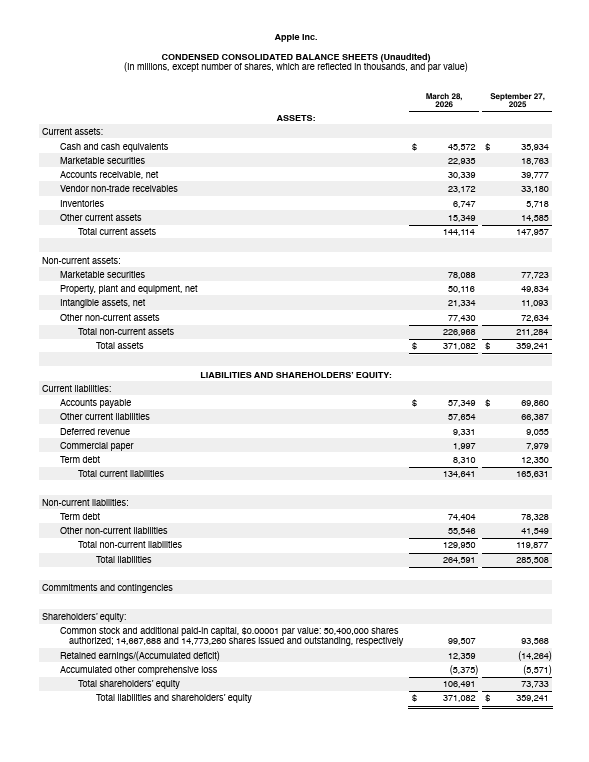
The key point is that these can typically be readily converted into cash that the company can use. So, while Apple has roughly $45.6 billion in cash and equivalents, this figure rises to more than $146 billion when marketable securities are included.
Second, it's important to realize that aside from cash and marketable securities, other values listed in the assets section aren't set in stone. For example, there's no guarantee Apple could sell its property, plant, and equipment holdings for the $50.1 billion listed.
The $6.75 billion in inventory listed assumes it will all sell for full price, and the $30.3 billion in accounts receivable assumes 100% of Apple's customers will pay their bills. And "other assets" is the vaguest of all, typically including the value of things such as patents, goodwill, and other difficult-to-value items. With that in mind, we can see that Apple has about $371 billion in assets on its balance sheet.
The biggest liability on Apple's balance sheet is its long-term debt, which stands at about $56 billion. It also has a smaller amount of short-term debt plus about $57 billion in accounts payable (e.g., to its part suppliers). Although Apple has approximately $113 billion in current and noncurrent "other" liabilities -- certainly a lot of money -- the key point is that this is a very broad category.
On the current side, this can include things like payroll obligations, accrued benefits, and other items due within a year. On the noncurrent side, liabilities can include lease obligations, deferred tax credits, customer deposits, and pension obligations, among others. In all, Apple has about $265 billion in liabilities reported on its balance sheet.
When we subtract Apple's liabilities from its assets, we see that its shareholders' equity is about $106.5 billion. As noted, think of this as the amount of money that would be left if Apple were to cease operations, sell everything it owns, and pay off its debts.
This is not a measure of how much this business is worth. Apple is a highly profitable and efficient business that is growing, even with its large size. In fact, Apple's market value is currently about $4.22 trillion -- about 40 times its shareholders' equity (book value).
Again, shareholders' equity is most useful for evaluating value stocks and comparing valuations across similar industries. For example, the price-to-book (P/B) ratio is especially useful when evaluating bank stocks, since other common valuation metrics (such as the price-to-earnings ratio) aren't always a good fit.
If you own a small business or simply want to analyze your personal financial condition, a balance sheet can help you tremendously. You can start by listing your assets, including your cash, investments, accounts receivable (money you're owed), any inventory you own, property you have, and so forth.
Next, list all the debts and other obligations you have. You can find excellent balance sheet templates online to help you stay organized. Subtract the liabilities on your balance sheet from the assets to find the equity you have in your business or your personal net worth.
It's also worth noting that shareholders' equity and a company's market capitalization (the market value of its stock) are often very different. That is especially true if a company can generate high returns on its assets or it's growing rapidly.
Let's look at a real-world balance sheet and how to read it. Here's Apple's (AAPL +1.18%) balance sheet as things stood on March 28, 2026: