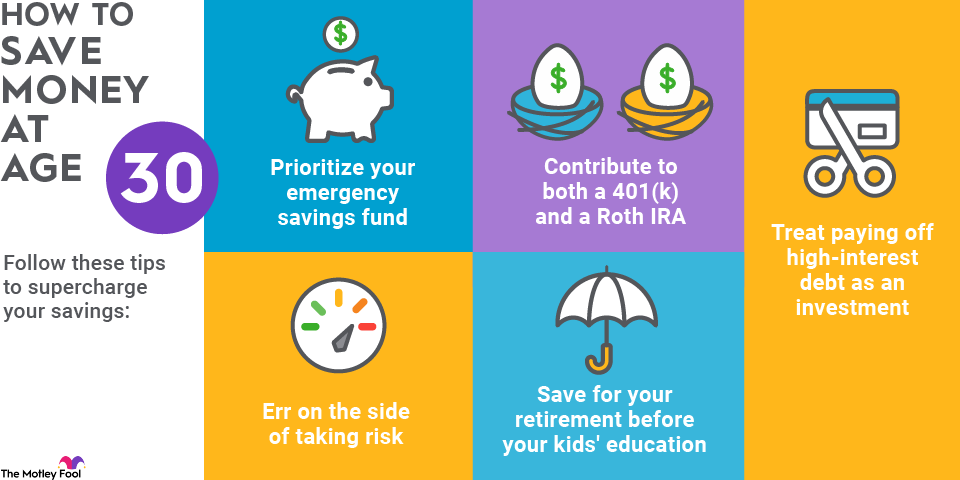
1. Prioritize your emergency savings fund.
An emergency savings fund with the equivalent to 3-6 months of expenses is vital for financial security no matter how old you are. But it tends to become more important in your 30s versus your 20s because you're more likely to have kids and be a homeowner.
It may seem counterintuitive to have money parked in a savings account when you could be investing for retirement. But having that money readily available helps you avoid liquidating your stock investments in a crisis. Raiding a retirement account early often results in taxes and penalties, and it may cause you to sell your holdings at a loss.
While you may be anxious to save for retirement or to rid yourself of student loan debt, establishing an emergency fund comes first. You don't necessarily need to get to the 3-6 months of expenses target before investing, but even having a few thousand dollars in emergency savings will put you in a better position than most.
2. Contribute to both a 401(k) and a Roth IRA.
If your employer offers a retirement plan with matching contributions, make sure to contribute at least enough each year to receive the full company 401(k) match. You can play catch-up by contributing even more, and you can also contribute to an individual retirement account (IRA) if you have additional money available.
A Roth IRA is often a good choice because you forgo a tax break now, when your tax bracket may be lower, in exchange for tax-free income in retirement. Plus, you can withdraw your contributions (but not the earnings on those contributions) any time without paying tax or a penalty. For people younger than 50, the most you can contribute to an IRA in 2025 is $7,000. The limit increases to $7,500 in 2026.
Not sure where to start? Motley Fool Money has reviewed and ranked the best IRA accounts available today, so you can find the right fit for your situation and start putting your money to work.
If you're a freelancer, independent contractor, or small business owner, you can save for retirement using a combination of IRAs and retirement plans for self-employed people.
3. Treat paying off high-interest debt as an investment.
The decision to invest versus repay debt comes down to whether you're paying more in interest on the debt than you could expect to earn by investing. Considering that investing in an S&P 500 index fund yields an average annual return of about 8% to 10%, you should invest in your retirement fund to take advantage of your employer's 401(k) match and then tackle any debt with interest rates above this 8% to 10% range.