How market makers improve the market
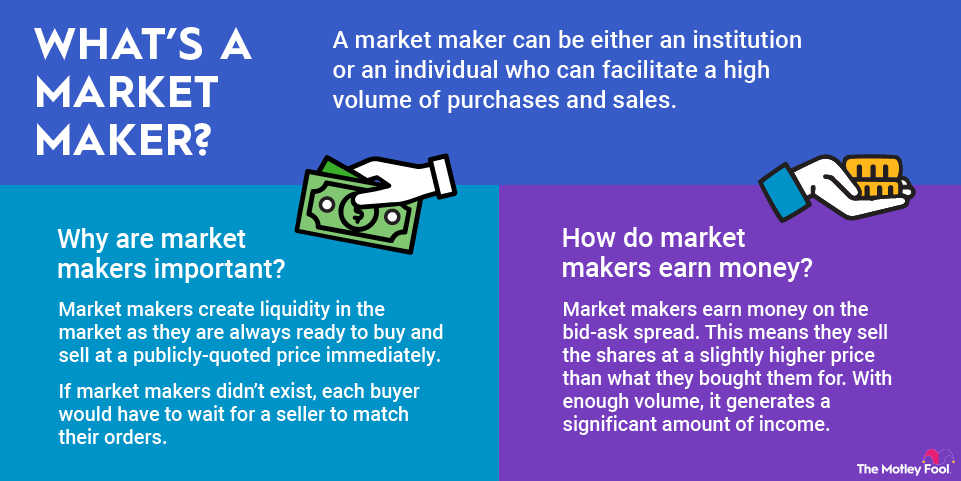
The main function of the market maker is to reduce volatility and facilitate price discovery in the stock market by providing a limited trading range on the security they make a market in. The market maker allows for the free flow of transactions because it will take the other side of a trade even when it doesn't have a buyer or seller lined up to complete the transaction immediately.
If market makers didn't exist, each buyer would have to wait for a seller to match their orders. That could take a long time, especially if a buyer or seller isn't willing to accept a partial fill of their order. (That is, they either take the whole number of shares they ordered or none.) Without market makers, it's unlikely most securities would have enough liquidity to support today's trading volume.
How market makers earn money
A market maker offers two quotes: One is the price at which it's willing to buy the security, and the other is the price at which it's willing to sell. The market maker's sell price is always higher than the buy price, usually by just a few cents. As previously noted, the difference between the buy and sell price is called the bid-ask spread.
Market makers earn money on the bid-ask spread because they transact so much volume. So, if a market maker is buying shares on average for a few pennies less than it sells them for, with enough volume it generates a significant amount of income.
For example, if Apple (AAPL -0.20%) was trading around $175 per share, the market maker may offer a bid price (the price at which it's willing to buy) of $174.95 and an ask price (the price at which it's willing to sell) of $175.05. The $0.10 difference may not seem like much to retail investors, but consider that 90 million shares of Apple trade hands every day. If every trade for Apple shares went through a market maker, that would add up to a cool $9 million in their pockets every day.
The market maker does take some risks, however. There's no guarantee that it will be able to find a buyer or seller at its quoted price. It may see more sellers than buyers, pushing its inventory higher and its prices down, or vice versa. And, if the market moves against it, and it hasn't set a sufficient bid-ask spread, it could lose money.
Related investing topics