iShares Global Clean Energy ETF (ICLN +1.95%) provides diversified renewable energy exposure at a lower cost, while Invesco Solar ETF (TAN +1.32%) offers concentrated, higher-volatility exposure to the solar subsector.
Renewable energy investing often involves a choice between a narrow focus on a single technology or a broader look at the energy transition. Both the Invesco and iShares funds launched in 2008, yet they offer distinct pathways to capture green growth. As the global economy shifts toward sustainable power, these two exchange-traded funds offer different ways to play the trend, ranging from a niche bet on photovoltaics to a broader clean-power strategy.
Snapshot (cost & size)
| Metric | TAN | ICLN |
|---|---|---|
| Issuer | Invesco | iShares |
| Expense ratio | 0.70% | 0.39% |
| 1-yr return (as of 2026-05-20) | 82.50% | 68.70% |
| Dividend yield | None | 1.20% |
| Beta | 1.30 | 1.05 |
| AUM | $1.9 billion | $2.9 billion |
Beta measures price volatility relative to the S&P 500; beta is calculated from five-year monthly returns. The 1-yr return represents total return over the trailing 12 months. Dividend yield is the trailing-12-month distribution yield.
The iShares Global Clean Energy ETF is notably more affordable for long-term holders, carrying an expense ratio nearly half that of its solar-focused peer. The 31-basis-point difference in management fees could significantly impact total returns over a multi-year holding period, especially in a sector known for high volatility. The iShares fund also provides a modest 1.20% payout, which may appeal to investors seeking some cash flow from their green energy positions.
Performance & risk comparison
| Metric | TAN | ICLN |
|---|---|---|
| Max drawdown (5 yr) | (74.00%) | (57.10%) |
| Growth of $1,000 over 5 years (total return) | $806 | $1,021 |
What's inside
The iShares Global Clean ETF provides a broad view of the renewable sector with 106 holdings. Its portfolio leans toward renewables at 22.3% and heavy electrical equipment at 20.6%. Top holdings include Bloom Energy (BE +9.18%) at 12.1%, First Solar (FSLR 2.62%) at 9.5%, and Nextpower Inc (NXT +3.53%) at 8.4%. Launched in 2008, it has a trailing-12-month dividend of $0.27 per share.
In contrast, the Invesco Solar ETF is a more focused vehicle with 31 holdings tracking the MAC Global Solar Energy Index. It is heavily weighted toward solar-related tech companies at 42.5%, utilities at 30.5%, and industrials at 23.5%. Its largest positions include First Solar at 11.7%, Nextpower at 9.8%, and Enphase Energy (ENPH +1.60%) at 8.7%. Also launched in 2008, it pays dividends but they can be irregular.
For more guidance on ETF investing, check out the full guide at this link.
What this means for investors
The world is increasingly shifting towards renewables, and it goes without saying that investors are eager to capture a piece of this multi-trillion-dollar transition. While investors can choose individual stocks, buying ETFs gives them exposure to a basket of stocks from an industry at one go.
The iShares Global Clean ETF tracks the S&P Global Clean Energy Index, which comprises roughly 100 companies, spanning wind, solar, hydropower, geothermal, biomass, green hydrogen fuel cells, and traditional electric utilities upgrading to green infrastructure. Importantly, you don’t just invest in the U.S. with this ETF. It tracks the shift from fossil fuels to cleaner energy sources globally. So the U.S. makes up only 49% of the ETF’s portfolio, while China is the second-largest region by exposure.
The Invesco Solar ETF, on the other hand, is a niche play on clean energy. It gives you exposure exclusively to solar companies but is also highly global, with the U.S. making up around 53% of its portfolio. Israel is the second-largest region with nearly 20% exposure.
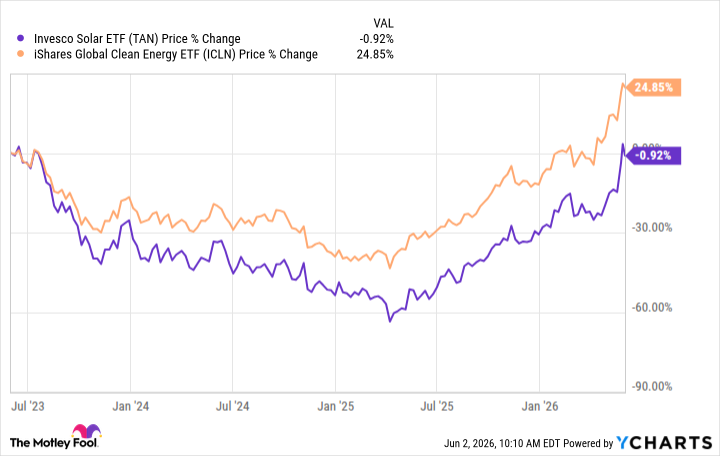
Choosing between the two ETFs is a choice between broad diversification and hyper-focused conviction. The iShares Global Clean ETF is a large, diversified ETF that captures everything from solar to hydro to green utilities. That’s your go-to ETF if you’re simple looking to bet on the global transition toward clean energy. Or if you’re particularly bullish about the solar industry, the Invesco Solar ETF is a top choice. Why solar? The artificial intelligence data center boom and electrification are driving demand for steady, clean power to unprecedented levels. The International Energy Agency (IEA) projects global renewable energy capacity will more than double by 2030, led by solar.