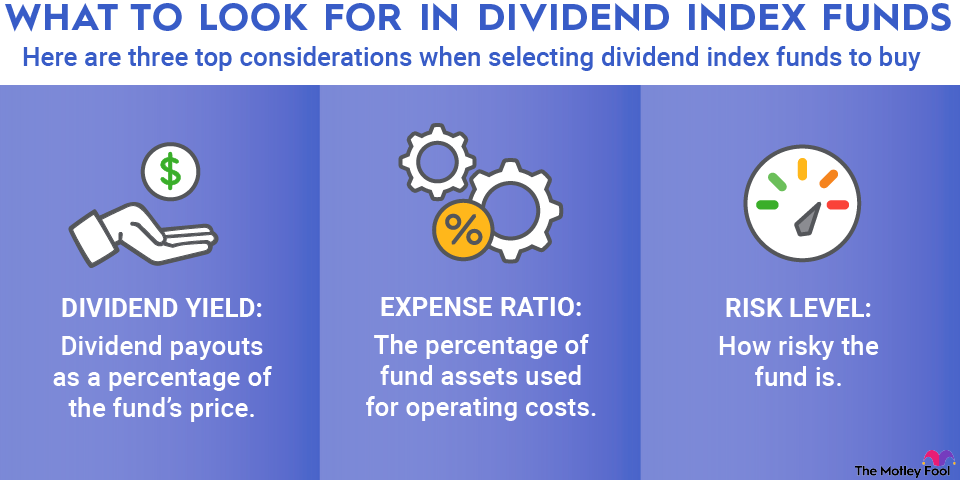
The choice between Vanguard High Dividend Yield ETF (VYM -1.03%) and Vanguard Dividend Appreciation ETF (VIG -0.74%) centers on whether an investor prioritizes current yield or long-term dividend growth potential.
Both funds serve as core pillars for income-focused portfolios, yet they filter the domestic market through distinct lenses. VYM targets companies that are forecasted to have above-average yields, whereas VIG selects businesses that have consistently increased their distributions for a decade or longer. This comparison explores how these differing mandates impact risk, cost, and long-term total returns.
Snapshot (cost & size)
| Metric | VYM | VIG |
|---|---|---|
| Issuer | Vanguard | Vanguard |
| Expense ratio | 0.04% | 0.04% |
| 1-yr return (as of June 3, 2026) | 26.20% | 19.60% |
| Dividend yield | 2.21% | 1.47% |
| Beta | 0.70 | 0.77 |
| AUM | $96.06 billion | $127.8 billion |
Beta measures price volatility relative to the S&P 500; beta is calculated from five-year monthly returns. The 1-yr return represents total return over the trailing 12 months. Dividend yield is the trailing-12-month distribution yield.
With an identical 0.04% expense ratio, both funds represent some of the most cost-efficient investment vehicles available to retail investors. However, Vanguard High Dividend Yield ETF provides a more substantial immediate payout for income-oriented investors, offering a 0.72 percentage point yield advantage over the growth-focused Vanguard Dividend Appreciation ETF.
Performance & risk comparison
| Metric | VYM | VIG |
|---|---|---|
| Max drawdown (five years) | -15.80% | -20.40% |
| Growth of $1,000 over five years (total return) | ~$1,722 | ~$1,656 |
What's inside
The Vanguard Dividend Appreciation ETF (VIG -0.74%) tracks the S&P U.S. Dividend Growers Index, specifically targeting companies with at least 10 consecutive years of dividend increases. This quality filter results in a portfolio of 338 stocks with a significant emphasis on Technology at 26.00%, Financial Services at 21.00%, and Healthcare at 17.00%. Its largest positions include Broadcom Inc. (NASDAQ:AVGO) at 5.18%, Apple Inc. (NASDAQ:AAPL) at 4.08%, and Microsoft Corp. (NASDAQ:MSFT) at 3.97%. The fund was launched in 2006 and has a trailing-12-month dividend of $3.45 per share. This strategy often captures mature growth companies that are returning capital to shareholders.
Meanwhile, the Vanguard High Dividend Yield ETF (VYM -1.03%) prioritizes stocks with above-average forecasted yields via the FTSE High Dividend Yield Index. It maintains a more diversified portfolio of 589 holdings, which leads to different sector concentrations: Financial Services at 20.00%, Technology at 18.00%, and Healthcare at 12.00%. Its largest positions include Broadcom Inc. (NASDAQ:AVGO) at 8.03%, JPMorgan Chase & Co. (NYSE:JPM) at 3.35%, and Exxon Mobil Corp. (NYSE:XOM) at 2.72%. Like its counterpart, it was launched in 2006 and paid $3.51 per share over the trailing 12 months. By focusing on current yield, it captures many value-oriented firms that may not meet the 10-year dividend growth requirement.
For more guidance on ETF investing, check out the full guide at this link.
What this means for investors
A higher dividend yield may be attractive, but investors should also consider whether they prefer immediate income or long-term payout growth. This distinction is central to the difference between the Vanguard High Dividend Yield ETF and the Vanguard Dividend Appreciation ETF.
VYM focuses on a broad group of U.S. companies forecasted to have above-average dividend yields, making it more directly tied to current income. VIG takes a different approach by tracking companies with a history of increasing dividends, rather than simply screening for the highest yields. That difference can lead to distinct portfolios: VYM often has more exposure to value-oriented income stocks, while VIG’s methodology tends to favor companies with established payout records and less emphasis on maximum current yield.
For investors, the main question is less about which Vanguard dividend ETF is better and more about how they want dividends to fit into their portfolios. VYM could be a good choice for those who want a higher starting yield from a wide range of dividend stocks. VIG might suit investors who are comfortable with a lower current yield in exchange for owning companies with a longer history of dividend growth.