The Schwab U.S. Dividend Equity ETF (SCHD +0.21%) may appeal to income-oriented investors seeking a higher yield and lower volatility, while the Vanguard Dividend Appreciation ETF (VIG +0.43%) offers broader market exposure and a heavier tilt toward technology growth.
Investors often look to dividend-focused strategies for a combination of income and relative stability. VIG prioritizes dividend consistency, requiring 10 years of growth, while SCHD uses a multi-factor screen based on cash flow and return on equity. These nuances result in distinct sector weightings and performance profiles.
Snapshot (cost & size)
| Metric | VIG | SCHD |
|---|---|---|
| Issuer | Vanguard | Schwab |
| Expense ratio | 0.04% | 0.06% |
| 1-yr return (as of June 3, 2026) | 19.60% | 27.10% |
| Dividend yield | 1.50% | 3.20% |
| Beta | 0.82 | 0.68 |
| AUM | $124.7 billion | $95.0 billion |
Beta measures price volatility relative to the S&P 500; beta is calculated from five-year monthly returns. The 1-yr return represents total return over the trailing 12 months. Dividend yield is the trailing-12-month distribution yield.
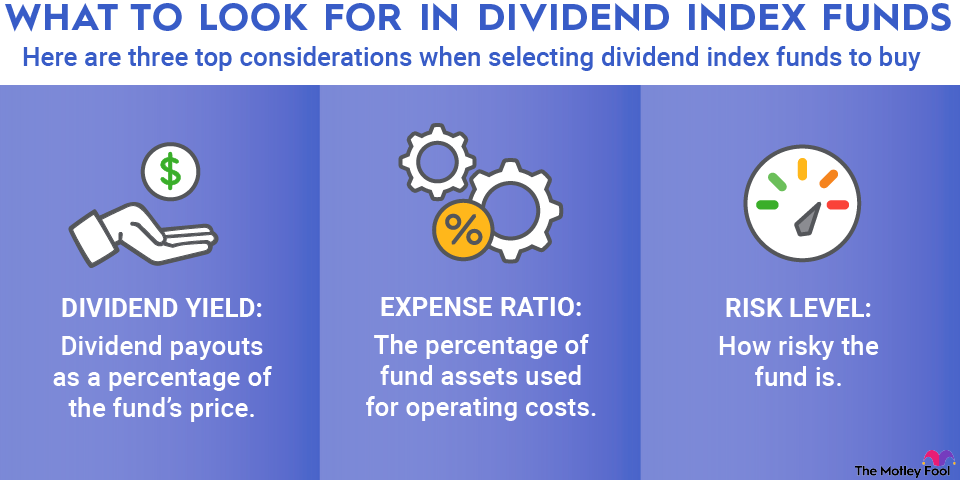
Both funds are extremely cost-efficient, though the Vanguard fund carries a slightly lower 0.04% expense ratio. The Schwab fund offers a much more robust payout, providing a trailing-12-month dividend yield more than double that of its Vanguard counterpart. A lower beta suggests that SCHD may provide a smoother ride during market turbulence compared to the broader market and VIG.
Performance & risk comparison
| Metric | VIG | SCHD |
|---|---|---|
| Max drawdown (5 yr) | (20.40%) | (16.80%) |
| Growth of $1,000 over 5 years (total return) | $1,656 | $1,494 |
What's inside
The Schwab U.S. Dividend Equity ETF (SCHD) tracks the total return of the Dow Jones U.S. Dividend 100 Index, focusing on 103 high-quality dividend payers with sustainable distributions. Its portfolio allocation features 19.00% in consumer defensive, 19.00% in healthcare, and 16.00% in technology. Its largest positions include Qualcomm (QCOM +1.87%) at 6.51%, Texas Instrument (TXN +2.54%) at 5.99%, and Unitedhealth Group (UNH +3.51%) at 5.09%. This fund, which was launched in 2011, has a trailing-12-month dividend of $1.06 per share and avoids more complex investment quirks.
The Vanguard Dividend Appreciation ETF (VIG) tracks the S&P U.S. Dividend Growers Index, holding 338 stocks with at least 10 consecutive years of dividend growth. It provides significant exposure to technology at 26.00%, financial services at 21.00%, and healthcare at 17.00%. Its top holdings include Broadcom (AVGO +2.21%) at 5.18%, Apple (AAPL +0.33%) at 4.08%, and Microsoft (MSFT 1.11%) at 3.97%. The fund was launched in 2006 and paid $3.45 per share over the trailing 12 months. Like the Schwab fund, it does not employ leverage or other complex structural quirks.
For more guidance on ETF investing, check out the full guide at this link.
Which looks like the better buy
The Schwab U.S. Dividend Equity ETF (SCHD) and the Vanguard Dividend Appreciation ETF (VIG) are both income-oriented exchange-traded funds (ETFs). Here’s how they stack up with one another.
First, there’s SCHD. This fund provides investors with exposure to U.S. dividend-paying stocks. It holds about 100 stocks, with top holdings including Qualcomm, Texas Instruments, Unitedhealth Group, Chevron (CVX +0.72%), Coca-Cola (KO 0.18%), and Merck (MRK +1.50%). The fund currently boasts a dividend yield of 3.2% and an expense ratio of only 0.06%. As for performance, the fund has underperformed the S&P 500 since its inception in 2011. Over those 15 years, it has generated a total return of 520%, equating to a compound annual growth rate (CAGR) of 13.3%. The S&P 500, by contrast, has delivered a total return of 705%, with a CAGR of 15.3%.
Then, there’s VIG. This fund also targets American dividend-paying stocks, though it leans more toward the tech sector. Roughly 30% of its holdings are classified as tech stocks, while only about 21% of SCHD’s holdings are in tech. With so much of its portfolio in tech, VIG has a lower dividend yield of about 1.5%. Similar to SCHD, it has a very low expense ratio of only 0.04%. Turning to performance, it has delivered a total return of 602% and a CAGR of 10.2% since its debut in 2006.
In summary, both funds have underperformed the S&P 500 over the long term. However, for investors seeking income from their portfolios, these are two funds worth considering. SCHD delivers greater cash flow with its superior dividend yield.