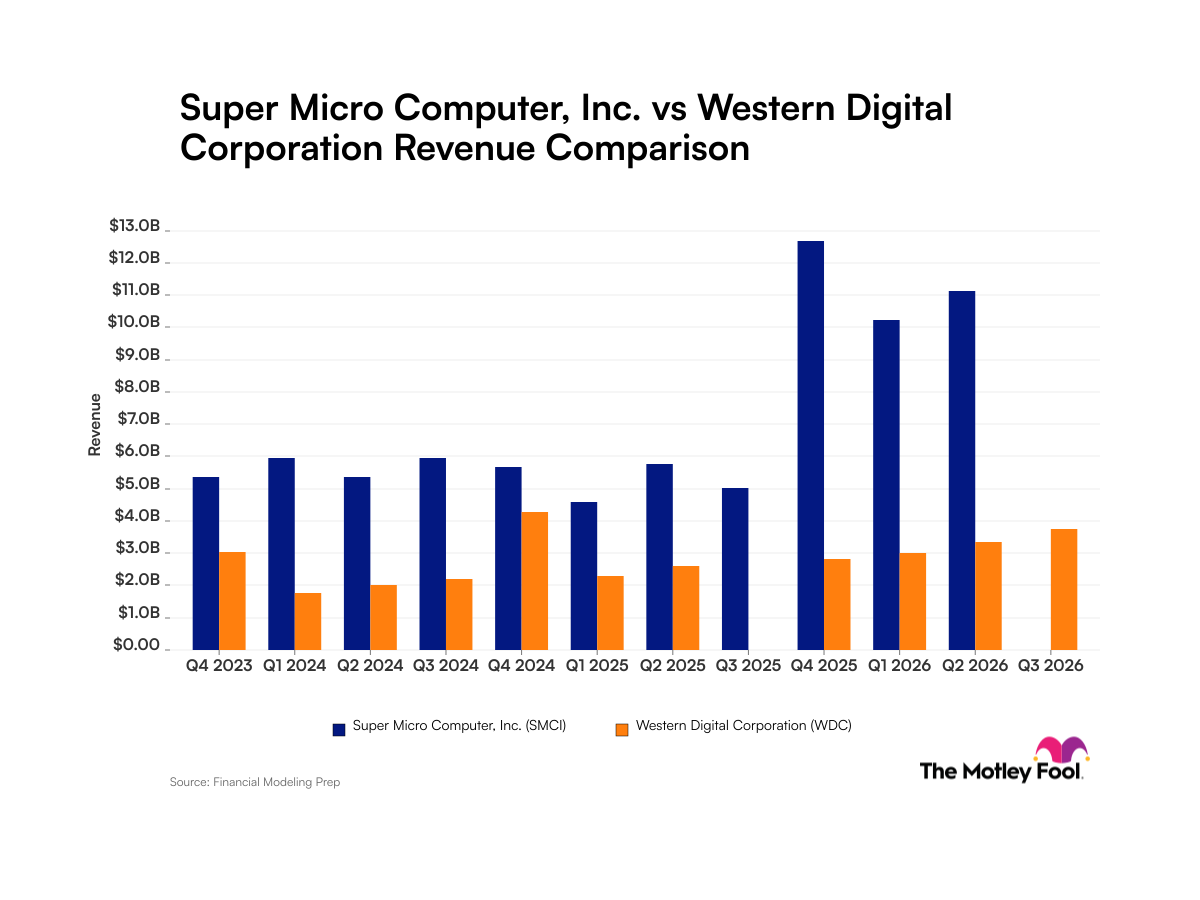
Image source: The Motley Fool.
DATE
Tuesday, May 5, 2026 at 5 p.m. ET
CALL PARTICIPANTS
- Founder, Chairman, and Chief Executive Officer — Charles Liang
- Chief Financial Officer — David E. Weigand
- Vice President, Investor Relations — Michael Thomas Staiger
TAKEAWAYS
- Revenue -- Super Micro Computer (SMCI +4.54%) reported $10.2 billion, reflecting a 123% increase year over year and a 19% decline quarter over quarter, attributed to component shortages and customer site readiness delays.
- Non-GAAP Gross Margin -- 10.1%, representing a 58% sequential improvement from 6.4% last quarter, driven by improved customer and product mix, and reduced tariffs, expedite, and inventory reserve charges.
- Enterprise Channel Revenue -- $2.8 billion, accounting for 28% of revenue, up 46% year over year, and up 45% sequentially; compared to 15% of revenue last quarter.
- OEM Appliance and Large Data Center Segment Revenue -- $7.4 billion, 72% of total, up 183% from prior year, and down 31% from previous quarter.
- AI GPU-Related Platforms -- Contributed over 80% of total revenue during the quarter.
- Backlog -- Management stated backlog reached a new record high, with deferred revenue expected to be recognized in upcoming quarters as customer sites become operational.
- DCBPS (Data Center Building Block Solutions) and Software Revenue -- Software product revenue rose from under $10 million per quarter to $34 million last quarter, and exceeded $46 million in the current quarter.
- Geographic Revenue Breakdown -- U.S. comprised 69% of revenue (up 154% year over year, down 36% quarter over quarter), Asia 13%, Europe 7%, and rest of world 11%, with notable 392% quarter-over-quarter growth in rest of world.
- Non-GAAP Operating Margin -- 7.3%, compared to 4.5% in prior quarter.
- GAAP Diluted EPS -- $0.72, compared to guidance of at least $0.52; Non-GAAP diluted EPS was $0.84, versus guidance of at least $0.60.
- Operating Cash Flow -- Negative $6.6 billion, impacted by a $10 billion reduction in accounts payable, and a $581 million increase in inventory, partially offset by higher net income, and a $2.6 billion reduction in accounts receivable.
- Inventory -- Closed the quarter at $11.1 billion, an increase from $10.6 billion in the previous quarter.
- Net Debt Position -- $7.5 billion at quarter end, up from $787 million last quarter, reflecting increased bank and convertible note debt, and Taiwan credit facility usage.
- Record Production Capacity -- Super Micro Computer reported current manufacturing capability allows for production of more than 6,000 high-end racks per month.
- Fiscal fourth quarter 2026 and fiscal 2026 guidance -- Net sales projected at $11 billion to $12.5 billion for the fiscal fourth quarter; full year net sales expected between $38.9 billion and $40.4 billion; fiscal fourth quarter gross margin guided at 8.2%-8.4%, and non-GAAP diluted EPS at $0.65-$0.79.
- Regulatory Investigation Update -- Management stated, "Super Micro Computer, Inc. is not a defendant nor a target of a grand jury investigation," and internal and external investigations continue, with current findings indicating no additional employee involvement beyond those named in the DOJ indictment.
- Customer Concentration -- Two customers accounted for more than 10% of revenue each: a large data center customer at 27%, and an enterprise customer at 10%.
- Cash Conversion Cycle -- Increased to 106 days from 54 days last quarter, with days of inventory up to 106 days, and days sales outstanding rising to 85 days.
Need a quote from a Motley Fool analyst? Email [email protected]
RISKS
- Management acknowledged ongoing supply chain constraints, including CPU, GPU, memory, and SSD shortages, which may persist and impact Super Micro Computer's ability to meet demand.
- Super Micro Computer reported a significant increase in net debt position to $7.5 billion, and negative free cash flow of $6.7 billion for the quarter, reflecting higher working capital requirements and inventory growth.
- Delayed recognition of revenue due to customer readiness and persistent supply constraints increases near-term visibility risk.
- Pending results of external investigations related to regulatory matters could lead to additional compliance or reputational risks, though current findings suggest limited company-level involvement.
SUMMARY
The quarter was marked by robust year-over-year growth, yet a sequential revenue decline driven by customer deployment delays and global component shortages. Super Micro Computer delivered a pronounced non-GAAP gross margin recovery, citing improved product mix and reduced tariff, expedite, and inventory charges. Substantial ramp in DCBPS and data center management software revenue supported margin expansion and enhanced Super Micro Computer's total data center solution positioning. Despite guidance for continued growth, Super Micro Computer experienced a material deterioration in operational cash flow, a prolonged cash conversion cycle, and higher debt levels to support rapid scaling. Growth in enterprise channel contribution, company-wide capacity expansion, and maintained strength in AI GPU-platform sales further diversified both revenue mix and customer base.
- Super Micro Computer confirmed internal and outside legal investigations are ongoing in response to the DOJ indictment, but currently sees no need for earnings restatement or delay in SEC filings based on presently available information.
- Management stated, "most customers feel very solid to continue our business and continue to grow together," indicating limited customer attrition despite regulatory developments.
- DCBPS and related software are expected to comprise at least 20% of net income in the coming years, reflecting a strategic shift toward higher margin, bundled data center solutions.
INDUSTRY GLOSSARY
- DCBPS (Data Center Building Block Solutions): Super Micro Computer's modular, end-to-end data center infrastructure product offering, which includes full racks, cooling, power, networking, management software, and services for AI and cloud applications.
- DLC (Direct Liquid Cooling): Advanced server and data center cooling technology using liquid to remove heat, directly improving density and efficiency for high-performance and AI workloads.
- TTO (Time to Online): The elapsed time from hardware order to operational deployment in a customer's production environment; a competitive metric for data center suppliers.
- NeoCloud: Super Micro Computer's term for next-generation, non-hyperscale cloud customers, often encompassing mid-sized or specialized cloud service providers.
Full Conference Call Transcript
Michael Thomas Staiger: Good afternoon, and thank you for attending Super Micro Computer, Inc.’s call to discuss financial results for the third quarter of fiscal 2026, which ended March 31, 2026. As you know, with me today are Charles Liang, Founder, Chairman, and Chief Executive Officer, and David E. Weigand, Chief Financial Officer. By now, you should have received a copy of the press release from the company that was distributed at the close of regular trading, and it is available on the company’s website. As a reminder, during today’s call, the company will refer to a presentation that is available to participants in the Investor Relations section of the company’s website under the Events and Presentations tab.
We have also published management scripted commentary on our website. Please note that some of the information you will hear during our discussion today will consist of forward-looking statements, including, without limitation, those regarding revenue, gross margin, operating expenses, other income and expenses, taxes, capital allocation, and future business outlook, including guidance for the fourth quarter of 2026 and the full fiscal year 2026. These statements and other comments are based on management’s current expectations and assumptions and involve material risks and uncertainties that could cause actual results or events to differ materially from those anticipated, and you should not place undue reliance on forward-looking statements.
You can learn more about these risks and uncertainties in the press release we issued earlier today, our most recent 10-K filing for fiscal 2025, and other SEC filings. All of these documents are available on the IR page of Super Micro Computer, Inc.’s website. We assume no obligation to update any forward-looking statements. Most of today’s presentation will refer to non-GAAP financial results and business outlook. For an explanation of our non-GAAP financial measures, please refer to the company presentation or to our press release published earlier today. The non-GAAP measures are presented as we believe they provide a means of evaluating and understanding how management evaluates the company’s operating performance.
These non-GAAP measures should not be considered in isolation from, as a substitute for, or superior to financial measures prepared in accordance with U.S. GAAP. In addition, a reconciliation of GAAP to non-GAAP results is contained in today’s press release and in the supplemental information attached to today’s presentation. At the end of today’s prepared remarks, we will have a Q&A session for sell-side analysts. Our fourth quarter fiscal 2026 quiet period begins at the close of business Friday, June 12, 2026. I will now turn the call over to Charles.
Charles Liang: Thank you, Michael, and thank you all for joining today’s call. We have significant business value growth with our technology leadership and market expansion. However, before I discuss the specifics of the quarter, I want to provide an update on our recent developments regarding the indictment of certain individuals formerly associated with the company. I must be clear. Super Micro Computer, Inc. is not a defendant nor a target of a grand jury investigation, and Super Micro Computer, Inc. has zero tolerance for any employee who violated federal law and regulation. I am personally shocked and saddened by these alleged actions, which in no way represent the values or ethics of this company.
We took immediate action by terminating our relationship with the defendants and cooperating fully with the U.S. government. Additionally, our independent directors have launched a thorough independent investigation with top forensic and legal firms to ensure we continue to maintain the highest standards of integrity. We are not waiting for this process to finish. We are further strengthening our global trade compliance program under expert leadership. Not only is Super Micro Computer, Inc. fully committed to protecting advanced American technology and following the highest ethical and business standards, but we continue to expand our manufacturing footprint right here in the United States. Again, the alleged actions of a few individuals do not define us.
Our focus remains on doing extraordinary work for our customers and partners and leading the industry with transparency and access. Now let us talk about our quarter. This was a quarter defined by value and focus for Super Micro Computer, Inc. Despite the industry-wide shortage of key components, including CPU, GPU, and memory, our business continues to grow and expand. Indeed, our backlog is now at another record high. We advanced and optimized our data center infrastructure using our leading direct liquid cooling (DLC) technology. Our focus remains on delivering the fastest time to online (TTO) in the industry, ensuring our customers can scale their AI factories quickly and most efficiently.
While our fiscal Q3 revenue of 10.2 billion was impacted by customer site readiness delays, our business fundamentals are stronger than ever. This is purely a short-term delay. Several customer sites were not yet equipped with the power and networking required for their cloud deployments, and we expect to capture this revenue in the coming quarters. One of the most significant achievements this quarter was our gross margin recovery, which increased significantly to 10.1% non-GAAP, representing a 58% improvement over the 6.4% non-GAAP reported in the previous quarter. We are committed to achieving a sustainable double-digit gross margin model by increasing our focus on the enterprise market and our DCBPS business. Here are some key growth drivers. First, market strength.
Business remains very strong in the near cloud, sovereign AI, and generative AI segments. We have been aggressively fostering the traditional enterprise and storage business for about one year, and we are starting to see strong growing opportunities. Our data center building block solutions (DCBPS) continue to attract old and new customer interest and create new profit streams by offering a total data center solution that includes complete DLC facilities, management software, networking, and service. We are providing much more value to our customers as they commit to our total solutions. On product mix and efficiency, we improved our product mix with more unique value this quarter and thereafter.
We also advanced our design-for-manufacturing with more automation in our factories to build products faster with higher yield rates and quality. On supply chain, we successfully managed inventories through a dynamic supply environment and took actions to reduce tariff-related costs and expedites. These efforts have improved our flexibility, protected margins, and supported customer delivery timelines. Here is the bigger story: Super Micro Computer, Inc. is developing from a U.S.-based server designer and manufacturer into a total data center solution provider. We are expanding our business to help customers plan, build, deploy, and service data center infrastructure for global enterprises and new cloud providers especially.
Our DCBPS business is essential to this transformation, providing almost everything a customer needs to build an AI factory, including cooling units, networking, power shelves, battery backup, management software, and many other data center subsystems. Our DCBPS business continues to grow exactly as we projected, showing a consistent and accelerating contribution to our top line and bottom line quarter over quarter, and I believe our DCBPS will soon contribute more than 25% of our total profit in the coming few years. As an IT technology leader for more than 30 years, we have consistently turned industry disruption into innovation and new strong opportunities. One of the key value drivers of our DCBPS business is our data center end-to-end management software.
We see significant demand for the Super Micro Computer, Inc. data center and cloud software suite, including our SuperCloud Composer that manages tens of thousands of systems or racks in real time. It provides comprehensive control over system and rack-level power usage, cooling status, safety conditions, and device utilization, alongside many other critical features. Our management software features also include advanced CPU and GPU workload orchestration, which is a critical function for today’s AI data centers. The revenue from this new software product line is growing at a tremendous pace, increasing from less than 10 million per quarter just a few quarters ago to 34 million last quarter, and more than 46 million booked for this quarter.
By bundling subscription-based software and service alongside our hardware, we are strengthening our customer relationships and improving our long-term profitability. We expect DCBPS, including software and service, to continue its rapid growth and to become a major part of our key value proposition. We continue to grow and expand our partnerships with many key suppliers, especially with NVIDIA. We are currently shipping many SKUs of the latest rack-scale systems, including GP300 MVL72, MGXQ, P200 MV804, and the inferencing application optimized RPX for the edge, and we are preparing to be among the first to market with the new Blackwell systems, including the MVL72 SuperCluster.
We continue to build on strong momentum of our AMD MI350 platform as we prepare for the next generation of AMD CDNA solutions, featuring EPYC “Venus” and MI400 series products. In addition, we are working closely with Intel and others on the development of upcoming Xeon 6+ platforms and new additions to our portfolio, including Arm and AGI GPU-based solutions. These systems will deliver exceptional performance per watt, specifically optimized for the growing demand of generative AI workloads. By leveraging Super Micro Computer, Inc.’s system building block solutions and data center scale building block architecture, we can efficiently support a wide variety of compute platforms and optimize them for different business verticals.
Moving on to our footprint, we are expanding our global production capacity with new facilities to better support AI demand across the world. Our sites in Taiwan and Malaysia are ramping up aggressively. Domestically, we recently announced our largest U.S. site to date: a new DCBPS campus in Silicon Valley that is one mile away from our headquarters. This brings our total Bay Area footprint to nearly 4 million square feet, featuring eight new buildings optimized for innovation, design, production, and validation of our next-generation end-to-end data center solutions.
Within this new campus, we are building multiple large-scale validation and production facilities, some of them including a clean room specifically to support our new DLC subsystems and next-generation networking solutions, including advanced optical photonics-based devices. With these expansions, we are on track to produce more than 6 thousand of the most powerful state-of-the-art racks per month. Super Micro Computer, Inc. continues to scale out revenue and scale up value. We have strengthened our governance, delivered a meaningful margin recovery, and expanded DCBPS, growing in both volume and value through software, networking, service, and more.
Our leadership in DLC technology and our ability to deliver rack-scale total solutions with the industry’s fastest time to online continue to fuel our strong growth, keeping Super Micro Computer, Inc. at the center of the AI revolution. With that, I remain very bullish about our growth in the AI and data center markets. For the fourth quarter, we target 12 billion, given stable supply conditions. For the full year, we target 40 billion. I will turn this over to Dave.
David E. Weigand: Thank you, Charles. Fiscal Q3 FY 2026 revenue was 10.2 billion, up 123% year over year and down 19% quarter over quarter. As Charles mentioned, the Q3 revenue was impacted by data center and customer readiness together with industry-wide supply chain constraints. We expect to recognize the deferred revenue in the upcoming quarters. Orders and backlog remain strong across our customer base driven by AI infrastructure demand, with AI GPU-related platforms contributing over 80% of revenue. The enterprise channel revenue during Q3 totaled 2.8 billion, representing about 28% of revenue versus 15% in the prior quarter. This was up 46% year over year and up 45% quarter over quarter.
The OEM appliance and large data center segment revenue was 7.4 billion, representing approximately 72% of Q3 revenue versus 85% in the last quarter. This was up 183% year over year and down 31% quarter over quarter. For Q3 FY 2026, we had two existing customers each representing more than 10% of revenues: one large data center customer at 27% of revenues and one enterprise customer at 10% of revenues. By geography, the U.S. represented 69% of Q3 revenue, Asia 13%, Europe 7%, and rest of world 11%. On a year-over-year basis, U.S. revenue increased 154%, Asia grew 1%, Europe grew 146%, and the rest of world increased nearly 500%.
On a quarter-over-quarter basis, U.S. revenue decreased 36%, Asia increased 17%, Europe increased 105%, and the rest of the world increased 392%. The Q3 non-GAAP gross margin was 10.1%, up from 6.4% in Q2. Gross margins were ahead of expectations, driven by our customer and product mix together with lower tariffs, expedite, and inventory reserve charges. Q3 GAAP operating expenses were 393 million, which was up 34% year over year and up 21% quarter over quarter. On a non-GAAP basis, operating expenses were 278 million, up 29% year over year and up 16% quarter over quarter. Both GAAP and non-GAAP operating expenses were up quarter over quarter due to higher headcount-related expenses.
Non-GAAP operating margin for Q3 was 7.3% compared to 4.5% in Q2. Other income and expense for Q3 totaled a net expense of 15 million, reflecting 49 million in interest and other income offset by 64 million in interest expense related to convertible notes and the revolving credit facilities. The tax provision for Q3 was 127 million on a GAAP basis and 156 million on a non-GAAP basis, resulting in a GAAP tax rate of 20.8% and a non-GAAP tax rate of 21.1%. The Q3 GAAP diluted earnings per share was $0.72, compared to guidance of at least $0.52, and non-GAAP diluted EPS was $0.84 versus guidance of at least $0.60 due to higher gross margins.
The GAAP fully diluted share count decreased sequentially from 694 million in Q2 to 692 million in Q3, while the non-GAAP share count was largely flat. Cash flow used in operations for Q3 was 6.6 billion compared to 24 million used in the prior quarter. Operating cash flow was impacted by a reduction of 10 billion in accounts payable and by an increase in inventory of 581 million. These factors were only partially offset by higher net income and a reduction of 2.6 billion in accounts receivable. The Q3 closing inventory was 11.1 billion, up from 10.6 billion in Q2. CapEx for Q3 totaled 80 million, resulting in negative free cash flow of 6.7 billion for the quarter.
At quarter end, our cash position totaled 1.3 billion. Furthermore, 2.7 billion of accounts receivable collections expected in March were received in early April. Our bank and convertible note debt was 8.8 billion, resulting in a net debt position of 7.5 billion, compared to a net debt position of 787 million in the prior quarter. In addition to using our existing U.S. revolving credit facility and non-recourse AR sale facility, we set up and commenced usage of a 1.8 billion Taiwan revolving credit facility to further support working capital requirements. Turning to the balance sheet and working capital metrics, the cash conversion cycle increased from 54 days in Q2 to 106 days in Q3.
Days of inventory increased by 43 days to 106 days versus 63 days in the prior quarter. Days sales outstanding increased by 36 days to 85 days versus 49 days in Q2, while days payables outstanding increased by 27 days to 85 days versus 58 days in Q2. Now turning to the outlook for Q4 fiscal year 2026, which ends June 30, 2026, we expect net sales in the range of 11 billion to 12.5 billion. We expect GAAP diluted net income per share of $0.53 to $0.67 and non-GAAP diluted net income per share of $0.65 to $0.79. We expect gross margins to be in the range of 8.2% to 8.4% based on expected customer mix.
GAAP operating expenses are expected to be around 433 million, which include approximately 114 million in stock-based compensation expenses that are excluded from non-GAAP operating expenses. The outlook for 2026 fully diluted GAAP earnings per share includes approximately 95 million in expected stock-based compensation expenses net of tax effects of 30 million, which are excluded from non-GAAP diluted net income per common share. We expect other income and expenses, including interest expense, to result in a net expense of approximately 36 million.
The company’s projections for Q4 fiscal year 2026 GAAP and non-GAAP diluted net income per common share assume a GAAP tax rate of 19.4%, a non-GAAP tax rate of 20.4%, and a fully diluted share count of 695 million shares for GAAP and 712 million shares for non-GAAP. Capital expenditures for Q4 are expected to be in the range of 30 million to 50 million. For the full fiscal year 2026, we expect net sales to be in the range of 38.9 billion to 40.4 billion. Michael, we are now ready for Q&A.
Michael Thomas Staiger: Great. Before we begin Q&A, I just want to remind everyone that the purpose of this call is to discuss our third quarter fiscal 2026 financial results. As such, we ask that you focus your questions on the results we announced today. Thank you in advance. We will now open the call for questions.
Operator: Thank you. We kindly ask that you limit yourself to one question and one follow-up. For any additional questions, please requeue. Your first question comes from Ananda Baruah with Loop Capital. Please go ahead.
Ananda Baruah: Thanks for taking the question, and congrats on the progress with the gross margin. It is great to see that. A couple if I could. First, on some of the stuff that has been press released throughout the year, specifically, could you give us an update on the indictment? Any more insight to any company employee involvement? Do you think you will have to restate earnings? Are you on track to file your 10-Q? And then, on the board investigation that you announced, if you could talk to the opportunity that could have to strengthen the organization and what those opportunities might be. Then I have a quick follow-up. Thanks a lot.
David E. Weigand: Thanks, Ananda. The company was surprised to learn of the alleged diversion to China of certain of our products. As we have previously announced, we are taking this matter seriously. The alleged conduct would violate our export control policies and procedures, and we are fully cooperating with the U.S. government to address this situation. In addition, our independent directors have retained an outside law firm, Munger, Tolles & Olson, and a forensic firm, AlixPartners, to conduct an independent investigation into these events. The investigations are ongoing, and we cannot give you any final information at this time.
Based on what we know so far—though that could change as the investigation progresses—no one from the company other than those named in the DOJ indictment was involved. As to your question on restatement of earnings, based on everything we know at this moment, and considering the independent investigation is ongoing, we do not believe we will need to restate. Lastly, on the 10-Q, again, the independent investigation is ongoing, and any filing will be subject to BDO review, but based on what we know at this moment, we are planning to file our 10-Q and are preparing accordingly.
We will take to heart the results of the independent investigation and look at that as an opportunity to grow and strengthen.
Ananda Baruah: Thanks for that context. As a follow-up, one of the top questions on investors’ minds is, in lieu of these aforementioned dynamics, is there a potential for customers to get a little skittish and move away to other GenAI server vendors? Any context you could offer there would be greatly appreciated. Thanks.
Charles Liang: Thank you for the question. Indeed, we are growing our customer base. As I have shared the last few quarters, now we have many more large customers and mid-sized customers. From our experience working with and communicating with customers, most customers feel very solid to continue our business and continue to grow together. So at this moment, I personally do not feel any negative trend.
Operator: Your next question comes from the line of Samik Chatterjee with JPMorgan. Please go ahead.
Samik Chatterjee: Hi. Thank you for taking my question. This is MP on behalf of Samik Chatterjee. For my first one, in your last call, you mentioned DCBPS contributions to profits were 4%. Can you please update how it tracked during the quarter, and how much that was relative to the gross margin improvement that you saw during the quarter? I have a follow-up.
Charles Liang: Very good question. Our DCBPS indeed continues to gain more and more traction from our old and new customers. It is a very good value-add to our hardware and also enhances our relationship with customers. The customers who use our DCBPS continue to grow, and we believe this growth will continue strongly in the next two years. I personally expect at least 20% of our net income will be from DCBPS, including the management software.
Samik Chatterjee: Thank you. As a follow-up on capacity additions during the quarter, can you help us quantify the revenue capacity that it helped add for the company? Thank you.
Charles Liang: Also a very good question. Our capacity now is very large, but we continue to grow our capacity because we want to make sure we are ready for a new generation of data center needs for our industry—for example, much higher density in power and computing, and also in photonics technology and new generations of switches. We are preparing all of that. Some of the new facilities include clean rooms to make sure we can provide advanced optical, high-bandwidth communication and minimize power consumption for next-generation data center needs. So although our capacity is already big, we continue to build more capacity.
Operator: Your next question comes from the line of an analyst with Raymond James. Please go ahead.
Analyst: Hi, thanks for taking the question. I wanted to follow up on the first question that was asked. Does the investigation around the indictment potentially impact your relationship with NVIDIA and, subsequently, your allocation or supply of GPUs and other components? That is another frequent point of concern we get from clients—whether that dynamic has changed at all.
Charles Liang: Our relationship with vendors has been very long term, including NVIDIA, AMD, Intel, Broadcom. At this moment, we feel our partnerships stay strong, and if not stronger, at least as strong as before. We continue to work together on lots of new projects. We have also shared with our vendors that this is a case involving a few individuals. So we hope there is no impact.
David E. Weigand: Our understanding is that there has been no change in allocation.
Analyst: That is very helpful. A quick follow-up: the investments that you previously noted that you made in engineering support and services—have those mostly peaked now, and is that contributing to the margin expansion at this point?
David E. Weigand: Could you repeat that?
Analyst: The investments you noted previously regarding engineering support and services—have those peaked? Where are we in the progress of those investments, and how is that contributing to the margin dynamics going forward?
Charles Liang: Very good question. Our service business—including data center planning, designing, deploying, and build-out services—continues to grow. We continue to grow that service team and consulting team, and the revenue continues to grow. In this segment, profit is much better than our average hardware, for sure.
David E. Weigand: I would say in no way has it peaked. We are just gaining traction.
Operator: Your next question comes from the line of Asiya Merchant with Citi. Please go ahead.
Asiya Merchant: Great, thanks for taking my question. On supply constraints, there has been a lot of talk about CPU-based shortages. For the guide you are providing, are you constrained in any components? And if these supply issues were resolved, how would that change the numbers? And then, on the data center building block solutions, clearly you are seeing traction relative to last quarter when it was just starting to kick through. Can you help us understand what kind of customers—any change by vertical or geography? Are you seeing traction with these data center building block solutions?
Charles Liang: Thank you. In terms of shortages, it is a global common problem. In the last six months, as you know, memory and SSD prices grew so much—double, triple, more than triple—and there is some CPU shortage, especially from Intel, and even some GPU shortage. Like other system companies, we suffer from those shortages. Those shortages may continue for—we do not know how long—like memory and SSD. But we have very good relationships with our vendors, so we continue to work with them and try to gain more long-term support. As to our customer base, as I shared last time, we are starting to gain many more enterprise customers globally, and NeoCloud.
We add more large customers and lots of mid-size and small-size customers, and we will continue in this direction to support more customers.
Operator: Your next question comes from the line of Katherine Murphy with Goldman Sachs. Please go ahead.
Katherine Murphy: Thank you for the question. Was there any one-time item that impacted gross margins in the quarter that you can quantify? You mentioned tariffs, expedite fees, and inventory reserve charges. And then I have a quick follow-up. Thank you.
David E. Weigand: Sure. Tariffs, as you know, were reduced by the Supreme Court, and there were some replacement tariffs that came in. We are hopeful that tariffs will be down on a net basis going forward. Whether I look at that as temporary or ongoing is based on optimism. Regarding expedite fees, we had a very large deployment in our December quarter, which ended up incurring a lot of expedite charges. Those did not recur in March, so we expect expedite to be incrementally up going forward. As to supply constraints, as Charles mentioned, it was especially troublesome in the last six months. We expect some challenges going forward, but not like we incurred over the last six months.
Katherine Murphy: That was very helpful. On the revenue miss in the quarter related to deliveries delayed because of customer readiness, and that deal was contemplated in your prior guidance with a modest quarter-over-quarter margin benefit—was that delayed deal a drag on consolidated gross margins? How should we think about the impact to margins as the revenue from that deal gets recognized in the coming quarters?
David E. Weigand: We think some of the large deals we have talked about have been incrementally beneficial to Super Micro Computer, Inc. because of the reputation it brings for us in deploying large-scale installations to some of the best sites in the world. We are not only getting more larger engagements, which gives us a diversified customer base, but we are also getting better margins from those sales. We actually had more diversification this quarter, and we see that continuing into the June quarter as well. On that basis, some of the strategic decisions we made on large installations have been beneficial.
Operator: Your next question comes from the line of Ruplu Bhattacharya with Bank of America. Please go ahead.
Ruplu Bhattacharya: Hi, thanks for taking my questions. I have two. First, a clarification on revenues and gross margins. David, you mentioned there was some pushout of revenue into future quarters. Can you help us quantify how much of that is coming back in the June quarter versus how much would be in future quarters? And on the margin side, can you clarify how you are thinking about the margin decline from fiscal Q3 to fiscal Q4? I think you guided 8.3% gross margin on about 11.8 billion of revenue. What are some of the factors impacting gross margin between fiscal Q3 and Q4? I have a follow-up.
David E. Weigand: Regarding deferred revenue, it really comes down to when customers and their data centers are ready. We are always optimistic that we can ship right away, but that sometimes depends on customer readiness. We have to wait and see how much lands in the June quarter and how much lands in the September quarter. As to margins, our margin mix is determined by which customers we sell to and which products we sell. That is the biggest dynamic affecting our margins. We see a good upward trend to that 8.2% to 8.4% range, but it will depend on which customers we ultimately sell to.
Ruplu Bhattacharya: Got it, thanks. As a follow-up on working capital, in the past when we have had GPU transitions, you have had to spend working capital and time and money as customers qualify new racks. As NVIDIA releases new GPUs and the transition happens from an older rack to a new Blackwell rack, how are you thinking about working capital needs? Is there a chance you might have to come to the capital markets again to raise capital for working capital?
Charles Liang: Very good question. We are diversifying our customer base and improving our product value. Now we have more and more partnerships where we not just build AI servers and storage, but we help customers deploy and build whole data centers with DCBPS total solutions. Our business will be more diversified and smoother in terms of revenue dynamics and profit margin changes. We are improving in this direction quarter after quarter.
Ruplu Bhattacharya: And in terms of working capital?
David E. Weigand: I always hope that we need to go back to the markets for more money—because that means we grow a lot. It depends on how fast our growth rate is.
Charles Liang: If we grow more stably, our capital should be sufficient. If we try to double revenue again quickly, then we may need more help in total capital. But if we grow more humbly, I believe we are pretty enough because our business model is improving.
Operator: Your next question comes from the line of Nehal Chokshi with Northland Capital Markets. Please go ahead.
Nehal Chokshi: Thank you, and congratulations on the strong gross margin. Charles, you mentioned that over the next two years, targeting 20% from data center building block solutions—was that gross profit or revenue?
Charles Liang: Profit.
Nehal Chokshi: Very good. I cannot remember—David or Charles—you gave a percentage or a dollar number of DCBPS this quarter and the quarter-ago period. Could you repeat that?
David E. Weigand: We did not give that percentage out, Nehal. Our gross margin did increase on our data center sales, but I do not have the percentage of our gross profit that represented.
Charles Liang: When the DCBPS percentage continues to grow, we may quickly provide that kind of percentage.
Nehal Chokshi: Thinking about the significant improvement in gross margin, would you attribute that more to DCBPS ramp or more toward the reduction in your 10% customer going from 63% to 27%?
Charles Liang: There are two factors that will continue to improve our gross margins. One is DCBPS solutions—within that segment, our profit margins most of the time are more than 20%. The other factor is our enterprise customer focus. We are starting to grow many more enterprise customers, and we will continue in that direction. That will improve our gross margin and net margin as well.
Nehal Chokshi: And included in the guidance is the expectation that this customer that was 27% of revenue in the current quarter will continue to be a 10%+ customer?
Charles Liang: Yes. We will have many more NeoCloud, mid-sized cloud, and even small-sized cloud customers. We will continue to support large cloud customers as well. But with more NeoCloud, small cloud, and enterprise cloud, overall our margin will continue to improve.
Operator: Your next question comes from the line of Quinn Bolton with Needham & Company. Please go ahead.
Quinn Bolton: Hey, this is Neil Young on for Quinn Bolton. Thank you for letting me ask a question. Could you touch on what drove the strong quarter-over-quarter increase in enterprise? And are you expecting to see healthy growth from enterprise again in the next quarter and through fiscal year 2027? Or should we think about the revenue split by channel more closely reflected in Q2? I have a follow-up.
Charles Liang: We do not provide detail by quarter, but the direction is very strong. We are winning many more enterprise customers. We see a lot of customers who want to work with us, and at the same time, DCBPS helps us to engage with more NeoCloud and enterprise AI data center customers. Long term, we feel pretty comfortable in this direction.
Quinn Bolton: Thank you, that is helpful. Going back to gross margin one last time, what level is sustainable as we look into fiscal year 2027, as it seems like large AI deployments will likely trend toward being a bigger mix of revenue?
Charles Liang: We believe we will continue to grow in a very healthy way because we are growing our customer base, our product lines, and our total solutions including software and service. We are becoming a much more mature, high-value partner to the market.
Operator: Your next question comes from the line of Jonathan E. Tanwanteng with CJS Securities. Please go ahead.
Jonathan E. Tanwanteng: Hi, thank you for taking my questions, and really nice quarter. Could you address a little more on the export violation issue and if that might impact your ability to finance growth or the cost of financing growth going forward? And have you talked about remediation or addressing the violations and preventing them from happening again?
David E. Weigand: I will go back to the comments I made earlier. The company was not named in this, and we take these things very seriously. We are conducting our own internal investigation, as you know, and I will not add more to that.
Charles Liang: Based on what we know so far—though that could change as the investigation progresses—no one from the company other than those named in the DOJ indictment was involved. We have very good confidence in our integrity.
Jonathan E. Tanwanteng: Thank you. As a follow-up, you mentioned record backlog and strong orders. What does that indicate heading into the back half of this calendar year from a growth perspective? And can the supply environment support growth over the first half?
Charles Liang: We are a fast-growing company. We can grow much faster, but we also care about margins. We try to balance growth with gross margin and net margin. We are in good shape, and we can control and decide that ratio and balance.
Operator: Your final question comes from the line of Mark Newman with Bernstein. Please go ahead.
Mark Newman: Thanks for squeezing me in, and congrats on the gross margin. On the gross margin and mix, it sounds like the rebound is driven partly by expedite charges reducing, and also the enterprise mix helping. Is that right? And within enterprise, is that AI server or more traditional server? I have another question on revenue as well.
Charles Liang: Indeed, both—AI enterprise with a lot of generative AI application evolution, where we see very strong demand, and also traditional server and storage and even IoT. We also started to aggressively support and expand this market, and we see very good progress. We will continue overall enterprise business expansion.
Mark Newman: On revenue, it sounds like the reason for the slightly light revenue was this 63% customer last quarter now pushed out a bit and was 27% this quarter. As that customer comes back, is that going to be a drag on margins in the coming quarters? And on record backlog, any clarity? I did not hear actual numbers on what the backlog is and how that has changed.
David E. Weigand: We do not give out our backlog number; we make general comments that it is very strong. We have diversified our pipeline extensively. As Charles mentioned, we have a large number of large deals from new NeoClouds and cloud service providers, which we expect to increase our footprint and customer diversity as well as our margins, along with our DCBPS and enterprise expansion.
Operator: Thank you. Ladies and gentlemen, that does conclude today’s conference call. Thank you all for your participation, and you may now disconnect.