Image source: The Motley Fool.
DATE
May 27, 2026, 5 p.m. ET
CALL PARTICIPANTS
- Chair and Chief Executive Officer — Marc R. Benioff
- Chief Operating and Finance Officer — Robin L. Washington
- Executive Vice President, Finance — Michael Spencer
- President and Chief Marketing Officer — Patrick Stokes
- President and Chief Revenue Officer — Miguel Milano
- President and Chief Engineering and Success Officer — Srinivas Tallapragada
TAKEAWAYS
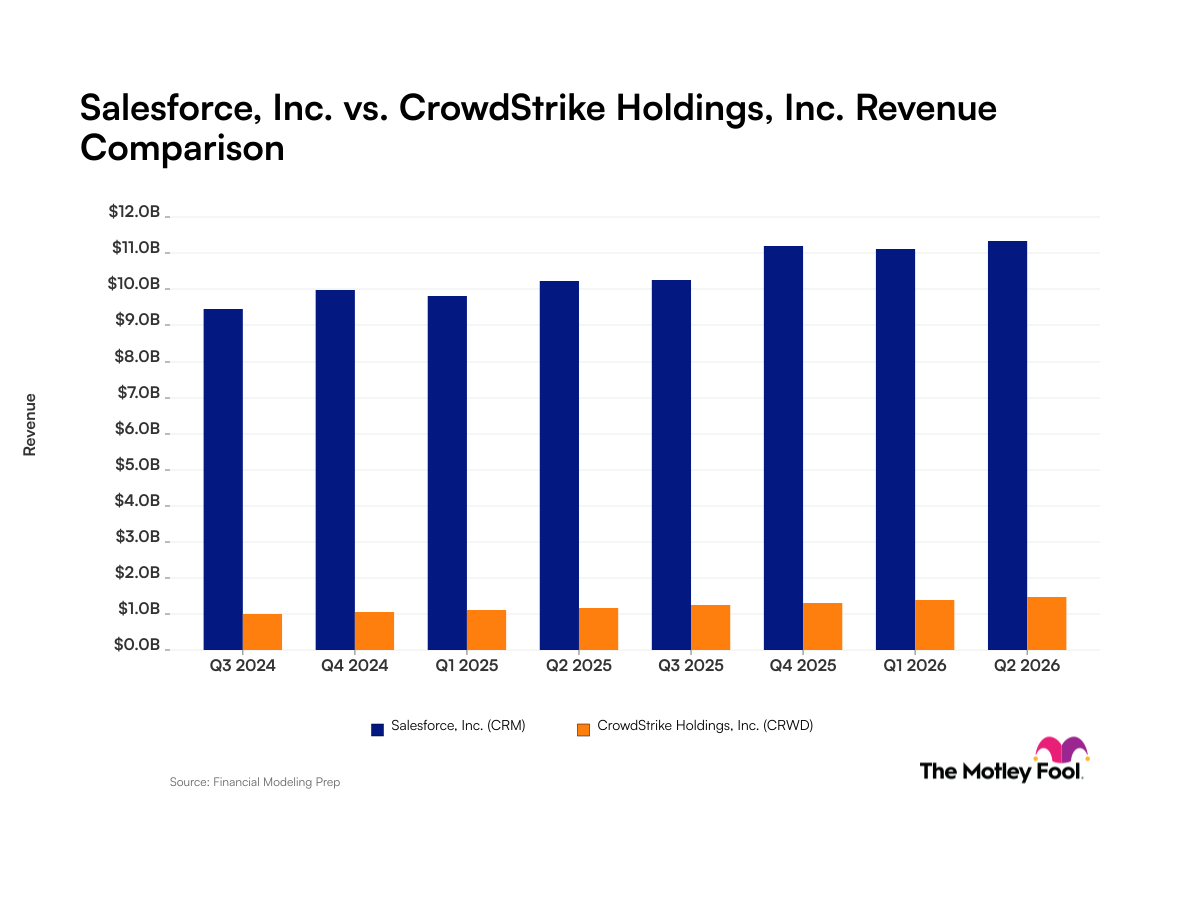
- Revenue -- $11.13 billion, up 13% year over year nominal and 12% at constant currency, with growth driven by Informatica’s on-premises business and professional services timing.
- Remaining performance obligation (CRPO) -- $33.6 billion, rising approximately 14% nominal and 13% in constant currency, propelled by agentforce, Data 360, and Slack, partially offset by softness in commerce and Tableau.
- Non-GAAP operating margin -- 34.8%, expanding 250 basis points year over year, marking a record high.
- GAAP operating margin -- 21.1%, increasing 130 basis points year over year.
- Operating cash flow -- $6.7 billion, reflecting sustained cash generation capability.
- Share repurchase plan -- Instituted a $25 billion accelerated share repurchase (ASR), reducing Q1 diluted share count by 10% year over year and impacting both non-GAAP and GAAP EPS in the quarter by $0.23 and $0.14, respectively; ASR alone cut share count by 103 million (11% of shares outstanding).
- Agentforce annual recurring revenue (ARR) -- Surpassed $1 billion, indicating rapid uptake of new AI-driven offerings.
- AI and data ARR -- $3.4 billion, with 50% attributed to Agentic and Data 360 bookings from existing customers expanding usage.
- Token and Agentic work unit metrics -- Processed 28.6 trillion tokens, up 152% sequentially from Q4 2026; 3.8 billion Agentic work units created, an increase of 111% sequentially.
- Salesforce platform usage -- Nearly 1 trillion API calls processed in the quarter; Headless 360 processed 4.5 million MCP calls since April launch.
- Big-deal activity -- 98 Q1 deals with over $1 million in new ACV; 7 of top 10 deals added net new seats; top 10 deals’ annual incremental bookings rose 60% year over year; $800 million TCV added by top 10 deals, representing 2.5x growth over last year’s top 10.
- Informatica integration -- Informatica’s on-prem business contributed to headline outperformance and enabled double-digit revenue growth two quarters post-acquisition.
- Net new AOV growth -- Outpaced AOV growth in the second half of fiscal 2026 and first half of fiscal 2027 (period ending Jan. 31, 2027); company expects this to drive organic revenue reacceleration in the second half.
- Bookings for premium SKUs -- A1E and A4x premium SKUs, including Agentic capabilities, grew nearly 60% year over year.
- Slack financial and usage impact -- Slack accounted for nearly half of “million-plus wins,” with ACV up 80% year over year and Slack Active Work Units (AWUs) growing nearly 350% sequentially.
- Custom app boom on Slack -- 3 million custom apps built this quarter (up 8x sequentially); 250,000 were third-party AI agents, more than doubling sequentially.
- Guidance update -- Fiscal 2027 revenue guidance midpoint raised to $45.9 billion–$46.2 billion; Q2 revenue expected between $11.27 billion and $11.35 billion, or ~10% year-over-year growth at constant currency.
- Operating margin outlook -- Non-GAAP operating margin guidance reiterated at 34.3%; GAAP operating margin guidance adjusted to 20.6% due to higher restructuring.
- Cash flow guidance -- Operating and free cash flow forecast adjusted to 4%-5% year-over-year growth due to recent debt issuance related to ASR.
- Headless 360 monetization -- Management believes Headless 360 “expands our addressable market into surfaces we have never previously monetized.”
Need a quote from a Motley Fool analyst? Email [email protected]
RISKS
- Management cited “ongoing weakness in marketing and commerce and increased softness in Tableau bookings and renewals” affecting guidance.
- Greater license revenue volatility anticipated due to the addition of Informatica on-prem revenue, as stated in outlook assumptions.
- Restructuring charges have driven a reduction in GAAP operating margin guidance for the year.
SUMMARY
Salesforce (CRM +2.09%) delivered accelerated top- and bottom-line growth driven by broad-based adoption of its Agentic AI product suite, highlighted by revenue growth, margin expansion, and robust usage metrics for both new and existing cloud offerings. Management attributed margin improvements primarily to the scalable efficiency gains from AI-driven internal productivity tools and disciplined operating leverage, as increased engineering capacity was achieved without net headcount growth outside the sales force. Sustained growth in premium product bookings and recurring revenue, paired with the rapid proliferation of new agentic workloads and Headless API usage, underscored a strategic focus on customer value expansion and product integration across the enterprise. Executives confirmed a substantial $25 billion accelerated share repurchase and raised full-year revenue guidance, while expressing confidence in organic reacceleration for the second half and underscoring the monetization opportunities from Headless 360 and Slack as operating system surrogates for enterprise AI work. The outlook acknowledged pockets of segmental softness and anticipated cash flow headwinds from incremental debt financing tied to the ASR, signaling continued focus on operational discipline and product-driven growth.
- Marc R. Benioff said Slack “drove nearly half of our million-dollar wins this quarter,” indicating Slack’s increased role in large enterprise deals.
- Robin L. Washington said, “Bookings for A1E and A 4 x are premium SKUs anchored in sales and service, including the value from our Agentic capabilities, grew nearly 60% year over year,” highlighting sharp demand for premium, AI-anchored products.
- Patrick Stokes noted, “agentforce customers in production grew by 50%,” reflecting the rapid adoption of AI agent automation capabilities.
- Srinivas Tallapragada stated, “there is a latent demand where people want to use Salesforce in their flow of work, but they need a trusted infrastructure,” emphasizing the market pull toward API- and agent-accessible functionality.
- Executives cited net new AOV growth surpassing AOV, with alignment on net new AOV as the No. 1 metric across Salesforce’s business units.
INDUSTRY GLOSSARY
- Agentic Work Unit (AWU): A metric representing discrete, AI-driven tasks or outcomes autonomously executed by Salesforce’s AI agents across its applications.
- Agentforce: Salesforce’s AI-powered automation suite integrating autonomous agents into workflows, customer interactions, and business processes.
- Headless 360: An extensibility layer allowing full access to Salesforce functionality via APIs, MCP (Multi-Channel Platform), or CLI (Command Line Interface) without reliance on Salesforce’s native interfaces, enabling flexible integration across platforms and AI agents.
- MCP (Multi-Channel Platform): A technology layer enabling programmatic or agentic access to Salesforce services via API endpoints, supporting integration with external applications, bots, or UI surfaces such as Slack and third-party AI coding environments.
- Unlimited ELA (Enterprise License Agreement): A contract structure permitting customers unlimited usage of Salesforce products and flex credits for a fixed period and price, designed to accelerate deployment of new use cases and agents.
- Flex Credit: Consumption-based licensing units used by customers to activate additional cloud functions and agentic workloads within Salesforce.
Full Conference Call Transcript
Video: Honestly, the power of AI for using Salesforce. At PenFed, we take 30 thousand phone calls a day. We need a technology that could scale. Using Agentforce, PenFed was able to create call summarization and save on average 3 minutes for every conversation, 30 thousand minutes in savings per day. We believe in the power of agentic AI, and that is the reason we partnered with Salesforce. If you take away health, that is done. there is nothing else. Health care is very fragmented. Patients are frustrated from the beginning. Because it is not centered on them. How can I fix this? Then I found Salesforce.
I deliver care personalized to the patient, and I do that all on the Salesforce platform. Data360 becomes the activation layer. Back into BrentForce health. Back into Slack using BrentForce pre procedure prep for doctors went from 90 minutes to 90 seconds. My purpose is to help people live their best lives. I could not do that without the agentic enterprise. If you read any industry news, you might have heard about the SaaSpocalypse. SaaSpocalypse. They are coming to the big sass. Disruption fear. Stop getting slammed. it is not the end of software. it is the end of software that makes humans do all the work. So what is replacing it? It? Software that listens. Software that understands.
Software that can actually do. And once you see it, there is no going back. We are going to this incredible new world, the agentic enterprise. Salesforce reports I am seeing accelerated revenue, robust top and bottom line lead. We are doing more cash flow, Jim, than Walmart. it is all about the Agentic enterprise, the best companies in the world are doing this right now. Data is everything. For an agentic enterprise. The foundation layer is always data. We have to get the data right. Data 360 is at the heart of our infrastructure. We can activate that data to make sure that they are getting the care that they need. Sales service, the marketing engine.
Salesforce was the 1 company that had all the tools in the toolbox. And with BrentForce, it takes us to that next level. Our agents now have encyclopedic knowledge. It was in that moment that we knew agentforce was the answer. And all of this is being front ended by Slack. Having Agentforce, Data 360, Tableau integrated in Slack All of a sudden, have a supercharged business. it is the power of all of the technologies working together. This is the Agentic Enterprise. Big companies are using BrentForce. BrentForce is now an $800 million business. Customers are not gonna deploy just 1. there is going to be many agents. Salesforce Headless 360. Changes the way that your company works.
Everything in Salesforce is now exposed as an API, MCP, or CLI command. Headless 360 is the biggest growth opportunity that any of us will see in our lifetime. And to see the velocity. Agents have participated in 250 thousand consumer engagements. BrentForce Voice will be a game changer. BrentForce, give me more information about the job. The subject of this order. And the cost savings is just unbelievable. 12 days we launched our first agent. saved us $2 million since we launched it. PenFed was able to save 30 thousand minutes per day. By being able to bring our Salesforce data into Slack I have seen our time in the deal desk stages go down by up to 60%.
For Slackbot truly is the ultimate teammate. We have saved and made at least $4.5 million just because of how we are using Slack. Slack is our operating system. We run our full business in Slack. The Salesforce platform has allowed our provider to see 40% more patients every day. Could not do that without the agentic enterprise. We are about $30 billion today. We can be a $60 billion firm on the Salesforce platform. it is driving down costs and in the end, having a better service experience. CSAT goes up, cost to deliver goes down, customers are we are getting them answers faster. it is just incredible opportunity for all these businesses.
Run on Salesforce today, you are nuts if you do not. I think we are in a new era of agents enabling you. that is really where the magic is. Human being, agent doing. This is the Agentic Enterprise.
Operator: At this time, I would like to welcome you to the Salesforce first quarter fiscal 27 conference call. This conference is being recorded. And all lines have been placed on mute to prevent any background noise. After the speakers' prepared remarks, there will be a question and answer session. At this time, I would like to turn the call over to Mike Spencer, executive vice president of finance. Sir, you may begin.
Michael Spencer: Good afternoon, and thanks for joining us today on our fiscal 27 first quarter results conference call. Our press release, SEC filings and a replay of today's call can be found on our website. Joining me on the call today is Marc R. Benioff, Chair and CEO; Robin L. Washington, Chief Operating and Finance Officer. We also have Patrick Stokes, president and chief marketing officer Miguel Milano, President and Chief Revenue Officer; Srinivas Tallapragada, President and Chief Engineering and Success Officer, joining us for the Q and A portion of the call. Some of our comments today may contain forward looking statements that are subject to risks, uncertainties, and assumptions. Which could change.
Should any of these risks materialize, or should our assumptions prove to be incorrect, actual company results or outcomes could differ materially from these forward looking statements. A description of these risks, uncertainties, and assumptions or other factors that could affect our financial results or outcomes is included in our SEC filings including our most recent report on Forms 10-K, 10-Q, and any other SEC filings. Except as required by law, do not undertake any responsibility to update these forward looking statements. As a reminder, our commentary today will include non GAAP measures. Reconciliations between our GAAP and non GAAP results and guidance can be found in our earnings materials and press release.
And with that, let me hand the call over to Marc.
Marc R. Benioff: All right. Fantastic. Thanks so much, Mike. I am so excited to be here with everybody. And great to do our second video earnings call with you. And it is really great. it is a gorgeous day in San Francisco, and we'are going to have a great time here with you. We have even got a couple customers joining us, which we are really excited about. Well, I think as everybody can see, this was really an outstanding quarter for Salesforce. We have delivered record revenue, record deals, and just incredible cash flow. And, of course, I think we have also returned record levels We'are going to talk about that and how important that is, especially during this unusual time.
So we'are going to come into that and also, by the way, we also mentioned we have some record token counts. I think we are going to talk about how we process 28.6 trillion tokens up 152% quarter over quarter. No greater example of the tremendous adoption of these new Agentic products by our customers. And how we have converted those into 3.8 billion Agentic work units. Agentic AI, well, it is the biggest growth opportunity for our customers, for us at Salesforce. And since we brought CRM into the cloud, we are just seeing tremendous new innovation every single day. And you can see it in our products. You can see it in our products.
You can see it in our results. Salesforce has never been more essential to our customers. We'are going to hear from them in just a second. And we are the number 1 agentic CRM, transforming every company into an agentic enterprise. Now let me tell you about these amazing Q1 numbers. Revenue was $11.13 billion, up 13% year over year nominal and 12% at constant currency. CRPO, $33.6 billion, up approximately 14% nominal and 13% in constant currency. And Q1 non GAAP operating margin of 34.8%, up 250 basis points. Again, hitting some record levels. GAAP operating margin of 21.1%, up 130 points. Pretty awesome. And we delivered $6.7 billion in operating cash flow.
Tens of thousands of businesses across every industry are building their agentic enterprise with Salesforce. We'are going to talk about that today. And OpenAI and Anthropic, Google, companies building the future of AI all of them Salesforce customers, all of them Slack customers, building these incredible new capabilities with BrentForce. We secured a record 98 Q1 deals with over $1 million in new ACV in the quarter 2098 q '1 deals with over $1 million. Miguel is going to talk about that today. Organizations like LVMH, Chobani, the US Air Force, which, by the way, just signed a new $72 million ELA with us during the quarter. Awesome.
And we are seeing incredible demand for agentforce with ARR now greater than $1 billion. And combined with Data 360 and Informatica Cloud, we have delivered $3.4 billion in AI and data ARR. 50% is Agentic and data 63 bookings, from existing customers expanding their commitment. And to date, we processed 28.6 trillion tokens, up 152% quarter over quarter. And converted them into 3.8 billion as I mentioned already, Agentic work units for our customers up 11% sorry, up 111% quarter-over-quarter. BrentForce now powering every Customer 63 application, and it is changing how organizations operate across service, sales, marketing, commerce, and so much more. Nowhere is this more evident than in customer service. Let's just start right there.
With agent for service. Humans and agents collaborate across every channel from first contact to first resolution across the trinity of channels, voice, website, apps, a great example. You are gonna hear in a moment. UCLA Health If you go to uclahealth.org, you will see right away, BrentForce is there to help you get your questions answered, to connect with their physicians, to connect with their technology at UCLA. it is a great example using our most current version of BrentForce. And since we deployed agentforcehelp.salesforce.com and on 1-800-NO-SOFTWARE, well, only 15 months ago. it is autonomously handled now 4 million inquiries. it is now double what human agents are handling. Every customer can turn this on now.
So many customers are seeing incredible results with BrentForce service. Vivino, the world's largest wine company, supporting 74 million users with only 37 reps. Kind of hard to believe, but it is possible because it is agent Vivina autonomously handles order status lookups, account questions, more autonomously slashing resolution time by 70%. McAfee has selected our new agentforce ITSM product or what we call agentforce IT service to replace ServiceNow. They are using it for everything, ticket deflection, hardware provisioning, incident management, really cool. And Florida prepaid a college savings plan provider of more than 200 thousand accounts is using the agentforce voice to autonomously handle 75% of business hour calls and 100% of after hour calls.
And with agentforce sales, we are powering the entire revenue life cycle from first lead to closed deal. And as I said before, over 25 years, Salesforce generated tens of millions of leads We never called back. In Q1 alone, agentforce sales worked 220 thousand leads autonomously generating $42 million in pipeline. Awesome. So I am more excited about what our customers are doing in service.
Sales, in marketing, in Slack, and all of these things Another great example of cybersecurity leader Fortinet using agent for sales to power predictive lead scoring, financial leader, Agribank now built an ace SDR agent that instantly qualifies leads on WhatsApp, You can go to salesforce.com and even see our own qualification system, running right on our homepage as well. Okay. In Q1, we completed the acquisition of Qualified. And integrated Piper, their SDR agent in the Salesforce, brought all those great Salesforce alumni back home, more than 700 customers are already using Piper. It is an incredible success. And we deployed Piper on salesforce.com, as I mentioned. So you are going to be able to use it firsthand.
I think that is so great. it is engaging 50% of our traffic. And qualifying thousands of leads and delivering 45% more pipeline than traditional web agents. Also very excited about our new agentforce coworker, which we announced last week. If you have not heard about that, every single 1 of our Salesforce applications now comes with a built in autonomous agent No complex configuration. You just turn it on. It becomes your coworker. Finding the answers, taking action, getting work done fast to give you an idea of the impact the coworker will have. People search for information inside Salesforce 1 billion times a month. Coworker turned search into answers and answers into action.
And 1 of our trailblazers, Andrew Russo, you probably saw him respond directly to me. On x kind of was a surprise, but said, there is no way this is real life right now. BrentForce coworker was able to pull together and navigate our complex sales and ERP data to answer questions that just yesterday would have been 60 minutes of swivel-chairing between screens and systems It was pretty cool to see that.
And I will tell you this quarter, we also announced Headless 360, again, making all of Salesforce accessible through our MCP clients, APIs, CLI prompts, Headless 360, bringing together the humans, agents, and headless platforms so you can use Salesforce any coding agent across any surface. it is gonna speed implementations, drive consumption, more actions, more workflow, more data, more intelligence, all compounding across Salesforce. We are meeting our customers where they are since launch in April. We have already processed 4.5 million MCP calls into our platform. Q1 alone, we processed nearly 1 trillion API calls. Incredible.
And with Headless 360, Indeed is building and deploying agentforce agents right from cursor and just eat takeaway, 1 of the leading online food delivery platforms in Europe. We just have them speak to our entire management team with such an amazing story. he is using Headless 360 already. To bring agents into WhatsApp and other channels engaging with 350 thousand partners across 15 countries. So now let's talk about our favorite Slack. Which every AI company, in the Bay Area here are using to run their business, including OpenAI and Anthropic. Transforming our customers into an agentic enterprise, Slack was nearly half of our million-plus wins this quarter. up 80% year over year.
It is a rocket ship to the moon. All of the AI companies run on Slack. As I mentioned, I do not think there is a start up. We next gen AI company that does not run on Slack. Anthropic calls Slack, its core operating system. And that is what Slack is becoming for every enterprise. All of our apps are Slack first. So now a service agent can summarize a case, update the record, escalate to a human right in Slack. And Slackbot is also an MCB client. So you can tell it to create a purchase order in NetSuite or update a project in Jira and it happens. No switching tools.
We have seen 1 million users of Slack MCP in the first 6 weeks. And Slack AWUs grew nearly 350% quarter over quarter. In 2 years, there will be more agents using Slack than people. Every 1 of those agents needs the context and the data and the insights directly from Slack. Every workflow needs the data. Every action needs the integration, and every customer needs see what is happening across the entire business. We have the largest collection of trusted CRM context ever assembled between Data 360, Informatica, MuleSoft, Tableau, manage, and deliver all that context so that any agent can reason, act, and deliver real outcomes. Informatica has an amazing acquisition.
It performed incredibly well this quarter. it is doing the heavy lifting and data management. That every customer needs to move from pilot to production. All of this is why we are the number 1, Agentic CRM. And we provide what every company needs to become an Agentic enterprise. Okay. So now let's keep going. And with SlaHeadless 3 the entire platform is accessible. We have some new people joining us at the table, so it is very exciting. Brent to see you, buddy. And we are transforming, and more importantly, our customers are transforming too. Okay. Alright. Anyway, here we are. Let's move on to what is really important. So welcome. Thank you for being here.
Thank you for having me. We are thrilled that you are here.
Analyst (James Gank): Would you just introduce yourself to everybody because I do not think they know you. I am James Gank, president and CEO of Penn Fed Credit Union headquartered in Jason, Virginia.
Marc R. Benioff: And is this your first time in San Francisco? Been here a few times. Meet with Salesforce. Usually, I see you in DC. So happy that you are here with us. And grateful that you are here. So why do not you tell us a little about know, you have been using Salesforce a while at PenFed. You have had this vision of becoming an agentic enterprise. Why you tell us you know, what is happening? We heard you a little bit on your earnings call. I think you everyone should hear you on our earnings call too.
Analyst (James Gank): Me just tell you the why. So I started in financial services 25 years ago. There was 8 thou I am sorry. 18.4 thousand banks and credit unions. there is 8 thousand today. Think about that. 500 credit unions and banks. Amazing. Are either merged or beaten out of existence every year. Amazing. And so we knew we had to change. We have been around for 91 years. And to remain relevant, we realized we need to partner with somebody back in sort of rebuild our tech deck to take us to a new level.
Marc R. Benioff: You are motivated? Super motivated. You gotta be hungry every day. I was 6'5" like you when I started. I am 5'6" today. Alright.
Analyst (James Gank): So now tell us a little more about what have you done? what is the vision? So about 2 years ago, I was actually at your world tour in New City, and I saw some other partners their vision of what they thought it can do for the member experience. We are competing against 8 thousand other firms, we gotta deliver hyper personalization in every transaction. We do about 500 transactions a second, 160 million member transactions a year. They have to be right anywhere in the world real time. So we built our entire platform over the last few years. We went from 400 platforms down to literally 12 strategic partners.
Our call center, our mobile, our web, and our branches all run on Salesforce. Every additional partner or tech siloed capability is a tax on innovation, is a tax on speed, and is a tax on security. So by building it around Salesforce, I really think it is taken me 25 years to realize Jim Collins' flywheel effect We have 76 agents now running across operations, mortgages, IT, HR. All of our areas are adopting it to make our employees be more productive. We like to say they are Bionic employees now. We are not losing employees. We are able to add more volume at scale, industrialized scale with the same number of people. We are very proud of that.
Marc R. Benioff: Well, you know, you have heard the narrative on the SaaSpocalypse. You know, everybody's heard of crazy thing that these AI apps are transforming, you know, software which definitely is true. You know, all of our products are just so much better because of it. You know, how is it impacting how you are using Salesforce?
Analyst (James Gank): Let me let me just talk about how people make a buying decision. Because I hear some of these stories Yeah. When somebody knocks in your door, are you gonna open the door and give them the keys to your safe or the code to your safe, to your family's jewels? So every day, a CEO of any firm is going to get 50 cold calls. Somebody can do it different or better. How was a decision really made? First of all, is the firm, in this case Salesforce, have the product and service that we need?
Second, do you have the engineers, the architects, the professionals, to work with my team in order to bring it that vision to reality? Then lastly, even if another firm had those first 2, who is the firm standing behind it that can be there good times and bad times that is going to stand behind that product or service? When you line up all 3, that is where a good trusted partnership exists. that is why we went with sales So we worked with your team literally hand in hand. We said we want a streamlined process We want to take out latency in the code.
We wanna do x, y, or z Your team was there in the trenches at every level, engineers, architects, building out the vision. But then it is not just pie in the sky on a white sheet. it is implementable. We have 76 agents running side by side with our employees. A good example is in our call centers. We have agent wingman. I am an aviator, so I think they named it because I like wingman. Agent Wingman is going to save me nearly $1.6 million this year. it is decreased our call handle time 10% this year, 50% reduction in after call work times and 40% reduction in held calls. So better experience for the member.
Remember, they can go to 8 thousand other institutions. I want them to have a great experience each and every time with PenFed. it is gotta be right each and every time. Yet I want my employees to do the knowledge work, building trust in the relationship not entering what just happened on a phone call. We have agents that listen to the phone call, transcribe it. The human's still in the loop. They approve what was just talked about. But then it is 360 if the transaction occurred in the branch, web, mobile, So the next person that deals with that consumer, that member, they know exactly the relationship.
They know what we might want to sell them next or what they need next for their daughter, their graduation. So it is creating a hyper personalized omnichannel experience without having 400 people I need to meet with.
Marc R. Benioff: I have 12 strategic partners. That are allowing us to power the business. And you have kind of alluded to this, but, obviously, thank you for your service as well. And just tell us about your members and how important they are to our country. We have been serving those. We started out as the War Department Credit Union in 1.94 thousand. We support the men and women who serve our nation across the national security community and all Americans who support them anywhere in the world. that is why it has to be right correct, real time industrial strength, and we are very proud of that. Well, we are very proud to have you as a Salesforce customer.
Before we wrap it up today, is there anything that you think other financial service leaders like yourself or other folks who are thinking about implementing agent technology should know.
Analyst (James Gank): It occurs faster than you think. So literally, we had a division. We saw what was possible 2 years ago. You can build it quickly. The most important thing is having the right partner and not to have too many partners. Too many partners slow things down.
Marc R. Benioff: Fantastic. Brent, we could not be more thrilled to have you here today. Marc. And it is great to have you in San Francisco. And thanks for everything you are doing for the whole country and everyone. Thank you, Brent. and everyone. Thank you so much, Brent. Great to be with you. Thank you. Alright. We are so happy to have James here. Thank you for coming to San Francisco. Unbelievable. Have him here is so great. And I think that is such a message. And then we have another customer with us as well, UCLA Health, another great customer. they are serving 450 thousand patients a day. I am not gonna go through all the details.
Please welcome our good friends here, and also Michael. So, guys, welcome, and thanks for coming on the show here with us. Thanks, Marc. Thanks for having us. Well, why do not tell us your story?
Analyst (Michael): Just heard James' story. Why do not why do not we hear your story down at UCLA Health?
Marc R. Benioff: I already told everyone to go to uclahealth.org and look at BrentForce. But can you tell us a little about what you are doing?
Analyst (Michael): Sure. So, we have been working with Salesforce for quite a few years, but most recently, we have consolidated into 1 single instance of, health cloud and we have built on top of that with Mark Cloud, Data 360, and most recently launched our first experiment with BrentForce, and that is a customer-facing chatbot. That just-- it is right now it is only scraping our website to act as a little bit of a virtual concierge to direct patients to where they need to go, helping with find a provider. it is helping with general inquiries. it is helping with clinical trials.
And the way I like to think about it is each of those topics may have been a phone call. They may have been an email. They may have been an onus put upon the patient, but now it is really it is a 1 stop shop for the patient as opposed to them in a time of need. it is getting them their answers faster.
Marc R. Benioff: Well, I will tell you, it is so exciting to have you with us. And, you know, there is so many healthcare institutions doing so much for you. I actually have press release here about CVS Health is gonna you know, launching something tomorrow, with us. And I just wanna just say you guys are way ahead of everyone else or so many people with a lot of conservatism in the health care industry and deploying agents. what is your message to them in regards to, you know, I already said you can go right to your website and see it, but is your message to your peers or to others who are considering deploying Agentic technology?
Analyst (Michael): I would say, it took a while for us to sort of dip our toe in the water in the customer facing space. We are doing a lot on the back end when it comes to, research, but this really has an impact on our operations. And, we took a lot of precautions. The this particular product really helped us from a testing perspective. There were a lot of protocols in place that allowed us to validate every step that we were taking. And that offered a lot of, offered a lot of certainty for senior leadership to kind of sign off on the on the first experiment that we that we took here.
Marc R. Benioff: Outstanding. Palma, give us the technical know how, the detail here. Know, it is we are in the SaaS apocalypse, as you know. So, you know, how do you look at the SaaS apocalypse? You are you are you are an you are an in this area. You are deploying the technology. Give us your insight.
Analyst (Palma): Yeah. Absolutely. I think fundamentally, we are looking at this technology with our business problem in mind of health care systems are stretched so thin. How do we help and support our health care workers? And how do we help and support our patients get access to care faster? So for us, this is a technology, as is anything. How do we best utilize this technology to service and address those pain points operationally make our staff faster, help our patients. that is really what is driving us and really how we approach As Mike mentioned, we are using the same oversight, same policy and procedures that we need to deploy these types of technologies.
Marc R. Benioff: Well, Palma, you deployed our most current version of BrentForce Incredible what you have done with it and the whole multimedia experience, the integration with the call center, the every capability you are connecting your physicians, you know, delivering the technical know how of UCLA. Right to your right to your to your clients. You know, get just give us give us your just biggest surprise, you know, deploying this technology. What was it that you just really just hit you with that was like, wow. This is what everybody should know.
Analyst (Palma): I think with any technology the biggest thing that we take away is how much debt we have built up from a workflow standpoint, how much, you know, technical or people that we create, and then we are get mired in this, this is the way that things have to be. So this is really an opportunity for us to open the door and say there is a way we can do things differently. Can we solve the problems of, yes, yesterday and start to make a new enterprise for tomorrow? So that is really how we have we have been approaching it.
We were excited that we were able to stand up our first stage of use case at UCLA Health within 8 months. We are really looking forward to what is next and how can we scale and capitalize on this technology next.
Marc R. Benioff: Alright, Mike. there is the question. You know, what is next and how are you going to capitalize on this technology as a next step?
Analyst (Michael): that is actually the other great thing about this is there is been a lot of insights that our own patients have let us down, and agentforce actually been great about sort of consolidating and chunking each of those. So whether it is what systems do we give agentforce access to, what capabilities do we ask it to do for us? So next, we are looking at potential integrations with MyChart, I think that is probably 1 that is relatively high on the list. But, you know, we also wanna start having some assistance with our back office functions as well. So there is a couple different things.
Marc R. Benioff: Well, I wanna just thank both of you for being on the call. We are so thrilled to have you We are thrilled to have you as a customer, and I hope you will not only continue to drive us forward, but also inspire our other customers as well. And with that, I am gonna turn it over to Robin L. Washington.
Robin L. Washington: Thanks a lot, Marc. Well, you have just heard the case Salesforce as the number 1 agentic CRM. The financials behind it tell the same story. So let me start with the drivers behind the numbers. Why our growth is durable, and how we are funding it with operational excellence. And I wanna update you on our capital allocation strategy, which as Marc said, is driving long term shareholder value. 1 framing note before I walk you through the quarter. This is our first quarter under the new FY 2027 revenue disclosure framework. As agents transform how we build, sell, and serve customers, our new framework reflects that BrentForce is now deeply embedded across every 1 of our applications.
So please review our earnings deck for additional details on this. So starting with our durable growth drivers. Sales, service, and Slack, are at the core of the number 1 agentic CRM. Collectively representing more than 60% of Q1 net new AOV. BrentForce ARR surpassed the $1 billion mark this quarter. Our largest applications, sales and service, saw year over year seat growth with humans and agents both expanding on the platform. Bookings for A1E and A 4 x are premium SKUs anchored in sales and service including the value from our Agentic capabilities, grew nearly 60% year over year. As customers adopt BrentForce, they expand across our platform.
On average, our top 10 customers by Q1 AWU usage have increased their total Salesforce spend by 1.5x in the last year. And now with Informatica as part of Data 360, we are already unlocking synergies with revenue growth accelerating since the acquisition. This is the flywheel we laid out at our Investor Day and it is working. Those signals show up in the headline numbers. Q1 revenue came in at $11.13 billion, up 12% in constant currency, ahead of our guide. The outperformance was driven by Informatica's on prem business and professional services timing. CRPO ended the quarter at $33.6 billion, up approximately 13% in constant currency. Driven by continued momentum in agentforce, Data 360, and Slack.
Both metrics were partially offset by softness in commerce and in Tableau. We are driving durable growth through operational excellence. We call our internal playbook customer zero. Our own first customer. Leveraging our products to run our business. it is how we are building a lean agentic enterprise and driving profitable growth. And it is keeping us on track for our FY30 Rule of 50 framework. In Q1, AI coding tools enabled us to double the amount of features and codes shipped year over year. While simultaneously reducing incidents, and defects. Slackbot which is embedded directly into the flow of work, is now our fastest adopted AI tool in Salesforce's history.
Driving 3.8 million hours of annualized productivity gains for our employees. It has become a daily driver of my own productivity as well. And disciplined execution continues to underpin our responsible capital return strategy. Underscoring our confidence in the future we commenced the largest ever $25 billion accelerated share repurchase, or ASR. Representing half of our $50 billion share repurchase authorization. Combined with our buyback program, this reduced Q1 diluted share count 10% year over year. Our ASR alone decreased Q1 share count by 103 million shares. representing 11% of shares outstanding. And it increased our Q1 non GAAP earnings per share and GAAP earnings per share by $0.23 and $0.14 respectively. Turning to our outlook for the year.
Building on the momentum from the second half of last year, we expect first-half net new AOV growth to outpace AOV growth. And drive organic revenue reacceleration in the second half of FY 27. Before discussing the numbers, a few key assumptions in our guide. Our Q2 and f y 27 revenue guidance reflect continued momentum in agentforce, Data 360, and Slack. Partially offset by ongoing weakness in marketing and commerce and increased softness in Tableau bookings and renewals. We also expect greater license revenue volatility with the addition of Informatica on prem revenue. to our business. Now, moving to the numbers. We are raising the midpoint of our FY 2027 revenue guidance. To $45.9 billion to $46.2 billion.
And we continue to expect subscription and support growth of 11% year over year in constant currency. We are reiterating our non GAAP operating margin guidance of 34.3%. And adjusting our GAAP operating margin guidance to 20.6%. Largely driven by higher restructuring. Our recent debt issuance tied to the successful initial delivery of our ASR resulted in an approximately 5-point headwind to operating cash flow and free cash flow. As a result, we are updating our guidance for both metrics to grow 4% to 5% year over year. We expect Q2 revenue of $11.27 billion to $11.35 billion growth of approximately 10% in constant currency. Q2 CRPL growth is expected to be approximately 13% year over year in constant currency.
Our guidance reflects the strength of our balanced portfolio and reinforces our confidence in our second half revenue acceleration. Enabling us to achieve our FY 2030 framework. And looking ahead, the Headless 360 strategy that Marc walked through expands our addressable market into surfaces we have never previously monetized. that is the next leg of our path to FY30.
Michael Spencer: Back to you, Mike. Thank you, Robin. Operator, we would like to move to questions now. I will ask each participant to limit to 1 question in respect for others on the call. With that, operator, we will take the first question.
Operator: We will now begin Q&A. For today's session, we will be utilizing the raise hand feature. If you would like to ask a question, simply click on the raise hand button at the bottom of your screen. Once you have been called on, please unmute yourself and begin to ask your question. Please limit to 1 question. Thank you. We will now pause a moment to assemble the queue. Your first question will come from Brent Thill with Jefferies. Please go ahead.
Brent Thill: Good afternoon. Marc, I am curious to get your thoughts and just the transformation to an AI led story. The agentforce numbers are great to see. But what else in terms of what you are most excited about, what are you seeing in the signals from the customer pipeline, in any other metrics that you are you are excited about that you can share with us that perhaps we cannot see. Thank you.
Marc R. Benioff: Well, that is why I thought it is so important that we move to this video concept for the earnings call and also that you get to hear directly from the customers. And I think we are trying to pick out a couple customers every quarter that can kind of you know, I would say that they kind of represent all of our customers in transformation. And I think that what is exciting is that the technology is really dramatically impacting how these customers are able to deliver their own results, which is why we even saw James, you know, bring this to his earnings call.
So I am going to say that we are going to do is we are gonna continue to make that happen. Now let me just give you my personal perspective. We are using it ourselves more than ever before. I kind of mentioned in the quarter, you know, you see the service numbers. If you go to help.salesforce.com that we have delivered more than 4 million autonomous service transactions, you know, in a relatively short order, it is kind of hard to believe. Even if you go to 1-800-NO-SOFTWARE and you, press and you get into the service queue and you bypass our sales organization, you will notice it is all autonomous. You even kind of authenticate in autonomously.
The agentforce will work with you. And then if at some point agentforce kind of says it cannot answer your question, it goes and then brings a human in directly into help work with it in resolving your problem. Also, in the quarter, you saw, we qualified huge numbers of leads autonomously. We have just really never been able to do that before. I think every customer is gonna be doing that. You saw we also bought qualified. And we have this kind of SDR sales agent going outbound as well, helping, you know, to kind of understand our own business. We are modeling this for all of our customers so that they can do this as well.
Or even in how I am using Slack every day, I use Slackbot to give me insights into my business to really look at everything that is happening with my core business, I can then get that insight in every aspect of my business, agents are transforming how I operate my business you heard in UCLA Health or in TedFed is transforming their business. From a technology perspective, the biggest thing that happened in the quarter from my perspective was that agentforce is now available and replaces essentially Salesforce search. So for those of you who are Salesforce users, the millions of people who use Salesforce every day, search bar is a critical part of how the application operates.
Now Agentforce is that search bar. So you can not only search and aggregate and get insights into information throughout every single app we have. But also create agents, and those agents can appear in Slack and Microsoft Teams, in other applications, even in an app that is gonna run directly on your phone called Salesforce coworker. That is the biggest exciting technology because that is going to be a technology that you are not gonna have to implement. You are not gonna have to rebuild things All of a sudden, this agentic technology is directly enhancing every single 1 of our applications. From our financial services cloud to our health care cloud, every app we have.
So that is what is really exciting. And I just think that the speed of innovation and the speed of change is what is awesome. And then the rate of innovation, you know, it far exceeds the ability of customer adoption. that is why bringing these customers in to help model for other customers what they can do is really mission critical right now.
Robin L. Washington: With that, looks like we have Keith up for the next question. Keith?
Keith Weiss: Excellent. Thank you guys for having me on the on the call, and congratulations with all the momentum behind AgenForce and those AWUs accelerating in the quarter. I think the investor debate right now is about the timing and how that translates into strength for the broader business. And the question I wanted to ask was where you guys garner your confidence of a back half organic subscription revenue acceleration because we have not seen outperformance in CRP over the last 2 quarters. This quarter was spot in line with your guidance. Last quarter was as well. And it feels like the bookings trends are lagging a little bit.
It feels like Tableau is dragging on the business a little bit. Commerce Cloud dragging on the business. So can you help us put those 2 sides of the debate like, really strong KPIs from agentforce, but the bookings not really looking to come through over the past 2 quarters. And how you sustain confidence in that back half acceleration.
Robin L. Washington: Yeah, Keith. Maybe I will start with the question and have Miguel and others chime in as well. So you are right. Overall, I would say Q1 and our Q2 guide show very strong. CRPO. It is a leading indicator for us. But also keep in mind, we raised our overall guidance for the year. And the 2 metrics that we have talked about, going all the way back to October, is the acceleration of net new AOV greater than AOV. We saw that in, the last half of FY26. And we also are seeing it and have huge confidence in it for the first half of 27.
What that will lead to is a reacceleration of our core revenue growth in the second half of the year. And that is what I would really ask you to kind of hone into. there is a lot of momentum that drives behind that. We have talked about our big deal motion. Miguel can talk about it more. Clearly, we have seen the success with BrentForce and Data 360. I would say that over 50% of those bookings came from existing customers refilling the tank So we are definitely seeing good usage. You know, our pipeline is very strong. We have also see an opportunity to expand our TAM.
So I will let Miguel maybe go into a little bit more details, but I think not only about CRPO, I think about our commitment and confidence relative to reacceleration growth is really the driver of how we see our bookings going forward.
Miguel Milano: And maybe thank you, Robin. Maybe to add a few other metrics under the hood a little bit. We feel very comfortable. We obviously, we like the headline numbers. But I also like, in particular, the strength of our core business. You alluded to the net new acceleration. We are confident on the reacceleration of our subscription and support business in constant currency. Organically By the way, in the H2, we also have another business we acquired, which is Informatica. Informatica was a business that was growing single digit. Both on bookings and revenue, In just 2 quarters, we have significantly reaccelerated that bookings of the chart beyond anybody's expectation because data is king.
Well, my daughters told me that says data is queen because I have 3 daughters. But it is on the booking front, but on the revenue front, we have seen a huge acceleration. Now we are in last quarter and this quarter, we are obviously subject to the timing of some of the on prem renewals, but we are in double digit growth. So I like a lot of things about the our core business, which is very important. Alluded to big deals. Oh my god, Marc. 98 deals above $1 million of net new ACV. In combination, the top 10 deals focus on the top 10 deals, In combination, the whole booking, the annual incremental booking, grew 60%.
When you look at the TCV, which goes in the RPO, added approximately $800 million that is 2.5x the same 10 deals last year, the top 10 deals. 7 -- this is a beautiful statistic. 7 of the top 10 deals added seats new seats. that is right. This is this is the new way that we have to monetize AI. We have 3 new ways, 3 ways and then 1 more way that coming up as you alluded to. The first 1 is we are upgrading the existing seats of our customers so that the users, human users can use unlimitedly AI. And this is the A1E that increased 60% in the quarter.
Because there is a big uplift on those seats. Second, we are finding new pockets of seats. That now with our transformed clouds, our clouds are not the same. We transform individually, every 1 of our clouds. Our sales cloud, I have been using sales cloud for 15 years. it is totally different. Our I mean, now we have Identity VDR. I can talk to my sales cloud. I mean, I want to say this because Parker already said it. I log into my sales cloud less because I have access to so many ways to interrogate my Sales Cloud, Commerce Cloud, Mark Cloud? Everything has been has been transformed.
There is a big a big growth So now the ROI of those clouds are higher. So there are pockets of users that they could not afford buying us. Now they are buying 7 of the top 10 deals included. Yeah. And then the biggest way that we have to monetize AI is with customer facing use cases Yes. by selling flex credits, putting fuel in the tank, 6 of the top 10 deals 6 of the top 10 deals were ILAs, unlimited enterprise license agreement. Where we threw in a bunch of flex credits and customers are deploying use case after use case, channel after channel are going deterministically. They are going to voice. Right.
So I am I am very confident, on the reacceleration in H2.
Robin L. Washington: that is And we are very optimistic on the whole overall business. And maybe the last thing I would ask on CRPO, Keith, is remember it is also subject to renewal timing. And the more we get this flywheel growing and think about consumption, it is viewed as a leading indicator and how it is going to change relative to our revenue is something that is developing over time. So Yeah. that is not a technical deal and Exactly. It just comes shorter sales cycles. Yes.
Miguel Milano: And the by the way, the last huge and you put it like a there is 1 more thing to come. There is 1 more thing to come, which is the headless Yeah. 360 is going to bring our number 1 agentic CRM to every surface meeting customers where they are. And we are gonna work together with our customers and with our partners. To find the right ways to in a fairly Right. In a fair way to monetize those new interactions and those new users that are accessing our platform.
Robin L. Washington: So you have heard it straight from our CRO. We are very confident, right, relative to reacceleration of our bookings. As well as our revenue for the second half of FY 27. Thank you, Keith.
Operator: Gabriela, welcome. We will take your question now.
Gabriela Borges: Good afternoon. Thanks so much, Miguel. You ticked me up perfectly on headless here. Marc and team, I would love to spend a little bit of time on your headless strategy. And more specifically how it intersects with the build versus buy debate. Now on the 1 hand, Robin was talking about how it expands the opportunity in the surface area for Salesforce On the other hand, talk to us about how you protect your downside from potentially enabling value abstraction out of Salesforce, perhaps customers wanna build things more in house or they or perhaps it enables competitors or value obstruction.
So talk to us a little bit about your monetization strategy and how do how do you protect yourself to the downside. Thank you.
Marc R. Benioff: Well, you are right. Headless is probably the most exciting of the quarter. And I would love for Patrick to come in. And Patrick is our chief marketing officer. Patrick Stokes is here. And, Patrick, do you wanna give us a little bit of an insight into our headless strategy?
Patrick Stokes: I would love to. You know, we were just backstage for this, and we said, what did we say about headless at the last earnings call? And I realized we did not. We, you know, we were still getting ready to launch it at TDX. Right. Yeah. I mean, we had not even used the word yet, and now it is become such a key part of our strategy and our customer strategy and how we are gonna grow. You know, it is just a TDX in March when we launched this. And I think what is so exciting about Headless is 2 things. 1, it is having a real impact on making it easier to implement with Salesforce.
So building out with Salesforce has now become easier than ever because we have seen these coding agents, Claude and Codex from OpenAI, As you use these things, what you realize is you need to be able to connect the underlying APIs, which you do through this layer that is called MCP. And if you can connect those into the coding agents, it makes it faster than ever to implement and deploy Salesforce. And I think we are seeing that show up in the numbers. Just this quarter alone, agentforce customers in production grew by 50%. So I think we are starting to see a little bit of that impact as not just our customers, but also our global SIs.
Across the entire platform. Absolutely. Implementing data 63, implementing agent implementing a service. Life sciences. All of this. Life sciences. All of this now becomes really just a conversation.
Marc R. Benioff: So that is 1 end. But the other end, is really what we heard from Miguel, which is this is really changing how people get value and consume Salesforce.
Patrick Stokes: In my experience, we are not seeing people take this capability and the coding agents, for example, and try to build all of this stuff themselves. What they wanna do is they wanna take this capability and they want to use Salesforce in different ways and get more value out of it. So rather than you know, logging in to this discrete application and this application and this application to get an answer to 1 question that might span multiple applications or multiple of sources of information, you can now just take these MCP servers and plug them into any tool that you want.
They are inside our application of course, with agentforce coworker as Marc described right up at that search bar. If you are a Slack customer, you can get to it right with Slackbot. that is really a headless experience as well. But if you want to plug these into ChatGPT and Claude, you can do that as well.
Srinivas Tallapragada: And all of this just results in more and more value being pulled, you know, being delivered to our from the Salesforce platform. I will just add to that. I think the even though we just announced it, it is been less than a month. Yeah. Correct? I think Salesforce historically has been very open, and we got more than a trillion API calls on our core platform just in this quarter. Yep. We have seen is on a headless MCP tool calls have been more than 1.5 million. So what people are using is they are using it not only in Salesforce, where they do with coworker and our regular UIs.
They are also able to use it in their flow of work. Similarly, on we announced the headless MCP server for Slack, Slack has done 30.1 thousand tool calls. So what we are finding is there is a latent demand where people want to use Salesforce in their flow of work, but they need a trusted infrastructure. They need an operational data store to run it at scale. All the compliance, with all the sharing and security models, with all the permissioning, all the compliance, So they will use-- continue to use that while getting value And like as Miguel said, what we want to do is it is a new way to capture value.
Wherever the work is happening. that is the conversation we are having with our customers. And as we talk to our customers, ISV partners, and all, we will figure out the right value. So I think it is a new monetization area for us. Alright.
Marc R. Benioff: Well, let's let's get down to 1 more level of detail. You know, this was the quarter where as we used the word headless for the first time, we used it in a we talked about it at Trailhead DX. I used it in the tweet. The tweet went really viral. You know, it was a surprise to me, I will be honest, because, you know, of course, you know, we had always been first on APIs. And XML, you know, in SOAP, you know, in REST Mhmm. You know, and now in CLI and MCP, but you know, the system was always built to be API first. It has always done massive amounts of transactions and complex transactions.
We have always reported those API figures And now we even have a new API, which is our whole user interface, basically, spinning out of the platform as an API with, you know so we have that incredible capability. So in all cases, the platform has always been API first. All the applications have been API first. But when we announced headless, know, everybody's like, oh, they have they have lobbed the top off of it, or they have cut the applications off They kind of got confused in my opinion.
Patrick Stokes: They do not understand that all of our apps are rendered dynamically with metadata, that they are driven it is a metadata driven platform. So Patrick, you are the marketing officer. Why-- where did that confusion come from for people? Why do they think headless means that there is no more application or Salesforce app? Well, probably from the name headless, which does seem to, which does seem to imply that I can understand. But that term, obviously, if you are in the technology world, that comes from a it is been a term that is been used in technology for quite some time.
To imply that the UI is not directly linked to the underlying capabilities or services that are underneath it in this case in this case, APIs. And, yeah, Salesforce has always been open. I think what people got so excited about here is this idea that was us endorsing this way of working. We were basically saying, hey. We want you to take the value of Salesforce and the value that you get from our app from sales, from service, from commerce, and marketing.
And we want you to be able to work however you want to work whether that is in Slack or whether that is in Claude or whether that is directly in the app. that is what this capability really enables. And I think people were really excited about that and maybe a little inappropriately skeptical that we would have locked it all down and said, no. It has to be in our app. And that is that is never been the case for Salesforce. We have always been I think, year after year, Postman says that Salesforce is the most used set of APIs on the planet.
And if you are building today, if We do not know what that means on this call. So can you just explain it? You are you got it down to the inside baseball.
Marc R. Benioff: Sure. Sure.
Patrick Stokes: So what that means is when you are a builder, when you are out there building something, and this is especially true today because there is now an ocean of builders that have been created as a result of this coding agent boom. When you go to build something for your business, you are, at some point, are likely going to want to connect to Salesforce. That is what we see. And it does not matter what platform you are doing it on. You can be building something on a competitive platform to Salesforce or on Google or AWS or 1 of our partners, but at some point, you are going to want to connect into Salesforce.
And that is why those APIs have always been hugely, hugely used. But when you are building with an agent, you need a slightly different type of API. that is what we call MCP. And so by really putting those MCP servers out and saying, yes. This is how we want people to build. I think it was a big surprise and a big move in the right direction, and it also creates, I think, a real monetizable for us. So if I could if I could add 1 thing.
Miguel Milano: Because the fact that we announced Headless at TDX, it made people think that this was just for builders. And that now they can take our CRM apart and which they can now also, by the way. But I think the big breakthrough was not with the builder workers, but with the knowledge workers. it is more about how you work. Let me give you 2 concrete examples. I met 100 customers basically face to face, 1 on 1 since the beginning of the year. And, let me give you 2 examples. Adecco. a great customer across the board. They use pretty much every cloud. They went into Data Cloud and BrentForce last year.
They did a big commitment in Q1, the beginning of Q1. They are basically designing ELA wall to wall. They have a amazing recruiter agents going there millions of transactions. Moving into voice. When we announced Headless, they called us. And they are like, wait a minute. This is I let me try to understand what you are doing. So now because they are also using other platforms to develop other agents. So they have agents with some of the AI labs that they are also trying to access our data. Are you saying that now these agents that we are building outside of BrentForce can also leverage Salesforce? And we said, exactly. We did it for that.
So now there are going to be a lot of new agents that are gonna be accessing our platform that is example number 1. Example number 2 is Anthropic. Anthropic is 1 of our biggest users of CRM of Sales Cloud. I mean, and, obviously, Slack. Their usage through Q1 has exploded. Fivefold because now they are using Sales Cloud from a headless perspective. And they are approaching this from Copilot, from other applications. From Slack, They are hitting, Sales Cloud. So Sales Cloud has become more prominent and more strategic for them than ever. Because of headless. These are 2 examples, extreme examples. But this is every single conversation that I have that I have with a customer.
They their smiles, are big. Because of Headless.
Robin L. Washington: Oh, thank you, Gabriela. Hope you felt the energy on that question. Operator, we will go to the next question, please.
Operator: Your next question will come from Brad Zelnick with Deutsche Bank.
Brad Zelnick: Brent. Thanks so much for having me, and nice to see everybody. Marc, the AWU and token consumption metrics are some of the biggest and fastest growing in software and seems to validate the customers are using and deriving value from the product. Can you help us translate the usage metrics to revenue Mike, the agentforce ARR is impressive, but the usage suggests much faster adoption. And just as a related follow-up, the gross margins show no degradation despite surging token demand. Can you just help us understand how you are able to do that? Thanks.
Marc R. Benioff: Yeah. Yeah. Well, there is a lot of different points there. I am not sure exactly where I want to go, but, I mean, you know, we are talking about the financial company, when we talk about the AgenTek enterprise, first and foremost, obviously, Salesforce is a large scaled company. In software, with many of the largest, 83 thousand employees. For the last couple years, we have not been loading up a lot more engineers with Srinivas. So Srini's here at the table. he is got, what, about 15 thousand engineers. And you have had the 15 thousand engineers for about 2 years. it is been mostly flat. Right?
And I would say that the reason it is been mostly flat is because we have been using AI to create more efficiency for our engineers. And especially this year, now with these new coding agents, we are seeing even more dramatic capabilities. So that is a key part of our margin story is that we are not hiring more engineers. We are not hiring more GA. We are, you know, we are mostly only in 1 area. You can see headcount has a has grown, but it is mostly growing in Miguel's area in sales.
Because I think we all realize the 1 thing that we are doing here with you selling and communicating that agents are not exactly doing that. They can qualify, Okay. They can provide service. But in sales, we still scale because there is so many different parts of the market that we have to get to. So that will be a critical part of explaining our company, but at the same time, expanding our margins. I think on the other part of that is really key is, you are right.
Robin L. Washington: You know, we are we are trying to really communicate that level of token usage. Maybe we are 1 of the first to really get out and talk about hey. Not only do we have agents, but we have delivered 28.6 trillion tokens. I listened to some of their earnings calls, and I do not think that they are at that level of detail. We have even gone down into this $3.8 billion Agentic work units where Patrick has really pioneered this idea to how to be able to communicate more effectively the level of depth that is really going on with our customers actually implementing this technology.
Marc R. Benioff: And that, I think, is also a critical thing that we are only a couple years into this agentic revolution, but we see all this, adoption and usage in every other product that we have rolled out, you know, you have never seen the level of scale and growth of a new product like we have seen with BrentForce. And you are gonna see that in my opinion, I do not know, but I am gonna give you a vision.
I think as we get BrentForce coworker live for all of our customers and it is just the ability for the administrator to say now that it is available to these users like that experience that we had with Andrew Russo this idea that all of a sudden, we are about to add a massive amount of new functionality and capability into all of our apps overnight, you are gonna see these token numbers continue to expand and grow. Are we using more tokens internally? We are for our own operations like in engineering. Are we using them for our customers? We are.
And then we are absorbing that into our margin structure. it is not that we are not spending a lot with OpenAI. We are. We are using, you know, their platform. We are using Codex, you know, their coding tool. We are using Anthropic. We are using their platform and their coding tool, Cowork. We are using both of these platforms. Both of these companies are our customers. We are very excited. About how they are using it. We use their products as well. They use our products very aggressively, both of them, in Slack and Sales Cloud. And Service Cloud across the board. So that is really what is happening. What which part did I not directly address?
I think you have it all.
Robin L. Washington: Brad, maybe to add to your monetization point, and you are right. AWU is something that we use to measure how work gets done with our customers and also internally. As customer zero. But our top 10 AWU customers spent more than 1.5 x over this past year with us. So it is being monetized over time, you know, via consumption and just basically getting more value from our core platforms. Probably just directly address this head on.
Marc R. Benioff: Look. We are not gonna give guidance on attrition on all these things. We never have. But, Miguel, you are talking about how attrition is falling in the second quarter. And what is your vision around attrition and heads in accounts and agents and what is happening in these customers?
Miguel Milano: I mean, our focus has been net new AUV. We did a lot of work, to be honest with you, to focus align everyone in the organization from product to back office to front office to professional services. Everybody is aligned on 1 metric, which is net new AOV, which is the difference between the new bookings and then the leakage, the attrition. And we managed to redirect and we show at the at the Investor Day how the curve was negative. At some point, the negative growth Q1 was a very strong net new AOV quarter for you as well. Right? So H2 what is that transformation-- tell us why is that transformation happening?
The important thing is we are focusing on customer success, which has been always a focus, but our some of the incentives were not aligned internally. They have been aligned now pretty much from the second half of the year. We saw net AUV outpacing AUV growth. We are very confident that in H1, we are going to see continued net new AOV growth outpacing AOV growth. Obviously, that is both levers. We are obviously increasing the new bookings. And we are minimizing the pain of attrition. In some cases, cannot expect this day swap products to make sure that customers are happy using the product.
So we are very confident on the net new AOV in H1 also being growing more than AUV and the reacceleration that we committed. And listen, when you commit something 12 to 18 months in advance, I mean, we are good professionals, but we are not magicians. Yes. And we did not I mean, there was a probability that it could not have happened. But we were very firm And it is I mean, I am very happy that we are executing as per plan. In fact, a little better than plan because you raised the guidance. So thank you so much.
Robin L. Washington: Do you. Okay. Other thing I would I would bring up to your point, Brad, on margins again, going back to our FY30, and to the-- it is getting worse. Down because of the depth of our ability to leverage these tools to improve our productivity. Right? Is that, you know, as we march to FY30 in that rule of 50, is a critical component of how we are going to get to rule of 50 is Miguel said, grow the top line, $63 billion-plus with Informatica, but also improve margins and operating profitability. So I said earlier, customer zero is number 1 for us, and going to help us reach our framework as the lean, agentic enterprise. Excellent. Okay.
Brent. Let's move on to the next question.
Operator: Okay. With that, operator, we will take our last question now, please. Your last question will come from Kirk Materne with Evercore Partners.
Kirk Materne: Well, thanks very much for squeezing me in. I wanna follow-up on Miguel. You had made a comment on 1 of your customers using Sales Cloud through Slack, and I wanted to dive in on Slack a little bit just as part of the broader headless strategy. Can you talk about Slack being potentially sort of a gate for broader agentic adoption in your customer base? What you are seeing now? How that sort of stacking up in your pipeline opportunities. It just seems like it is a unbelievable network effect product.
And I was curious how that is having an impact, if at all right now, or you expect it to, on sort of broader agentic bookings as we go into the back half of the year. Thanks. that is such a that is such a good question.
Marc R. Benioff: I think each of these folks should address it. But, Miguel, why do not you start?
Miguel Milano: So first of all, from a top line perspective, and we will talk about how strategic Slack has become, Slack has become 1 of the favorite platforms and surfaces for in this case, specific, both the builders and the knowledge workers found in Slack the way to it is a multiplayer collaborative platform. To access your applications to ease your work operating system. it is incredible what has happened on Slack, how we are leveraging it. By the way, great partnership with, 1 of the labs with Anthropic to launch Slackbot is our personal assistant. It has increased productivity of the whole company around 3% more or less. So now I do everything. I ask everything. To an agent.
That agent has access to all my applications, all my approvals, all my sharing models, all my conversations, and the business is booming. By the way, the bookings are booming, but also the net new AOV, that business is very impressive. And the key characteristic is when we talk about the NCP server tools calls on Slack, most of them were done by the builders building applications that needed that rich context that the Slack provides. So huge growth AOV top line growth, bookings growth, NAND AUV, very little attrition.
Srinivas Tallapragada: So Also on the Slack, I think, is the best manifestation when we say agents and humans working together, you experience it in Slack. When you are in a channel and suddenly in a lot of these especially I see it now in my engineering channels, like, half the time, somebody puts a question or a request on a Slack channel, and the agent is listening and answering it, developers do a PR request in Slack, and then suddenly the agent is picking up and is trying to do it. They want status reports.
So I think Slack is where people can really understand the manifestation and they are all asking questions as a human, and Slackbot is even a better way of articulating that. In a packaged way. So that is, like, why what is driving and the advanced use cases because the developer community tends to try these tools. it is very embedded. They see this manifestation a lot more. Which is also the reason why some of our most advanced customers and labs and engineering organizations are using Slack MCP even more than we thought. And I think that is a key interest.
And I feel as it goes to the general population, in the knowledge worker, Slack, will become even more prominent because people will say this is the way to work. And we always said Slack is the operating system of work. I think now people can really, see it. And once they start using it once, it looks like magic, and that is why they say this, oh, this is how it is always meant to be.
Patrick Stokes: Patrick, we are gonna give you the last word here. Brent. Yeah. I mean, I think it is all about the experience that Slack delivers. I mean, when you get in and you use a product and it just works, that is a moment for you, and you are gonna go back to that product. And I think that is exactly what Slack is, and it is it is it is it is more sophisticated really than it is ever been. You know, we started as this collaboration tool, but it is become so much more than that. it is not just a place where all of your institutional knowledge is. It now can make calls out to other tools.
You can have agents working right in there side by side with humans. You know, you look at these coding projects and the incredible coding agents that have surfaced in the last 2 years. But the thing about coding is, like, that is not a single job. Right? When you code, you are working with a team, and Slack is the only place where you can have that coding agent and the full team of all of your engineers and your developers all work towards that model.
Miguel Milano: Deals of support channels. it is there. Absolutely.
Patrick Stokes: And with Slack CRM, this is all we brought to life. So I think it is it is a natural place to work.
Marc R. Benioff: So I really see that is what is driving number 1 is this. You know, which is that when we bought this company, it was doing less than $1 billion in revenue. Yes. And it was struggling. It was having problems. The management team was really not clear how they were competing against Microsoft. But I think coupling with our distribution capability now adding the value of our core applications And I think this key point that it drove nearly half of our million dollar wins this quarter. Know, up 80%, you know, year over year. That means that Slack is really having its absolute moment.
And I think the second thing that is really important is here's these Slack AWUs. Have grown 350% quarter over quarter. Mhmm. That is amazing. 350% quarter over quarter AWUs In 2 years, there are going to be more agents using Slack than people. I mean, this is an incredible example of the future. And also how this product is more valuable, being used more, has more data, more capability. And, therefore, it is gonna have more intelligence and more value back to all of these customers as well.
Srinivas Tallapragada: Plus, all of these companies can create Slack communication between each other that is right. As well.
Marc R. Benioff: You know, if you are a Slack customer, you can easily have a secure communication with another customer as well. Miguel, do you wanna add?
Srinivas Tallapragada: Because that word graph that will become 1 of the richest work context the enterprise. Is getting richer and richer. So we build mean, the community built 3 million custom apps on Slack in Q1. that is 8x quarter on quarter. I mean, there is a huge boom out of those custom apps there were 250 thousand that were AI agents that were built, third party AI agents and that grew that grew by more than double in, quarter on quarter. grew eightfold year-on-year. on year. Everybody is working on Slack.
Marc R. Benioff: Well, I think that it is safe to say, and I am not giving guidance through what I am saying, but sales is a $10 billion cloud already. Service is a $10 billion cloud already. Data is already a $10 billion cloud. I think when we see the growth rate that is happening in Slack, you saw the ACV was incredible in the first quarter. You know, this is going to be fast-tracked from something we bought with less than $1 billion that I am sure we will be talking in short order about Slack being a $10 billion cloud. As well. Alright. With that, I am gonna turn it back over to you, Michael.
Michael Spencer: Yeah. Thank you, and thank you everyone for joining us on the call. Just a quick reminder, we have our quarterly webinar on Friday. Very timely given the questions today. We are gonna talk about Slack Slackbot and our headless strategy in a deeper way with our product leadership. So please join us for that on Friday. You can find the information on our website. With that, we would like to thank everyone for joining us, we will be seeing everyone in the coming weeks. Thank you for joining. This concludes today's call, and you may now disconnect.