Benefits and risks of dividend index funds
There are several benefits to investing in dividend index funds, including:
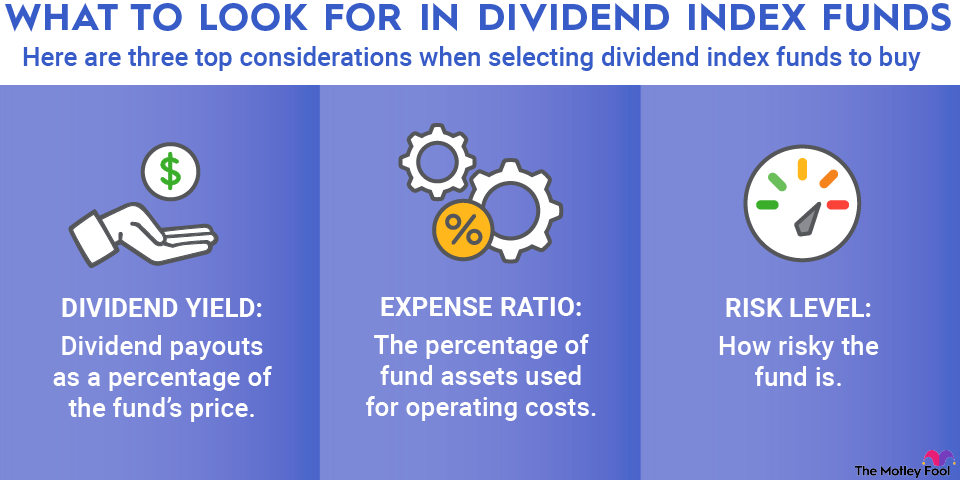
- Steady income: Dividend ETFs provide regular cash distributions, making them attractive for retirees and other investors seeking ongoing cash flow from their portfolios.
- Diversification: Instead of relying on a handful of dividend stocks, these ETFs spread investments across dozens or even hundreds of companies, reducing company-specific risk.
- Value exposure: Many high-dividend strategies naturally tilt toward value stocks because dividend yield rises as share prices become cheaper relative to the cash payout.
- Quality tilt: Dividend growth ETFs tend to favor companies with strong balance sheets, consistent earnings, and a history of increasing payouts, characteristics often associated with higher-quality businesses.
- Low-cost passive investing: Most dividend index ETFs charge modest expense ratios and provide a simple, hands-off way to build an income-focused equity portfolio.
However, there are risks to keep in mind as well, such as:
- Dividend cuts: Dividends are never guaranteed. Companies can reduce or eliminate their payouts during recessions, periods of financial stress, or industry downturns.
- Yield traps: The highest-yielding stocks are not always the best investments. An unusually high dividend yield can sometimes signal deteriorating business fundamentals rather than an attractive opportunity.
- Interest rate sensitivity: Rising interest rates can make bonds and other fixed-income investments more attractive, reducing demand for dividend-paying stocks and pressuring their valuations.
- Potential to lag growth stocks: Dividend ETFs may underperform during prolonged bull markets driven by fast-growing sectors such as technology, where companies often reinvest profits rather than pay dividends.
- Tax drag: Even qualified dividends create taxable income in brokerage accounts, which can reduce after-tax returns compared with strategies focused primarily on capital appreciation.
Methodology: How these dividend index funds were chosen
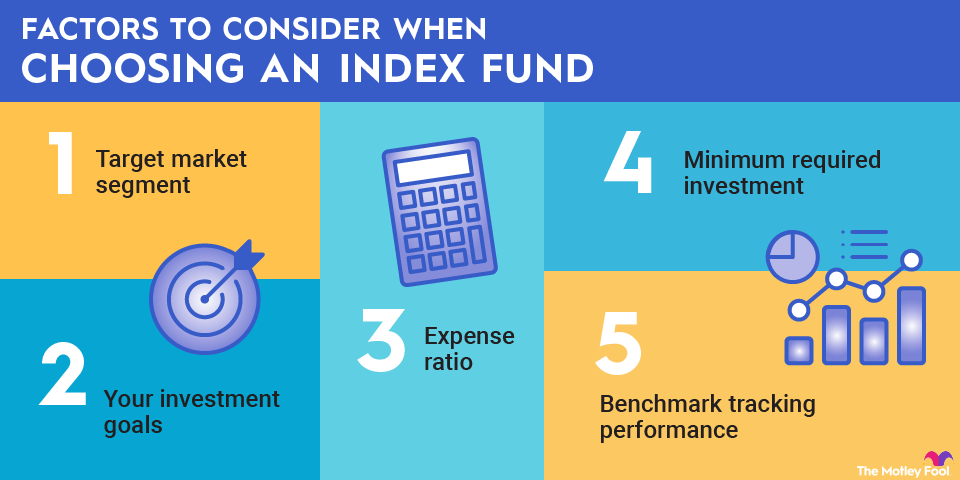
We prioritized dividend index funds with low expense ratios, substantial assets under management, strong trading liquidity, and long operating histories. Lower fees help preserve more of an investor's total return, while larger, established ETFs generally offer tighter bid-ask spreads and a lower risk of fund closure.
Beyond cost, the primary consideration was methodology. Rather than simply chasing the highest dividend yields, we favored ETFs that balance current income with dividend quality and long-term growth potential. That includes strategies emphasizing sustainable payout ratios, consistent dividend growth, strong profitability, and shareholder-friendly capital allocation. In our view, a sensible dividend strategy should seek to maximize total return, not just headline yield.
Finally, we considered tax efficiency. Passive index ETFs typically have low portfolio turnover, which can reduce taxable capital gains distributions. We also gave preference to funds whose portfolios primarily consist of qualified dividend-paying U.S. companies, making them more tax-efficient than many higher-yielding income strategies over the long run.
The bottom line on dividend index funds
The stock market can be volatile in the short term, so it's important to keep in mind that dividend index funds are meant to be held for the long run. The longer you hold your index funds, the better performance you're likely to see. Longer holding periods allow for more compounding, enabling your money to grow rapidly in later years.
Short-term market movements tend to be unreliable for successful investing. As we've seen this year, short-term market swings can be erratic both in direction and magnitude. Meanwhile, longer-term investment horizons have reliably trended upward, especially for dividend-paying blue chip stocks.
Finally, longer holding periods also make your portfolio more tax-efficient. If you keep your dividend index funds for longer than a designated holding period, you'll be eligible for qualified dividends, which are taxed at a lower capital gains rate.
If you do choose to allocate a portion of your portfolio to dividend index funds, know that short-term price movements are entirely normal. A long-term focus has historically been a preferable strategy.