Understanding data center REITs
A data center is a specially designed facility consisting of the building shell, electrical systems, heating, ventilation, and air conditioning (HVAC) mechanical systems, and other commercial space. Data centers feature highly secure and redundant equipment. They aim to provide customers with uninterrupted access to their data at any time.
Like most other real estate investment trusts (REITs), data center REITs rent space in their facilities to tenants. They typically rent space to multiple customers, as in co-location, but can rent the entire facility to one tenant. The tenants house their networking equipment and servers in the space, enabling them to process and store data.
In addition to renting space, data center REITs provide several other specialized services to their customers, including highly reliable power, a regulated temperature, and physical building security. Data center REITs also provide interconnection services to their clients, meaning a physical network connection between two parties.
Types of data center REITs
Currently, there aren't really "types" of data center REITs. According to Nareit, there are only two pure play data center REITs in operation, and they are structured very similarly. They provide data storage and equipment to power some of the world's largest companies, ensuring they have both the physical and data storage space they need to do business.
A third company is sometimes lumped into this group, but it largely focuses on storing and maintaining paper-based data, along with some data center functions.
Advantages of investing in data center REITs
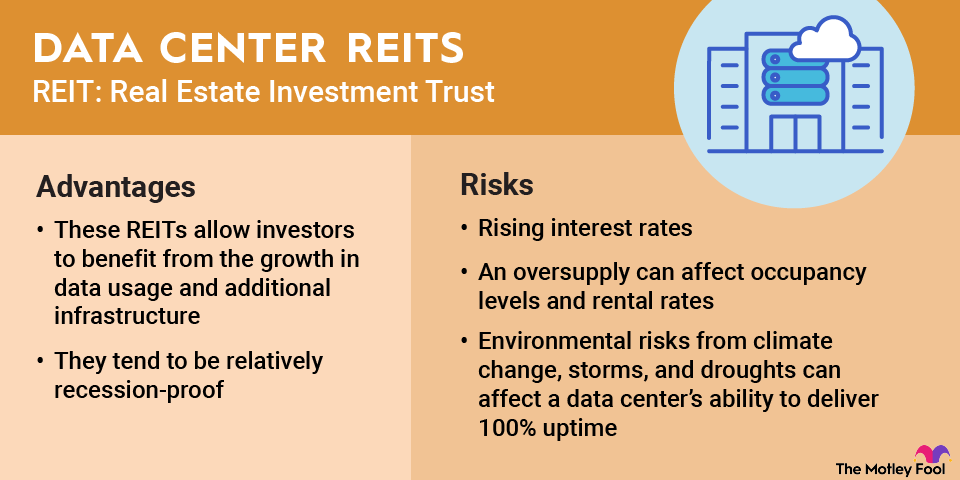
Data center REITs allow investors to benefit from the growth in data usage. With the rise of artificial intelligence (AI) and the immense computing power it requires, the need for server farms and large facilities capable of significant data processing will continue to grow. That should drive the need for additional infrastructure to transmit and store data, including more data center capacity.
Another benefit of data center REITs is that they tend to be relatively recession-proof because most tenants sign long-term contracts for space in a data center, allowing data center REITs to generate recurring revenue.
Risks of investing in data center REITs
Data center REITs are less risky than many other real estate investments and technology stocks. However, they aren't without risk. Here's a look at some of the factors that can affect these REITs.
- Interest rate risk: Rising interest rates affect all REITs because they tend to borrow heavily to expand. As rates rise, borrowing costs can increase. In addition, rising rates make lower-risk, yield-focused investments, such as bonds, more attractive. That often weighs on REITs to push up their dividend yields and compensate investors for their greater risk.
- Oversupply risk: Data center operators often build new capacity on speculation. If they build too many data centers, the surplus can affect occupancy levels and rental rates.
- Environmental risks: Data centers consume significant energy and water to keep servers and networking equipment running and cool. They face environmental risks from climate change, storms, and droughts that can affect their ability to deliver 100% uptime.
Data center REITs vs. data center ETFs
Data center REITs are companies that own and lease space on large servers within a data center, along with the bandwidth that's required for users to access those sites.
Data center ETFs, on the other hand, may include data center REITs but can also include other companies related to data centers, including those that service, build, or are otherwise less directly involved in the day-to-day running of a data center. ETFs are generally managed and adjusted as needed by the financial institution that manages the fund, so stocks can move in and out of the ETF over time.
Data-powered growth
Data center REITs have benefited from the explosive growth in data usage over the years. This secular trend has allowed these REITs to expand their portfolios, driving fast-paced revenue, earnings, and dividend growth. Those upward trends aren't showing any signs of stopping, given the current projections for data growth in the coming years. Consequently, investors should take a closer look at data center REITs.
Investing tips
As with any REIT investment, it's important to understand the company you're buying, what it does, and how it makes money in its industry. Just because there are only a few data center REITs doesn't mean you have to choose one if something feels off about their fundamentals.
Generally speaking, you want a company with healthy income, geographical diversification, and markets that can still be tapped. If its dividend continues to grow, this is also a great sign that its actual revenue is increasing, beyond just on paper.
The future of data center REITs
The future of any particular data center REIT depends on its business model and how well it manages debt and customer demand, but overall, the future of data center REITs is bright.
With the rise of AI and the growing demand for computing power that doesn't yet exist, data center REITs have significant room to grow and capture future market share. As the AI boom continues, the need for data centers will only continue to grow.
The flip side of that, of course, is that when or if the AI bubble pops, and some amount of demand disappears, data center REITs that haven't been managing their business well may suffer, or even fail. Even just the plateauing of demand for computing power will leave some data center REITs naturally behind.