You could own many stocks throughout your investing career, but it only takes a few, like Nvidia (NVDA +3.21%), to change your life. The semiconductor company specializing in graphics processing units (GPUs) has been one of the decade's best investments.
If you had the foresight (or luck) to invest $1,000 into the stock in 2013 and held on to those shares all these years, you would have $91,940 today (had you reinvested your dividends). You don't need to major in mathematics to figure out that's a good return on your money.
But while past performance was incredible, the burning question of the hour is what will the future look like? Nvidia's future looks bright, but investors should brace for some potential bumps along the way. Here is what you need to know.
Artificial intelligence -- the hype is real
You've probably seen the hype by now, but artificial intelligence (AI) is a legitimate leap forward for the global economy, much like the internet was. According to estimates by Insider Intelligence, AI could add as much as $15.7 trillion in value to the world's economy by 2030, and Nvidia is potentially well-positioned to capture AI's growth.

NASDAQ: NVDA
Key Data Points
Nvidia is the world's leader in discrete GPUs, chips designed to handle heavy computing workloads. Nvidia's chips were initially used for gaming, data centers, and cryptocurrency mining, but applications like autonomous driving and AI could drive a surge in demand for Nvidia's chips over the coming years.
Additionally, Nvidia has built a computing ecosystem that goes beyond its chips. It has created a cloud-deliverable computing resource, which could be considered computing-as-a-service. Companies can pay Nvidia for a piece of its computing power instead of spending a ton of money and time building their own. Nvidia's GPUs still have roughly 80% of the global discrete GPU market, making it a prime competitor to capture growth in AI through its GPUs and computing platform.
But short-term expectations are sky-high
Nvidia's significant growth opportunities have not gone unnoticed. Investors are piling into the stock, sending shares soaring 100% since January. The stock's price-to-earnings ratio (P/E) has surpassed 167, more than triple its average over the past decade.
You can think of a stock's valuation like a rubber band; the more it gets stretched one way or another, the more violently it could snap when something gives. While Nvidia could grow into such a lofty valuation over time, it also sets up the stock for potential volatility, as Wall Street expects perfection when paying such a high valuation.
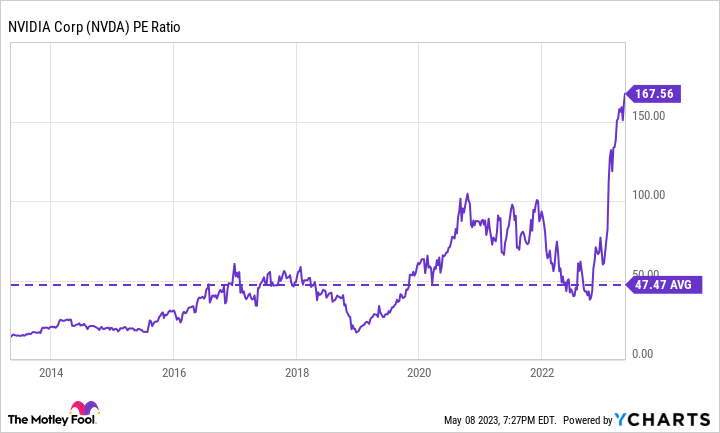
NVDA PE Ratio data by YCharts
Analysts believe the company could earn $6 per share in profits in 2025. If the stock reverted to its long-term average valuation between now and then, investors would see zero share price growth over the next two years.
A potential recession adds additional risk
Semiconductor companies are traditionally cyclical stocks, sensitive to the ups and downs in the economy. Warren Buffett recently hinted that he expects a recession later this year, which could cloud Nvidia's short-term prospects. Rival chip company Advanced Micro Devices recently issued soft guidance for later this year, a potential look at what might come for Nvidia.
Investors must decide whether Nvidia's long-term potential warrants the risk of what could happen in the short term. The stock's very high valuation leaves little room for error in the company's operating results, and little margin of safety for investors holding shares. A dollar-cost average strategy might be a smart way to ease into the stock slowly, avoiding jumping in all at once only to get hit with a massive share price haircut if things don't work out.
Proceed with caution -- no matter how you cut it, a stock as big as Nvidia doubling in a matter of months should be reason enough to pump the brakes and think before submitting that buy order.