Warren Buffett and Michael Burry are two of the most well-known forces in the capital markets.
For the last 60 years, Buffett has turned Berkshire Hathaway into one of the most successful, market-beating portfolios in modern history. Burry is no stranger to success in the stock market, either. The astute hedge fund manager was one of the first investors to bet against the housing market in 2008 -- which ultimately culminated in the Great Recession.
Last quarter, Burry and Buffett made some eyebrow-raising moves pertaining to the artificial intelligence (AI) revolution. While Buffett went long on Alphabet (GOOGL 0.80%) (GOOG 0.85%), Burry took a short position in both Palantir (PLTR 3.45%) and Nvidia (NVDA 0.29%).
This raises the question: Which investor -- Buffett or Burry -- got the AI trade right?
Let's break down the mechanics of their underlying positions and assess which investor made the better choice for the long term.
Image source: Nvidia.
Why is Burry bearish on AI?
According to the 13F filing for Burry's hedge fund, Scion Asset Management, the investor purchased put options on Nvidia and Palantir during the third quarter.
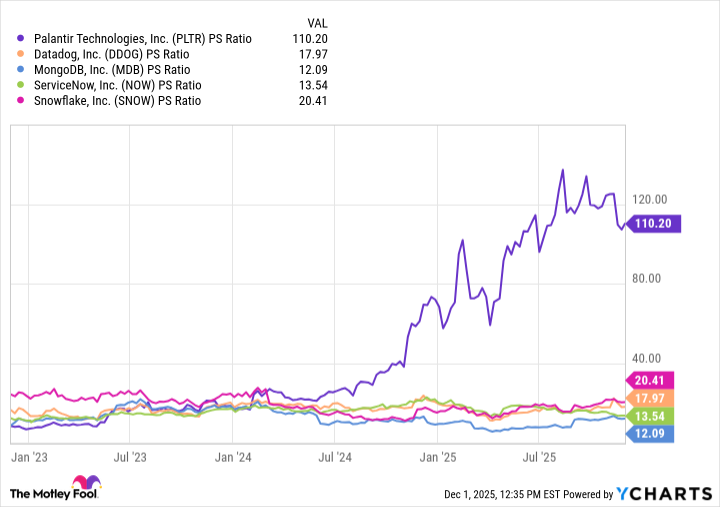
Many analysts on Wall Street have expressed concerns over Palantir's valuation. The company's price-to-sales (P/S) ratio of 110 is shockingly high -- even for a growth stock in the enterprise software industry. Some investors are drawing parallels between Palantir's soaring valuation and what was seen during the peak of the dot-com bubble. As history shows, many internet darlings were not able to sustain their frothy valuations.
PLTR PS Ratio data by YCharts
When it comes to big tech, Burry seems to have a problem with the accounting policies employed by the hyperscalers. Companies like Amazon, Microsoft, Alphabet, and Meta Platforms -- all of which are Nvidia's largest customers -- are depreciating their AI infrastructure over timelines longer than their actual useful life.

NASDAQ: NVDA
Key Data Points
Burry contests that since the average product life cycle for Nvidia's GPUs is only about 18 to 24 months, the semiconductor king is at the center of a deliberate accounting fraud exercise among AI's most influential developers.
After years of waiting, Buffett finally makes his AI debut
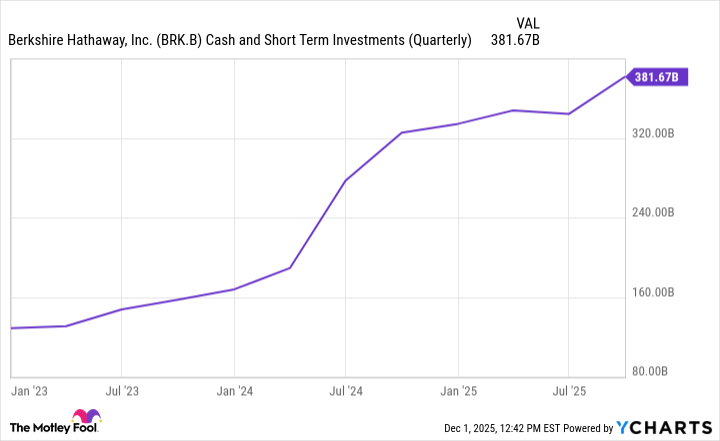
For the last three years, Berkshire has been stockpiling cash. While just about every other major investment fund was buying AI stocks like there was no tomorrow, Buffett sat on the sidelines and bought Treasuries. Moreover, the Oracle of Omaha was actually a net seller of stocks over the last year or so -- trimming major positions such as Apple and Bank of America.
BRK.B Cash and Short Term Investments (Quarterly) data by YCharts
Nevertheless, Berkshire's third-quarter 13F revealed a new position: Alphabet stock. Alphabet's modest valuation relative to other members of the "Magnificent Seven," in combination with the company's brand recognition, consistent profitability, and diversified ecosystem, were all likely major contributors to Buffett's decision to purchase the stock.

NASDAQ: GOOGL
Key Data Points
However, I think there is a deeper motivation at play here.
Buffett does not chase narratives or follow the crowd. In fact, he's a contrarian -- so he has a reputation for doing the opposite of what the crowd thinks.
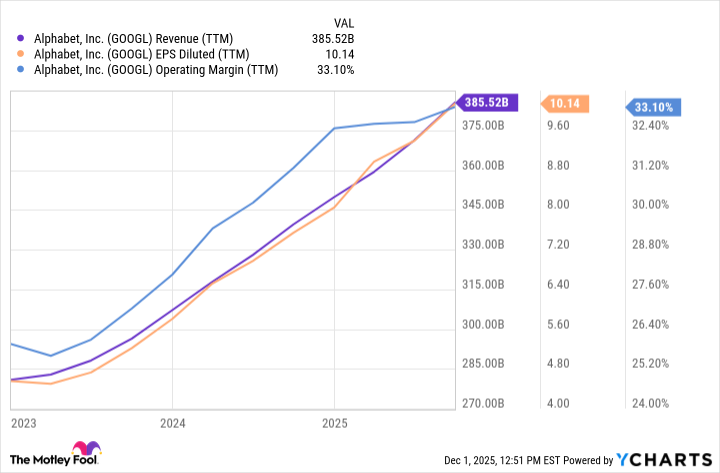
In my view, Buffett has spent the last three years monitoring the AI trade -- keenly watching which companies are making investments that actually yield new products, accelerate revenue, and generate earnings.
GOOGL Revenue (TTM) data by YCharts
Alphabet absolutely checks those boxes. The company has integrated AI into its internet platforms -- Google and YouTube -- and has brought new life to its cloud infrastructure business, giving Microsoft Azure and Amazon Web Services a run for their money.

Image source: Getty Images.
Buffett vs. Burry: Who is right?
Since Burry filed Scion's Q3 13F on Nov. 3, shares of Palantir and Nvidia have slid by 19% and 13%, respectively (as of Dec. 1).
While it's impossible to know the underlying details of which specific options chains Burry purchased, I have a hunch that he's done well since his short position was revealed a month ago. Although Burry may have profited in the short term, I think his bearish views are aligned with that of a day trader rather than a long-term investor.
The takeaway to understand here is that just because an investor makes money on a position doesn't necessarily mean they were right.
There are many principles within Buffett's investing playbook, but chief among them is to hold on to positions for the long term.
I think Buffett's decision to buy Alphabet stock now -- three years into the AI revolution -- carries a hidden meaning. In my eyes, the purchase could suggest that Buffett sees value in a rather frothy AI opportunity. The underlying message here is that Buffett could think that AI will remain resilient during various macroeconomic cycles -- making it a compelling long-term opportunity.
Against this backdrop, Buffett may have chosen Alphabet due to the company's proven durability and positioning to benefit from various secular tailwinds fueling the AI movement.
Ultimately, I think Buffett's long-term mindset and decision to choose an established AI leader will prove the more profitable investment decades from now.