Quantum computing is a technology poised to deliver transformative change to industries. As an example of its potential, computers developed by D-Wave Quantum (QBTS +0.38%) completed complex calculations in minutes that the company says would take nearly one million years with today's supercomputers.
IBM (IBM +2.59%) is also working on quantum computers, but its business priorities lie with artificial intelligence and cloud computing. Given this, can it compete with a pure-play quantum company such as D-Wave?
If so, the payoff could be high. The technology is still in its early stages, but the businesses that can overcome the shortcomings could be leaders in the emerging field. One of these challenges is to create processors capable of what's called "quantum advantage."
Quantum advantage is the point at which a quantum computer can solve real-world problems more accurately, cheaply, or efficiently than conventional computers. Let's compare D-Wave and IBM to see which is the better investment in this technology.

Image source: Getty Images.
A look at D-Wave
D-Wave offers annealing quantum computers. Using this specialized technique, the company announced this year that its quantum device outperformed a supercomputer in a demonstration.
According to CEO Alan Baratz, "Our achievement shows, without question, that D-Wave's annealing quantum computers are now capable of solving useful problems beyond the reach of the world's most powerful supercomputers."

NYSE: QBTS
Key Data Points
This achievement sounds impressive, but there's a catch. The quantum components performing calculations, called qubits, are difficult to control in the quantum annealing method. This limitation renders D-Wave's computers impractical for general computing, where algorithms must be executed exactly, but they excel at solving optimization problems involving lots of variables, such as optimizing vehicle routes for the logistics industry.
Due to the limited use cases for quantum annealing, the company is also working on the prevailing quantum gate technology. This method can precisely control qubits, and is therefore capable of reaching detailed and accurate results from a wide range of algorithms. This approach was adopted by IBM, but D-Wave claims to be the only company in the world to build devices using both annealing and gate-based methods.
However, D-Wave's primary focus has been on annealing quantum computers, and that has led to revenue of $21.8 million through the first three quarters of 2025, a vast improvement over the $6.5 million in 2024. That said, its operating expenses are also growing, reaching $84.1 million through the first nine months of 2025 compared to $61.1 million in 2024, resulting in an operating loss of $65.5 million.
IBM's quantum progress
IBM has developed many technologies throughout its long history, so it's no surprise that quantum computing is part of its portfolio. The company has made great strides in this field: It was the first to make quantum devices available via the cloud in 2016, and claims its Qiskit quantum software is the most widely used in the world.
On Nov. 12, IBM made a number of impressive announcements in this area that sent its stock soaring to an all-time high of $324.90. Among the news, Big Blue unveiled its new Nighthawk quantum processor, which the company believes will allow it to reach quantum advantage by the end of 2026.

NYSE: IBM
Key Data Points
And management predicts it will have a fault-tolerant quantum computer by 2029. Today, quantum machines are prone to calculation errors that prevent their widespread use. A fault-tolerant quantum device is one that can correctly complete calculations, overcoming a major hurdle to adoption. D-Wave has not announced when it can produce a fault-tolerant device.
These new developments position IBM to surpass D-Wave in the quantum space. Moreover, its financials are excellent. Big Blue isn't seeing the kind of revenue growth D-Wave is experiencing, but sales are increasing. Through the first three quarters in 2025, revenue rose 6% year over year to $47.8 billion. It's also profitable, delivering net income of $5 billion during that period. IBM also pays a dividend with a yield of over 2%.
Choosing between D-Wave and IBM
In weighing whether to invest in D-Wave or IBM for exposure to the growing field of quantum computing, technological superiority is certainly a key consideration. But with IBM recently reaching a 52-week high, another factor to consider is share price valuation.
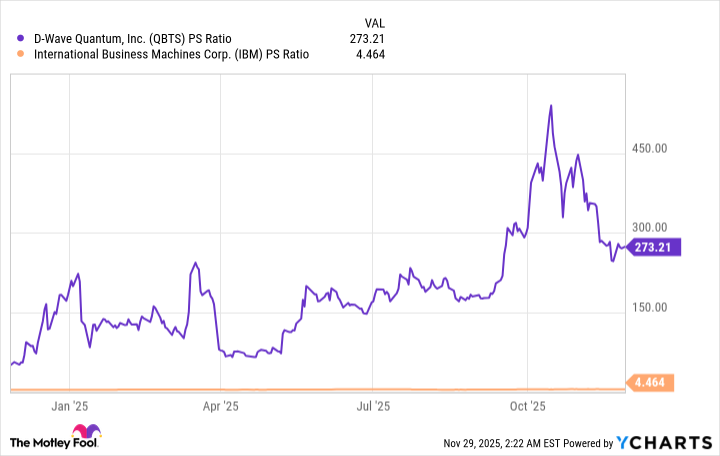
You can measure this factor with the price-to-sales ratio (P/S), which indicates how much investors are paying for each dollar of revenue generated over the past 12 months.
Data by YCharts.
The chart shows D-Wave's P/S multiple has dropped from a peak reached in October, but remains well above where it's been over the past year, and is substantially higher than IBM's. This suggests D-Wave's stock valuation is high.
Consequently, IBM is the better value. Combined with its Nighthawk processor moving the company toward quantum advantage next year, then a fault-tolerant device in 2029, IBM looks like the superior quantum computing investment over D-Wave for the long haul.