Electric vehicle (EV) sales in China remain robust. Over 1.1 million fully electric vehicles were sold there in October alone. Nio (NIO +5.86%) has been taking a bigger piece of that pie this year, too.
Investors might wonder, then, why Nio stock tumbled 24.1% in November, according to data provided by S&P Global Market Intelligence. Here's a look at what investors might like, as well as some concerns, surrounding Nio shares.

Image source: Nio.
What's going right at Nio
Last year, Nio added two new brands to its lineup. Initially focusing mostly on higher-end, luxury models, Nio added the mass-market brand Onvo and its new premium compact brand, Firefly, last year. Firefly shipments began in the spring of 2025.
The company wanted to expand its addressable market with these new brands. Higher sales volumes would help the company lower unit costs and approach profitability. That plan has been working. October was the company's first month with over 40,000 vehicles delivered. Nio followed that up with its second-biggest shipment month ever in November.
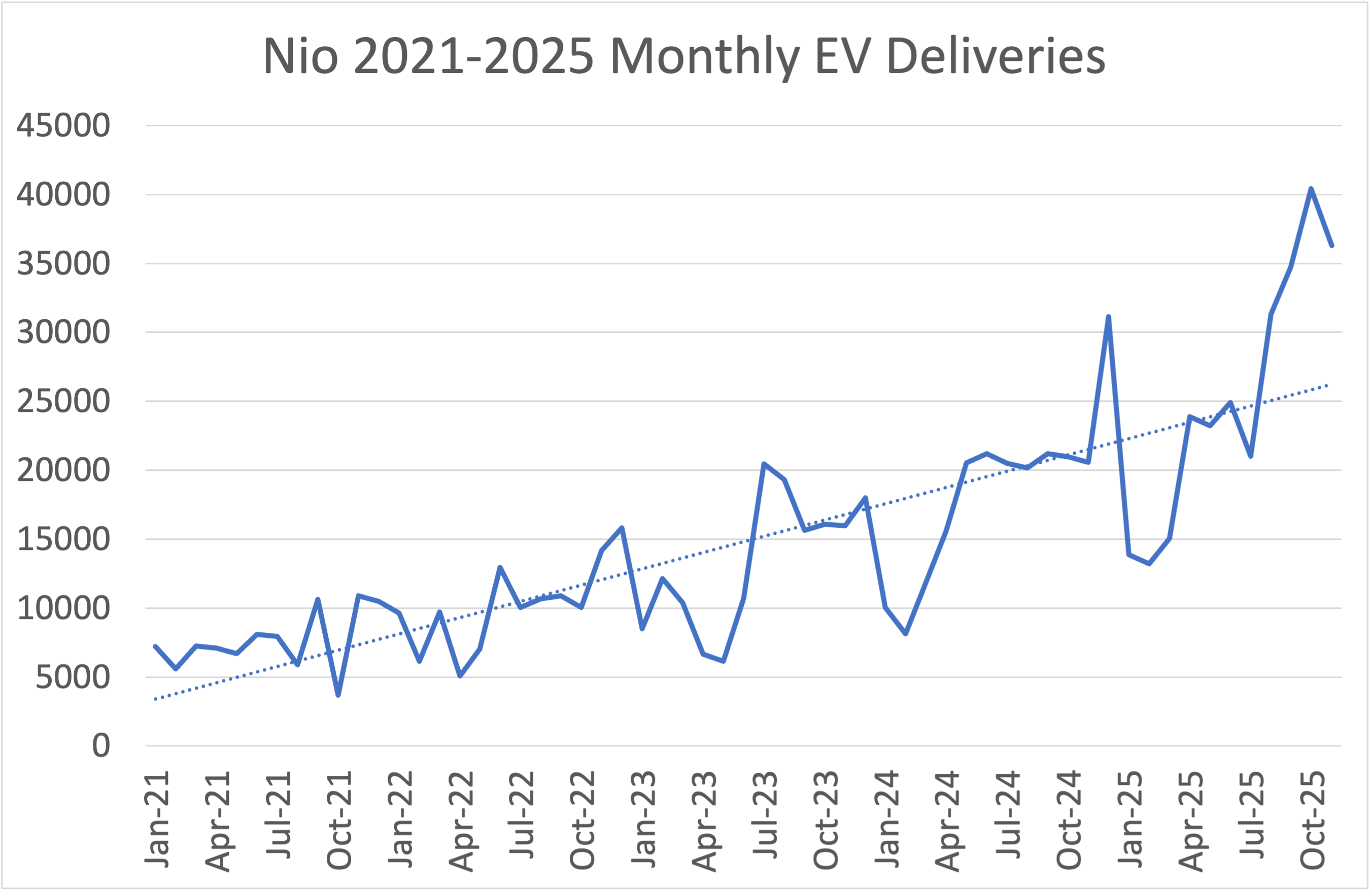
Data source: Nio. Chart by author.
Year-to-date deliveries through November are up 45.6% versus last year. Those higher shipment volumes helped Nio improve gross margin to 13.9% in the third quarter. That compares to just 10.7% in the year-ago period and 10% in the second quarter.
Investors are still concerned
Nio stock crashed in November, though. That may be due to what investors see coming. China's government has been supportive of the EV industry for years. However, a 10% EV purchase tax exemption is being reduced by half starting in 2026. Some analysts think that will contribute to lower overall vehicle sales.
Additionally, competition is fierce in China. Chinese multinational corporation Xiaomi was a relative latecomer to the domestic EV market. Yet deliveries are accelerating quickly. Xiaomi has thus far delivered 500,000 vehicles, less than two years after its first shipment. Following November's deliveries, which exceeded 40,000 units, the company had already surpassed its annual delivery goal of 350,000 units.

NYSE: NIO
Key Data Points
Is Nio a buy now?
The answer to that question is complicated. There are plenty of risks involved. The previously mentioned competition is just one factor among many. The Chinese EV market may not be as robust as it has been in recent years as government support wanes. Nio has never generated a profit, and the company felt the need to raise fresh capital as recently as September.
That has helped bolster its cash position, though. As of Sept. 30, Nio had about $5 billion in cash and equivalents. It also generated positive operating cash flows for the third quarter. Buying Nio stock means believing the world's largest EV market will continue to drive demand.
Last month, many investors might have just put Nio in the "too hard" pile. That's understandable. Investors wanting to participate in what could continue to be a high-growth market should just be sure to allocate an amount that fits one's risk profile.