It sounds wild, of course: Tesla (TSLA +4.00%), the trillion-plus-dollar car company, unprofitable?!
But numbers don't lie, and the numbers show that a net loss in Q4 is a very real possibility. Here's why I think Tesla CEO Elon Musk is going to be forced to admit to the world that Tesla is already losing money.

Image source: Tesla.
Auto sales are declining
In both Q1 and Q2 of 2025, Tesla's quarterly revenue from its automotive division declined year over year. It's also the first time Tesla has posted two consecutive quarters of revenue declines since 2012. True, Tesla also reported record Q3 automotive revenue of $21.2 billion, but that quarter's sales were artificially boosted by the Sept. 30 expiration of the $7,500 U.S. federal electric vehicle tax credit, which provided a strong incentive to buy a Tesla in Q3.
Other automakers that experienced similar Q3 surges in electric vehicle (EV) sales have now released their monthly EV sales figures from November. As expected, they're terrible: Ford Motor Company's November EV sales fell by 60.8% year over year, Hyundai's were down 58.8%, Kia's dropped 62%, and Honda's plunged a jaw-dropping 88.6%.
Even if Tesla's vehicle sales somehow outperform this industrywide trend and fall by "only" 50% year over year in Q4 2025, from 495,570 to 247,785, its Q4 2025 automotive revenue would fall to about $9.9 billion. The company's other business units -- energy generation/storage and services -- might pick up some of the slack if they continue growing revenue at their strong Q3 year-over-year rates of 44% and 25% (respectively). But that still only translates to total Q4 revenue for Tesla of about $17.9 billion, a 10% decline.
Less money per car
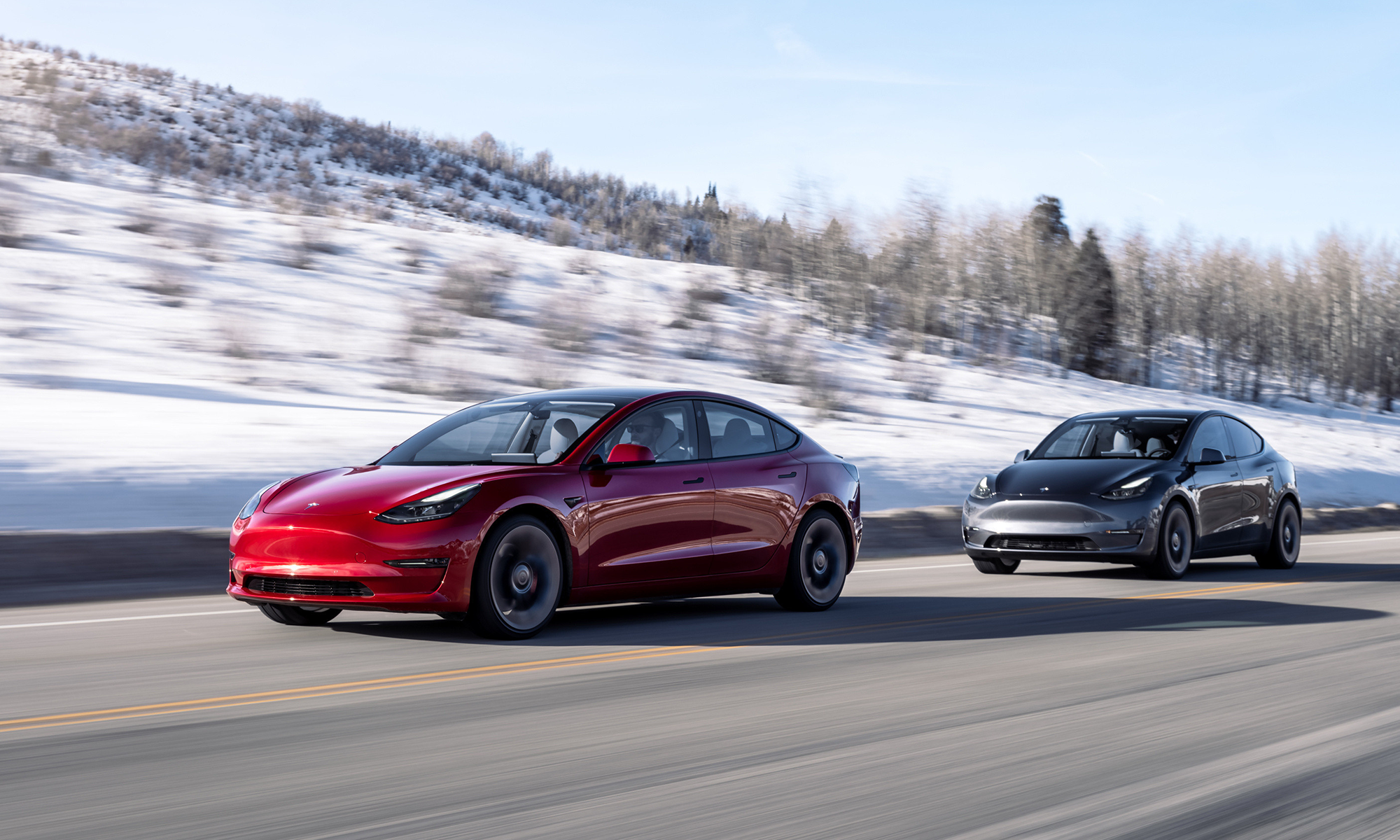
To partially make up for the expired $7,500 EV tax credit, Tesla has introduced cheaper "Standard" versions of its Model 3 sedan and Model Y crossover SUV. These stripped-down models cost about $5,000 less than their counterparts, but lack some key features, including Autopilot and Full Self-Driving.
If all of the Model 3s and Ys that Tesla sells moving forward were the new Standard versions, the $5,000 price difference alone would shave more than $1 billion off the company's revenue next quarter. Let's be generous, though, and estimate that only half of them will be the Standard versions. Let's also say that besides the lower selling price, they'll have no further impact on the company's overall automotive margins. Under this scenario, Tesla's Q4 revenue still drops another $600 million and totals $17.3 billion.
In addition, Tesla has been experiencing margin compression for years. In Q1 2022, its gross margin peaked at 29.1%, but it's been steadily declining since. In Q3, Tesla's gross margin was 18%, the highest it's been in more than a year.
If Tesla's sequential quarterly margin decline trajectory doesn't change, its Q4 gross margin would be 17.2%. Coincidentally, that's also what its gross margin was in Q2, up from just 16.3% in Q1 and Q4 2024. If we apply a 17.2% gross margin to our Q4 revenue estimate of $17.3 billion, the company's Q4 gross profit would be just shy of $3 billion.

NASDAQ: TSLA
Key Data Points
Higher expenses
That $3 billion gross profit estimate doesn't include expenses.
In Q3, the company stated that one of the primary factors in its 40% year-over-year operating income decline was an "increase in operating expenses, driven by SG&A, AI and other R&D projects." Those "increased" operating expenses totaled $3.4 billion in Q3.
It seems unlikely, given Musk's new focus on robotics and automation, that the company's operating expenses will go down in Q4. I'd expect them to rise substantially instead. However, even if they remain flat from Q3 at $3.4 billion, that's still more than even an optimistic $3 billion Q4 gross profit estimate. This would translate to a quarterly operating loss of $400 million in Q4, and likely an even higher net loss after non-operating expenses like taxes and interest are factored in.
An optimistic scenario
In other words, Tesla already looks unprofitable even if:
- Its EV sales decline in Q4 is lower than its industry peers.
- Its non-automotive revenue continues to grow at a high year-over-year rate.
- The cheaper Standard versions of its Model 3 and Y make up only 50% of its Q4 Model 3 and Y sales.
- Those Standard versions have no impact on the company's gross margins.
- Overall gross margins decline only modestly, rather than reverting to their lower Q1 levels.
- And the company's operating expenses, including R&D expenses, don't substantially increase.
If any of these optimistic assumptions turn out to be wrong -- say, if Tesla's EV sales decline is in line with other automakers, or if its R&D spending skyrockets -- that net loss could be much, much higher.
Of course, maybe Tesla will surprise us with only a 25% year-over-year sales decline, or a surge in non-automotive revenue, or some other unexpected situation that keeps the company in the black for the quarter. I'm predicting that Elon Musk will have to come clean during Tesla's Q4 earnings call and let shareholders know the company is already operating at a loss, though.
Even if I'm wrong, Tesla stockholders would be wise to prepare themselves for that possibility.