The U.S. stock market is having a fantastic 2025 despite the economic uncertainty created by the Trump administration's tax and trade policies. The benchmark S&P 500 (^GSPC 0.51%) added 16% year to date, nearly double the historical average.
However, the Federal Reserve has recently sent investors a "silent warning" about the economy, and elevated valuations across the stock market have sparked concerns about an artificial intelligence (AI) bubble. Against that backdrop, history suggests the stock market will decline (possibly sharply) in 2026.
Here's what investors should know.
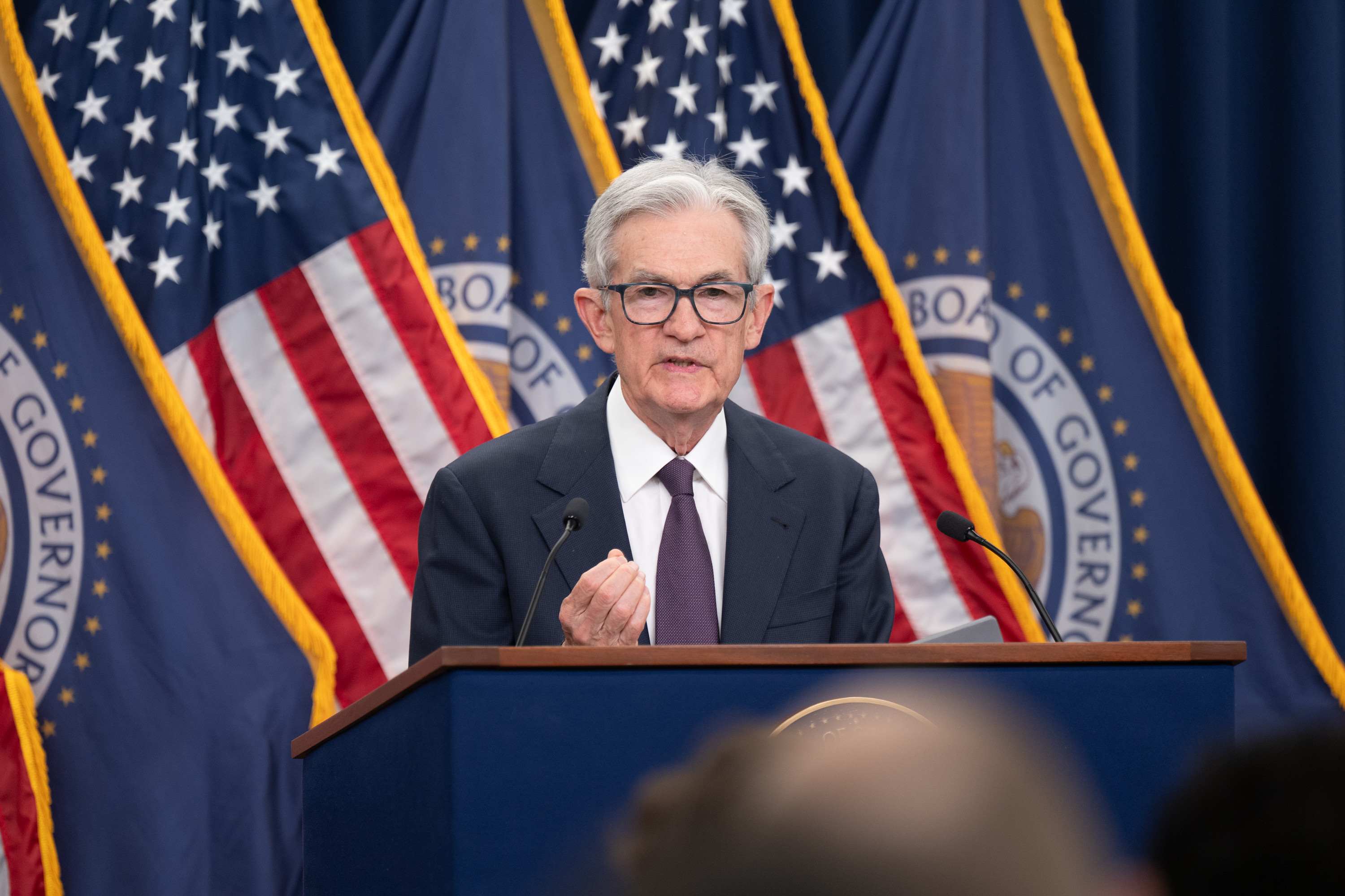
Image source: Official Federal Reserve Photo. Chairman Jerome Powell answers reporters' questions at an FOMC conference.
Federal Reserve policymakers are unusually divided
Something strange happened when the Federal Open Market Committee (FOMC) met in December. While policymakers cut interest rates by 25 basis points, as expected, they were notably divided about the decision. Three FOMC members dissented, and they did so in opposite directions.
- Chicago Fed President Austan Goolsbee and Kansas City Fed President Jeffrey Schmid wanted to hold interest rates steady; Schmid has now dissented in favor of no rate cut at two consecutive meetings.
- Governor Stephen Miran wanted to cut interest rates by 50 basis points; Miran has now dissented in favor of a larger rate cut at three consecutive meetings.
Dissents are uncommon. No FOMC members dissented during the 19-year period from October 2005 to November 2024. Three dissents at the same meeting are unprecedented in recent history. It last happened in June 1988, according to Torsten Slok, chief economist at Apollo Global Management.
Multiple dissents are theoretically bad news for the stock market. If experts are divided on the appropriate monetary policy, it suggests that economic conditions are difficult to interpret, and the stock market dislikes uncertainty.
In this case, President Donald Trump's tariffs are the root cause of the division within the Federal Reserve. The combined baseline and reciprocal tariffs have raised the average tax on U.S. imports to its highest level since the 1930s, meaning there is essentially no historical data (at least not recent data) to guide policymakers.
Tariffs have coincided with higher inflation and unemployment, putting Fed officials in a difficult position. Inflation will worsen if interest rates are too low, but unemployment will worsen if interest rates are too high. In short, policymakers cannot address both problems simultaneously.
Typically, inflation slows as unemployment rises (and vice versa), but Trump's tariffs have distorted the economy. The fact that three policymakers dissented at the last FOMC meeting is a "silent warning" because it underscores the uncertainty created by that economic distortion.
The stock market's valuation is abnormally elevated
Readers may be wondering: How did the stock market perform the last time three FOMC members dissented at the same meeting? Quite well. The S&P 500 advanced 16% during the next year. However, that incident differed in one very important aspect: stocks were priced more reasonably in 1988.
Indeed, while the Federal Reserve does not take an official stance about the correct value for any financial asset, Fed Chairman Jerome Powell said in September. "By many measures... equity prices are fairly highly valued." And valuations have only trended higher since he made that comment.
The S&P 500 had a cyclically adjusted price-to-earnings (CAPE) ratio of 39.2 in November, a reading so high that it was last seen during the dot-com bubble in late 2000. In fact, there have only been 25 incidents when the index recorded a monthly CAPE ratio above 39 since it was created in 1957 (i.e., about 3% of the time), and it has typically performed poorly during the next year.
The table shows the S&P 500's average return (as well as its best and worst returns) during the 12-month period, following a monthly CAPE reading above 39.
|
S&P 500's Average Return |
S&P 500's Best Return |
S&P 500's Worst Return |
|---|---|---|
|
(4%) |
16% |
(28%) |
Data source: Robert Shiller.
Following past incidents when the S&P 500's monthly CAPE ratio exceeded 39, the index has returned as much as 16% and declined as much as 28% during the next year. But the index declined by an average of 4% under those conditions.
To summarize, history says the S&P 500 could soar or crash next year, but the most likely outcome is a modest decline. Of course, past performance should never be viewed as a guarantee of future results, but 2026 is shaping up to be more challenging than 2025. Investors should prepare themselves for that outcome.