The recent decline in Advanced Micro Devices (AMD +7.33%) stock may leave investors scratching their heads. Its advancements in the artificial intelligence (AI) chip market have stoked optimism. Its announcements at the CES trade show last week also should have bolstered the bull case for its stock.
Instead, the stock price has pulled back by around 9% over the course of the week. Does this mean bullish investors should change their outlook on AMD? Let's take a closer look.

Image source: Getty Images.
What happened to AMD stock?
Despite the recent drop, AMD stock has risen in recent months. One major catalyst is the upcoming release of the MI450, which could potentially challenge Nvidia's dominance in this market. Hence, it would seem to make sense that the announcement of the MI500, which comes out in 2027, would have built on that.
Instead, the stock pulled back, and it is unclear why, though AMD could have failed to meet expectations. The company's historical focus on PCs and gaming makes it more of a consumer-oriented company than Nvidia. Conversely, the AI industry tends to focus directly on data centers, which are not the direct consumer products one might hear about at CES, a consumer-focused trade show.
Also, Nvidia stock fell over the same period, albeit to a smaller degree. Thus, the selling could be a case of "selling the news," which happens frequently over short-term time frames.
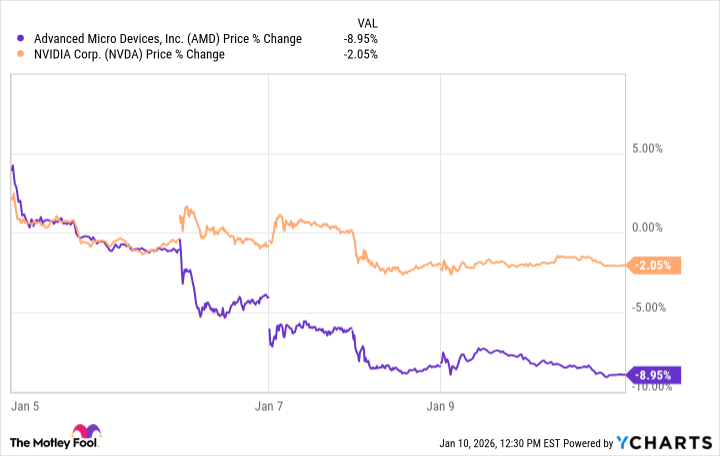
Data by YCharts.
Why AMD's stock price growth will likely resume
Nonetheless, this news should not change the long-term bull thesis on AMD stock.
Despite how investors may feel right now, CEO Lisa Su expects AI to grow to around 5 billion daily active users. Su also speculated that compute has to increase by 100-fold to meet this demand.
Right now, the world is in the middle of a compute shortage, delaying product launches across the industry. Such conditions indicate that the bull market in AI chips, including those designed by AMD, is on track to continue.
Unsurprisingly, this optimism also led AMD to forecast a 35% compound annual growth rate (CAGR) for its revenue over the next three to five years. This includes a revenue CAGR of more than 60% for its data center business.

NASDAQ: AMD
Key Data Points
Although lower profits in past quarters led to a price-to-earnings (P/E) ratio of 100 for AMD, the forward P/E of 31 implies that massive profit growth is forthcoming.
Investors should also remember that the S&P 500 average P/E ratio is 31. Assuming the current business conditions stay in place for the foreseeable future, the forward P/E likely means AMD is an inexpensive stock. That makes it more likely that the sell-off in AMD stock is temporary as more investors take notice of its increasingly inexpensive valuation.