The new year is still young, but one of the biggest stories in the stock market so far has been the breakout performance of the Russell 2000, the small-cap index. In fact, the Russell 2000 beat the S&P 500 (^GSPC 1.52%) in each of the first 14 trading days of the year, a streak that snapped on Jan. 23 when the Russell 2000 fell by nearly 2%.
Still, the small-cap index has built a sizable edge over its large-cap peer over the first three weeks of the year as the chart below shows.
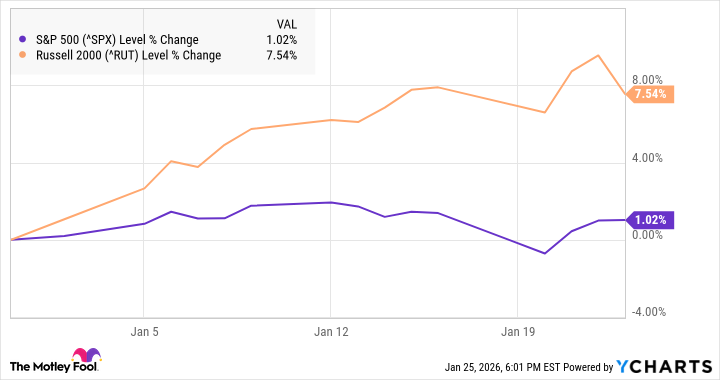
The S&P 500 has outperformed the Russell 2000 over each of the last five years, and dominated it through the AI boom of the last three years. However, after a strong start, the Russell 2000 looks poised to finally beat the S&P 500 this year. Here are two reasons why.

Image source: Getty Images.
The valuation gap has gotten too big
After jumping more than 75% over the last three years, the S&P 500 is nearly as expensive as it's ever been. It's trading at a price-to-earnings ratio of 28, according to ETFs that track the S&P 500, and concerns about an AI bubble, high concentration among "Magnificent Seven" stocks, which now make up roughly a third of the index, and expectations for the bull market to broaden all favor alternatives like small-caps.
The biggest Russell 2000 ETF, the iShares Russell 2000 ETF (IWM 2.15%), now trades at a price-to-earnings ratio of 19.5, a discount of roughly a third versus the S&P 500. In other words, the Russell 2000 would have to increase by about 50% to have the same valuation as the S&P 500.
That should help encourage a rotation out of large-cap stocks and into small-cap ones.
Interest rates could continue to come down
Small-cap stocks are more sensitive to macroeconomic factors, in particular interest rates. In fact, the Russell 2000 has jumped 17% over the last six months as the Federal Reserve cut rates three times at the end of the year, lowering the benchmark Fed funds rate by 75 basis points.
This year, the Federal Reserve is currently forecasting just one additional rate cut, but there's a good chance that we could see more than that, given that the job growth has been nearly flat for the last eight months and the Fed will get a new chairman in May, and President Trump has pressuring the central bank to lower rates so he may appoint someone who's more amenable to rate cuts.
Further rate cuts, especially when the market isn't expecting them, are likely to favor small-cap stocks.

NYSEMKT: IWM
Key Data Points
How to capitalize on a small-cap rotation
The easiest way to get exposure to small-cap stocks is through an ETF that tracks the Russell 2000. The iShares Russell 2000 ETF (IWM) is by far the biggest with net assets of roughly $75 billion. You can also buy a more-focused small-cap ETF like the Vanguard Russell 2000 Growth ETF (VTWG 2.59%) or the Vanguard Russell 2000 Value ETF (VTWV 1.70%) if you'd prefer to have exposure to growth or value stocks.
There are options if you're looking for individual small-cap stocks. One software stock that could break out in 2026 is Amplitude (AMPL 3.14%), a maker of digital product analytics software that introduced a range of AI agents last year that should drive accelerated growth in 2026.
Another option is Innodata (INOD 4.84%), a specialist in data-labeling, which is a key step in making it easier for AI to process data. Innodata has delivered strong growth and is profitable.
While the streak of outperformance by the Russell 2000 from the beginning of the year isn't likely to repeat itself, small-caps look well-position for a breakout year. Between ETFs and individual stocks, there are plenty of ways to take advantage of the expected rotation.