Investors who didn't own artificial intelligence (AI) stocks last year probably underperformed the broader market because they would have missed out on significant contributions from high-flying stocks like Nvidia, Alphabet, and Palantir Technologies, which soared between 39% and 135%.
However, there's a simple way to rectify that in 2026. The Roundhill Generative AI and Technology ETF (CHAT +0.05%) is an exchange-traded fund (ETF) that exclusively invests in AI stocks, so it could be a great addition to a diversified portfolio that doesn't already have exposure to this high-growth industry.
A single share in the ETF trades for under $70, so it's very accessible, even for investors with smaller portfolios. Read on.

Image source: Getty Images.
A simple way to buy the world's top AI stocks
The Roundhill Generative AI and Technology ETF targets companies that are developing the infrastructure, software, and platforms powering the AI revolution. It holds just 49 stocks, and its five largest holdings alone represent 26.9% of the total value of its portfolio. However, in my opinion, they are five of the AI industry's must-own names:
|
Stock |
Roundhill ETF Portfolio Weighting |
|---|---|
|
1. Alphabet |
6.75% |
|
2. Nvidia |
6.66% |
|
3. Microsoft |
5.29% |
|
4. Amazon |
4.38% |
|
5. Meta Platforms |
3.80% |
Data source: Roundhill Investments. Portfolio weightings are accurate as of Jan. 25, 2026, and are subject to change.
Nvidia supplies the world's most powerful data center chips for processing AI workloads, so it's central to this technological revolution. Alphabet, Microsoft, and Amazon buy those chips and rent the computing capacity to developers who use it to create AI software. Without these providers, the average business wouldn't have access to AI because the sheer cost of building data center infrastructure is prohibitive.
But I want to shine the spotlight on a few other stocks that sit outside the Roundhill ETF's top-five holdings. Believe it or not, the following four names delivered an eye-popping average return of 123% last year, and I think they are poised for even further upside:
- Advanced Micro Devices has become one of Nvidia's top competitors in the market for data center chips. It will launch its most powerful AI hardware ever this year, with OpenAI among the first companies to take delivery.
- Palantir Technologies developed a portfolio of software platforms that use AI to help organizations extract value from their internal data, so they can make faster and better-informed decisions.
- Micron Technology supplies industry-leading, high-bandwidth memory for data centers, which stores information in a ready state for AI chips to draw upon when required. This maximizes processing speeds in AI workloads, which is why Nvidia and AMD are two of Micron's biggest customers.
- Snowflake created a platform called Cortex AI where businesses can access a suite of tools to help them collect, process, and analyze internal data, and then use it to train AI software.
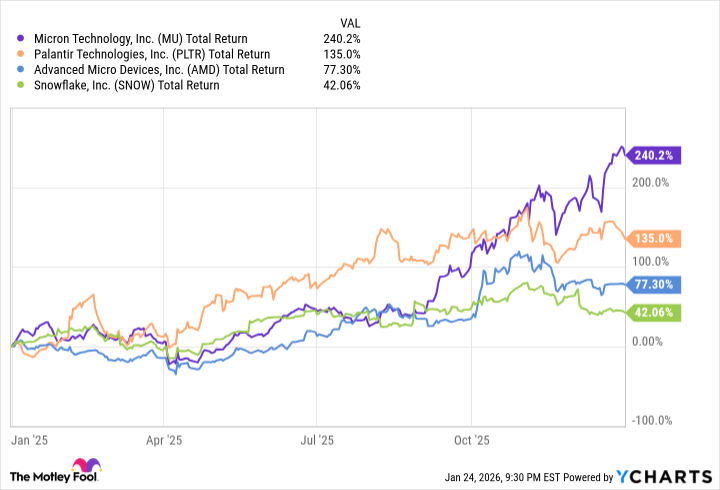
Data by YCharts.
The Roundhill ETF crushed the S&P 500 last year
The Roundhill ETF produced a return of 45.7% last year, tripling the return of the S&P 500 index, which climbed by 16.4%. However, that certainly doesn't mean investors should put all of their eggs in one basket, because any serious hiccup in the AI industry could trigger a sharp correction in this ETF. That might not be a concern in the short term with trillions of dollars in infrastructure spending in the pipeline, but risk management is a key part of investing.

NYSEMKT: CHAT
Key Data Points
Instead, the Roundhill ETF is ideal for a diversified portfolio that has little or no exposure to the AI space already. It gives investors a simple way to own a slice of every segment of this booming industry, without having to pick individual stocks.
Finally, cost is another thing to keep in mind. The ETF is actively managed, which means a team of Roundhill's investment experts will regularly adjust its portfolio based on what they believe will deliver the best returns. This costs money, which is why the fund has an expense ratio of 0.75%, meaning an investment of $10,000 will incur an annual fee of $75.
That doesn't sound like much at face value, but it's 25 times more expensive than the passively managed Vanguard S&P 500 ETF, which would incur an annual fee of just $3 on the same investment.
In summary, the Roundhill ETF can supercharge a diversified portfolio as long as the AI boom rolls on, but investors should be mindful of position sizing in case this emerging industry hits a speed bump.