For many people, "I invest in dividend stocks" doesn't have the same ring to it as investing in "the next big thing." But the former can often be just as lucrative, if not more so. Even relatively small dividends compound and add up over the years.
There's also a peace that comes with knowing that you'll be rewarded for holding a stock regardless of how its price moves. That's why you shouldn't just go searching for high yields; you should invest in companies built to maintain their dividend for the long haul. That's how you truly get the most value from your dividend stocks.
If you're looking to add dividend stocks to your portfolio, each of the following three options is a go-to you can confidently hold for the next 20 years.
Image source: Getty Images.
1. Chevron
Chevron (CVX +0.93%) is the second-largest U.S. oil company, operating across three main segments of the value chain: upstream, midstream, and downstream. Upstream involves exploration and extraction; midstream involves transportation, processing, and storing; and downstream involves refining products and selling them to consumers.
Having a hand in all three segments helps Chevron weather segment-specific downturns, price swings, and disruptions caused by geopolitical events. It's not foolproof, but it's better than relying on one part of the oil business in many cases.

NYSE: CVX
Key Data Points
Over the past decade, Chevron has averaged a dividend yield of around 4.2%, more than 2.5 times the S&P 500 average in that span. It provides high income and stability, with 38 consecutive years of annual payout increases.
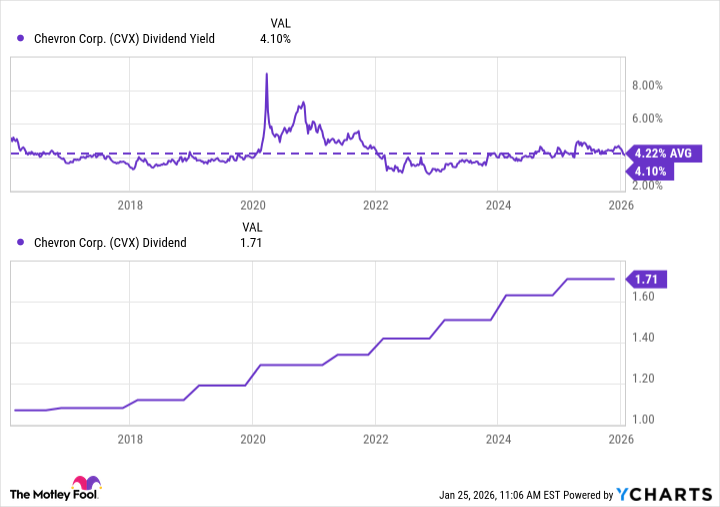
CVX Dividend Yield, data by YCharts.
The oil industry can be cyclical, but you don't have to worry about Chevron's dividend at any point. Its finances comfortably support the dividend, and it has said it's committed to running a more efficient operation. This includes prioritizing profits over expansion and aiming to maximize shareholder returns.
If you're investing for the long haul, you usually can't go wrong with a cash-flow-heavy business with financial discipline.
2. Procter & Gamble
Even if the name Procter & Gamble (PG 0.68%) does not ring a bell for anyone, the products that it owns probably will. In its portfolio, it has notable brands like Tide, Pampers, Old Spice, Febreze, Crest, and dozens of others.

NYSE: PG
Key Data Points
P&G is a poster child for defensive and recession-proof stocks because it owns products that sell no matter what. If it's a recession and money is tight, people will cut back on a lot of things before they stop buying laundry detergent, disposable diapers, and toothpaste.
You won't get explosive earnings or stock growth from P&G, but you'll get dependability, both with its finances and dividend. It's a Dividend King, a company with at least 50 consecutive years of payout increases. In fact, it has 69 consecutive years under its belt. There are only five companies on the U.S. stock market with a longer streak.
Procter & Gamble might be a "boring" stock, but those are often the ones you feel comfortable holding for decades. Flashy isn't always sustainable.
3. Johnson & Johnson
Johnson & Johnson (JNJ +1.33%) is one of the largest healthcare companies in the world, but its business looks much different now than it did just two and a half years ago. In August 2023, it spun off its consumer division (which included products such as Tylenol and Band-Aids) and focused on pharmaceuticals and medical devices.

NYSE: JNJ
Key Data Points
Even with the restructuring, it has hardly missed a beat. Revenue dropped in 2023 because of the spinoff, but it has been a good two years since then. Revenue was $94.2 billion in 2025, up 6% from 2024 and 17% since 2023. It's modest growth, but that's all you can ask for in a company as mature and big as Johnson & Johnson.
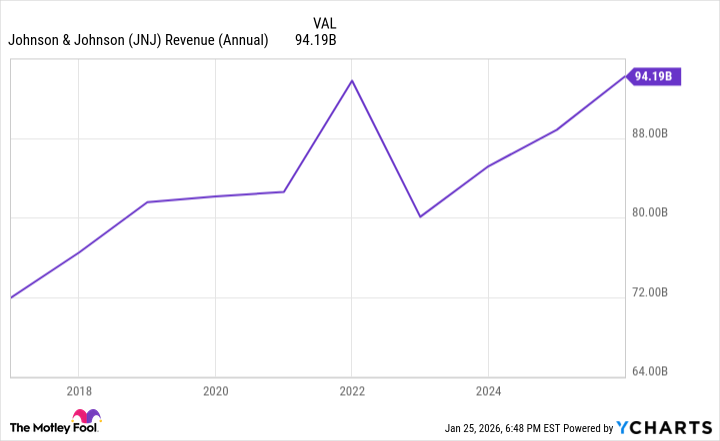
JNJ Revenue (Annual) data by YCharts.
Similar to P&G, Johnson & Johnson has necessity working in its favor, except it's not hygiene or cleaning products, it's healthcare. Chronic diseases and age-related conditions are here to stay. They're unfortunate, but they're also responsible for the company's longevity.
The healthcare landscape will look different 20 years from now, but you can bet Johnson & Johnson will have its hand in it. You can also bet that its dividend will still be going strong. It's currently on its 63rd consecutive year of annual increases.