Buying and holding a top artificial intelligence (AI) stock for the long run can indeed be a life-changing investment, as is evident from the terrific returns that Nvidia has delivered in the past five years.
An investment of $1,000 in shares of Nvidia made just three years ago is now worth almost $14,000. So, if you'd invested a larger amount in Nvidia stock at the beginning of the AI boom, you would be sitting on remarkable gains presently. The good news is that there is another AI stock that could replicate the stunning gains Nvidia has delivered over the past three years -- Micron Technology (MU 4.80%).
Let's look at the reasons why Micron could be a life-changing investment.

Image source: Micron Technology.
Micron Technology can deliver eye-popping growth for years to come
Nvidia's multibagger gains have been powered by its graphics processing units (GPUs). These chips have played, and continue to play, a central role in AI data centers thanks to their ability to process massive workloads in parallel. Micron plays an important role in helping Nvidia's GPUs unlock their full potential with its memory chips.

NASDAQ: MU
Key Data Points
Memory is a critical component in AI chips designed by Nvidia and others. It stores massive amounts of data and allows AI chip systems to fetch the data in an instant due to high bandwidth, enabling the chips to function at full capacity. Meanwhile, slower memory could limit the performance of AI accelerators. As a result, demand for high-bandwidth memory (HBM) used in AI data centers is extremely robust, driving outstanding growth in Micron's revenue and earnings.
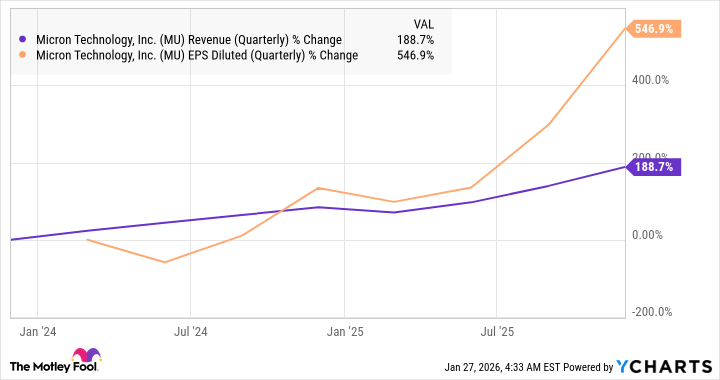
MU Revenue (Quarterly) data by YCharts.
Notably, HBM is deployed across a wide range of AI accelerators, including both central processing units (CPUs) and custom AI processors. So, it is easy to see why Bloomberg estimates that the size of the HBM market could jump from just $4 billion in 2023 to $130 billion in 2030. Bloomberg predicts that Micron could capture a quarter of this market, suggesting its HBM revenue could increase to $32.5 billion in five years.
Morningstar points out that HBM accounted for 15% of Micron's revenue in fiscal 2025 (which ended in August 2025). Micron generated $37.4 billion in revenue last year, indicating it sold $5.6 billion in HBM chips, according to Morningstar's estimates. So, HBM sales could significantly boost Micron's revenue in the next five years, while additional demand from smartphones, automotive, and personal computers (PCs) could further accelerate its growth.
Investors can expect terrific upside
Micron's valuation and growth potential suggest it still has significant room to grow. The stock is trading at just 12.6 times forward earnings, which is well below the Nasdaq-100's forward earnings multiple of 25.8. Analysts are expecting a 300% increase in Micron's earnings in the current fiscal year to $33.17 per share.
Importantly, analysts have become bullish about Micron's prospects for the next year as well, primarily due to the favorable memory pricing environment.
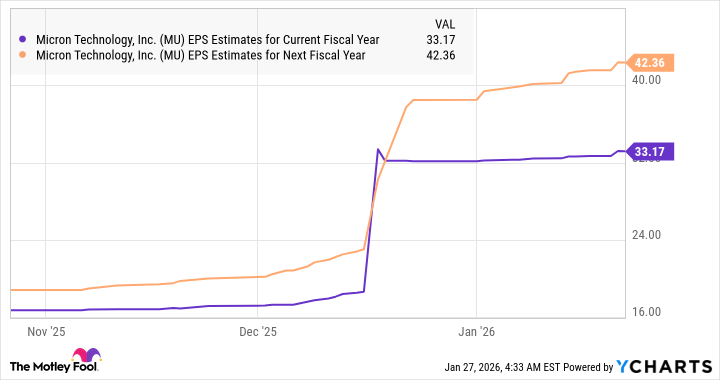
MU EPS Estimates for Current Fiscal Year data by YCharts.
Assuming Micron generates $42.36 per share in earnings in the next fiscal year and trades in line with the Nasdaq-100's forward earnings multiple, its stock price could jump to $1,093 per share. That's a potential jump of 173% from current levels, indicating that investors can still buy this semiconductor stock, as it can deliver stunning gains even after soaring 277% in the past year.