Since ChatGPT's commercial launch on Nov. 30, 2022, shares of semiconductor giant Nvidia (NVDA +1.34%) have rocketed over 1,000%. The artificial intelligence (AI) revolution has ushered in a wave of unprecedented demand for Nvidia's graphics processing units (GPU) -- the hardware backbone on which AI models are trained.
While Nvidia remains king of the AI realm, rising infrastructure spending is becoming a major tailwind for another type of AI chip: memory and storage. Let's dig into how Sandisk (SNDK -3.79%) is quietly disrupting this pocket of the AI landscape and assess if the company is about to have its "Nvidia moment."

Image source: Getty Images.
Sandisk's pivot from flash drives to AI data centers
During the early 2000s, Sandisk dominated the flash memory market, as its chips were often found in digital cameras, gaming consoles, and other consumer electronics. This is similar to Nvidia's early origins, as the company's GPUs were initially focused on enhancing visuals for online gaming.
However, developers discovered that Nvidia's chip architectures are ubiquitous -- repurposing this hardware to train and inference AI models. Sandisk is currently undergoing a similar evolution, as its enterprise solid-state drives (SSD) and NAND flash memory services become an integral component of hyperscaler data center stacks.

NASDAQ: SNDK
Key Data Points
Can Sandisk become the Nvidia of AI memory storage?
One of the reasons Nvidia became so dominant so quickly is because of the company's first-mover advantage in GPU designs. Advanced Micro Devices is only now just beginning to raise the stakes in the GPU space. Sandisk is in a similar position. The memory storage market is highly fragmented, with Micron Technology, Samsung, and SK Hynix the other major players.
Last year, the total addressable market (TAM) for high-bandwidth memory (HBM) was estimated to be $35 billion. Micron's management expects the market to grow at a compound annual growth rate of 40% over the next couple of years -- reaching a size of $100 billion by 2028.
Considering Sandisk generated revenue of only $9 billion over the last year, the company has barely scratched the surface of its growth potential relative to the size of the rapidly expanding AI memory market. Given limited competitive dynamics and the accelerating of Sandisk's top line, I think the company is in the early stages of following a similar trajectory to that of Nvidia during the early days of the AI boom.
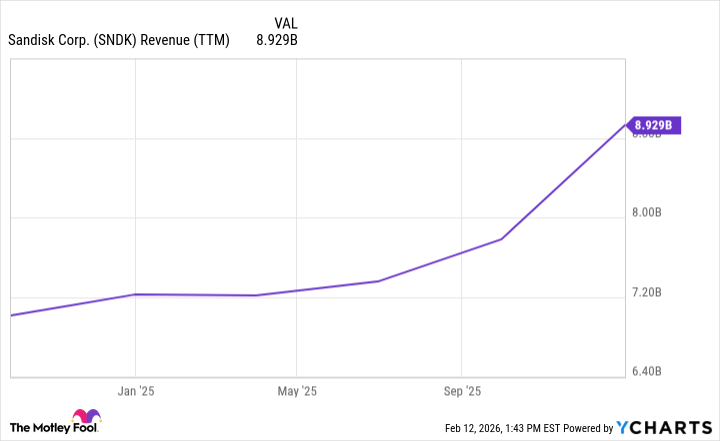
SNDK Revenue (TTM) data by YCharts
Sandisk is the ultimate pick-and-shovel AI infrastructure stock
This year, companies in the "Magnificent Seven" plan to spend $680 billion on capital expenditures (capex). Make no mistake about it: The hyperscalers will continue buying GPUs from Nvidia and AMD as both designers release new architectures this year. In addition, big tech is also investing heavily in custom application-specific integrated circuits (ASICs) with the help of Broadcom.
Underneath the surface, the demand that Nvidia, AMD, and Broadcom are witnessing will flow downstream to the memory market. The hyperscalers are moving beyond chatbots and now exploring far more sophisticated products across robotics, autonomous systems, and agentic AI.
As AI workloads scale, capacity alone is not the only bottleneck. Rather, demand for memory storage solutions should go parabolic as AI infrastructure spending accelerates. These secular dynamics make Sandisk a terrific pick-and-shovel opportunity for growth investors right now.
Sandisk is set to grow alongside its chip counterparts throughout the AI infrastructure era, making it a no-brainer buy. With this in mind, I think Sandisk can be thought of as a "new Nvidia."