With the exception of the five-week COVID-19 crash in February-March 2020 and the nine-month bear market in 2022, the bulls have been running the show since 2019 began. Over the last six months, the ageless Dow Jones Industrial Average (^DJI +0.33%), broad-based S&P 500 (^GSPC +0.71%), and growth-focused Nasdaq Composite (^IXIC +1.32%) have all hit record-closing highs.
But over the last six weeks, these record closes have become a distant memory. The Iran war has sent crude oil prices soaring and is triggering inflationary fears on Wall Street.
But something far more nefarious may be lurking than inflation. I'm talking about the Federal Reserve's nightmare scenario: stagflation.

Fed Chair Jerome Powell delivering remarks. Image source: Official Federal Reserve Photo.
Select economic data points are putting stagflation back on the table
Stagflation is a scenario characterized by three variables:
- Rising inflation
- Increasing unemployment
- Slowing or stagnant economic growth
What makes stagflation so challenging for the central bank is that there's no blueprint to quickly fix it. Lowering interest rates to spur economic growth and lower unemployment can send the inflation rate even higher. Meanwhile, raising interest rates can curb rising inflation but worsen economic growth and/or the jobs market.
The first of these variables, rising inflation, is being met. Skyrocketing crude oil prices mean consumers are paying more at the fuel pump, and the cost of producing and transporting goods is rising for businesses. The Federal Reserve Bank of Cleveland's Inflation Nowcasting tool predicts the trailing 12-month inflation rate for March will jump 85 basis points to 3.25%.
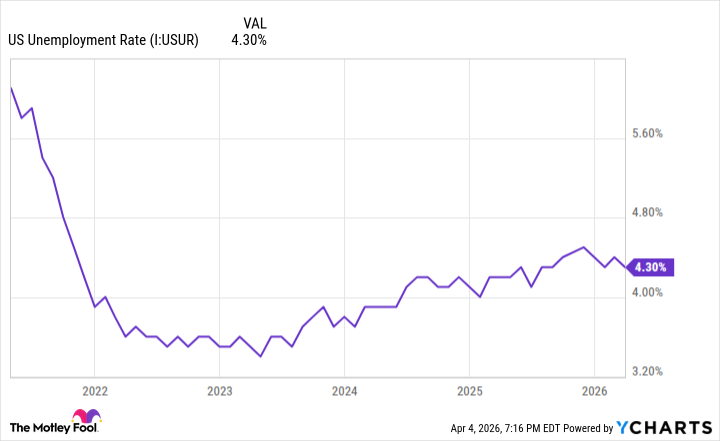
US Unemployment Rate data by YCharts.
The second factor, rising unemployment, is sending mixed signals. Although the unemployment rate of 4.3% is historically low, it's been trending steadily higher since the start of 2023.
The third variable for stagflation, slowing or stagnant economic growth, hasn't been met – but this may be changing. In early March, the Federal Reserve Bank of Atlanta's GDPNow forecast for first-quarter gross domestic product (GDP) was over 3%. The latest update, as of April 2, shows first-quarter GDP clocking in at just 1.6%.
While these three variables don't confirm the presence of stagflation, it does suggest the puzzle pieces are in place for this unwanted scenario to take shape.

Image source: Getty Images.
Fed Chair Jerome Powell isn't worried about stagflation -- and Wall Street shouldn't be, either
Although stagflation is a buzzword that's known to raise eyebrows and draw attention, Federal Reserve Chair Jerome Powell believes stagflation fears are much ado about nothing.
When Maria Eloisa Capurro of Bloomberg News questioned Powell about the possibility of stagflation taking shape following the March 2026 Federal Open Market Committee meeting, Powell had this to say:
When we use the term "stagflation," I always have to point out that that was a 1970s term at a time when unemployment was in double figures, and inflation was really high, and the misery index was super high -- add them together and you get the misery index. We actually have unemployment really close to longer-run normal, and we have inflation that's, you know, 1 percentage point above that.
While inflation is absolutely a concern for the central bank, and higher prices may lead to a shift in the Fed's rate-easing policy -- which would be terrible news for a historically expensive stock market -- the U.S. economy is showing few, if any, parallels to the 1970s or the stagflationary climate that flummoxed the central bank.