The first quarter was a difficult one for the S&P 500 and for investors as a variety of concerns circulated -- from worries about the revenue potential of artificial intelligence (AI) companies to the pressures of turmoil in Iran. All of this pushed many investors to avoid AI players and other growth stocks and turn to companies seen as stable parts of the economy -- such as healthcare businesses.
While many industries struggled in recent weeks, a variety of healthcare stocks soared -- from pharma giant Johnson & Johnson to dialysis services provider DaVita Inc. But you'll never guess which healthcare stock delivered the best first-quarter performance in the S&P 500. It's a company that's been through ups and downs in recent years, but could be heading for a whole new era of growth. Let's zoom in for a close look -- and consider whether the positive momentum may last.

Image source: Getty Images.
A shift in investor sentiment
The company I'm talking about is Moderna (MRNA +3.66%) -- it soared 72% in the first quarter, the best performance among healthcare companies in the S&P 500. What's particularly impressive here is that this marks a clear shift in investor sentiment regarding Moderna. The company soared in the early days of the pandemic as it developed a coronavirus vaccine, brought the product -- its first -- to market, and generated blockbuster revenue. But in later stages of the crisis, as demand for vaccines slipped, Moderna's earnings and stock performance followed.
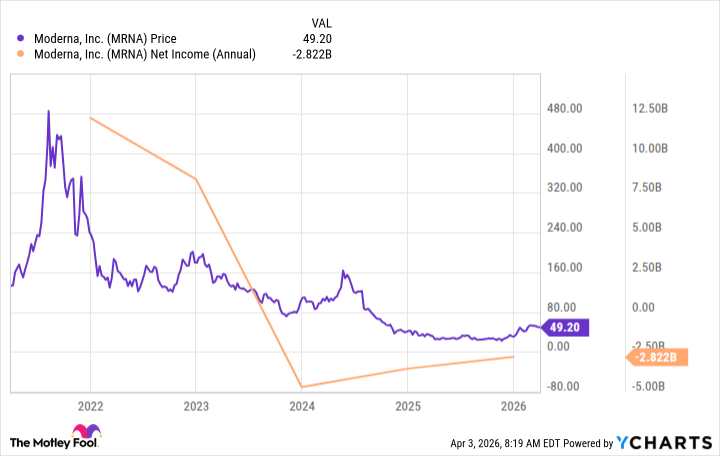
And for the past few years, despite Moderna's efforts to turn things around, many investors have avoided the stock.
So, what's prompted the recent optimism? As investors shifted out of stocks that have soared in recent years, they looked for new opportunities -- stocks that haven't performed very well but could generate growth in the quarters or years to come. And that led them to Moderna.
The company has a plan that sets it squarely on the path to transitioning from a coronavirus vaccine player to a biotech with strengths across many areas -- from infectious disease prevention to oncology and rare disease therapeutics. Moderna today generates revenue from two coronavirus vaccines and a respiratory syncytial virus (RSV) vaccine and has submitted a flu candidate to regulators for review. The company expects revenue from this franchise, which may also eventually include a combined flu/covid vaccine and a norovirus vaccine, to fund its oncology and rare disease programs.
Potential for 10% growth
The company predicts that seasonal vaccines will deliver up to 10% revenue growth this year, and the positive momentum will continue throughout this decade. Moderna is also keeping a tight grip on costs, having reduced them by 30% since 2024. Last year, the company delivered more than $2 billion in cost savings. And the biotech has more than $8 billion in cash, which is another source of support for its pipeline.

NASDAQ: MRNA
Key Data Points
Meanwhile, Moderna is making significant progress in the area of oncology with a total of eight phase 2 and phase 3 trials ongoing across tumor types for mRNA-4157. This is a collaboration with Merck and the pharma giant's blockbuster Keytruda. Moderna may report phase 3 melanoma data this year.
Success here could be big since Merck already has a significant position in the oncology market, so doctors working with Keytruda may be interested in the combination with an eventual Moderna drug.
And with a full pipeline spanning many treatment areas, even if Moderna experiences some setbacks, the company is well-positioned for success in the years to come.
Now, let's return to our question: Could Moderna's shares maintain their positive momentum? It's impossible to predict short-term stock performance, but it's fair to say that Moderna has the elements that may attract investors' attention: The company has commercialized products that ensure a certain level of revenue, and it has a solid pipeline that includes several late-stage candidates. This pipeline strength is paving the way for a new era of growth -- one that isn't dependent on a pandemic.
All of this suggests that Moderna, regardless of short-term performance, could be a winner for investors over the long haul.