There are plenty of dividend stocks on equity markets. Few are more secure than Dividend Kings, a group of corporations that have raised their payouts annually for at least 50 years straight. This is a highly exclusive clique that features only a few dozen companies, including Johnson & Johnson (JNJ +1.41%) and AbbVie (ABBV +0.17%), two leading pharmaceutical giants. Both drugmakers clearly have reliable dividend programs, but which one is safer to invest in right now? Let's find out.
Image source: The Motley Fool.
The diversification king
Johnson & Johnson is one of the more diversified healthcare stocks on the market. The company's business spans pharmaceuticals and medical devices. Within both niches, Johnson & Johnson operates across many different areas, including oncology and neuroscience in its drugmaking business, and surgery and vision care within medtech, among others. Johnson & Johnson's large product portfolio has enabled it to navigate stiff competition and patent cliffs. Despite losing U.S. patent exclusivity for Stelara, a notable growth driver, last year, the company's revenue increased.

NYSE: JNJ
Key Data Points
Johnson & Johnson also expects its sales to climb in 2026 -- the company will reach $100 billion in revenue, according to its guidance, making it only the second biopharma in history to reach this milestone. Johnson & Johnson also has a deep product pipeline and should succeed in launching newer, better products. Johnson & Johnson could tap into important long-term opportunities, notably with its Ottava robotic system, which will compete in the underpenetrated robotic-assisted surgery market.
Given all that, the stock is an excellent pick for risk-averse investors, especially in the current climate, thanks to its reliable revenue and earnings, as well as its AAA credit rating from S&P Global -- the highest available -- which underscores the strength of its balance sheet.
AbbVie's key growth drivers are flying
AbbVie isn't quite as diversified as Johnson & Johnson. The company has historically been a leader in immunology and continues to generate significant revenue from this area. AbbVie's two core growth drivers, Skyrizi and Rinvoq, are both immunosuppressants, and they are performing extremely well. In the first quarter, AbbVie's revenue was $15 billion, an increase of 12.4% year over year.
The company's top line came in ahead of its own expectations of $14.7 billion. AbbVie's immunology lineup (including the off-patent Humira) did much of the heavy lifting as it was responsible for $7.3 billion -- nearly half of its sales -- Skyrizi and Rinvoq accounted for $6.6 billion of that. That could become a problem if the duo encounters stiff competition, fails to secure pending label expansions, or does not achieve significant market penetration in new niches.

NYSE: ABBV
Key Data Points
AbbVie does have other growth drivers, though, including Vraylar, a schizophrenia therapy, Qulipta, a migraine treatment, and its Botox franchise. Further, AbbVie will not encounter any significant patent cliff for the rest of the decade. And in the meantime, the company should succeed in launching brand new products. On that front, it's worth noting that AbbVie's investigational weight-loss treatment recently performed well in a phase 1 clinical trial. Between the company's core growth drivers beating expectations and an attractive pipeline, AbbVie's medium-term outlook is bright.
Which is the safer buy?
Johnson & Johnson has raised its dividends for 64 consecutive years, compared to AbbVie's 54, when taking into consideration the time it spent as a division of Abbott Laboratories, its former parent company. So, Johnson & Johnson is more impressive in this regard, and it also has a broader product lineup. Further, Johnson & Johnson generates higher revenue and earnings, and it has been growing its top-line at comparable levels in recent quarters.
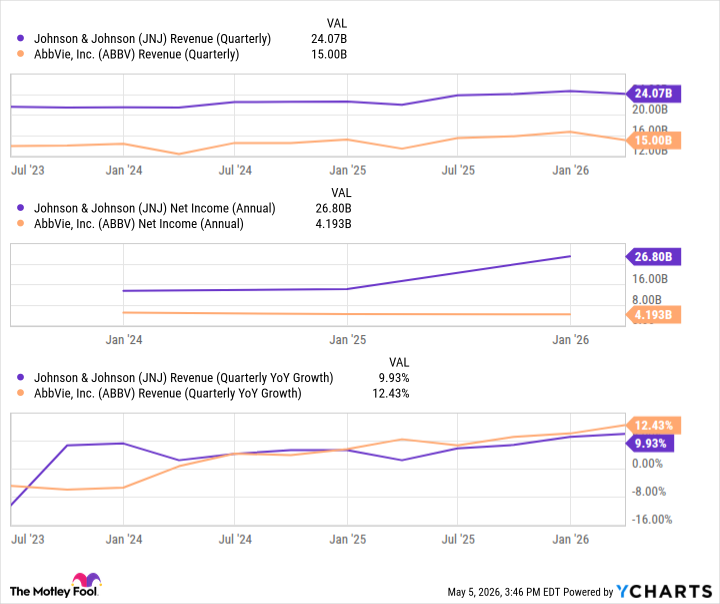
JNJ Revenue (Quarterly) data by YCharts
Both corporations face some risks. Johnson & Johnson isn't done dealing with the thousands of lawsuits related to its talc-based products that allegedly caused cancer, while both have been subject of government imposed drug price negotiations in the U.S. With all that said, I'd choose Johnson & Johnson as the safer and less volatile of the two. Johnson & Johnson's large, diversified portfolio can help it navigate the most challenging headwinds, including drug pricing negotiations. But AbbVie may have more upside if Skyrizi and Rinvoq continue to grow rapidly, while other products also perform very well. At any rate, dividend-seeking investors cannot go wrong with either.