Wholesale prices in April rose much higher than expected, fueling concerns about sticky and persistent inflation. And it wasn't just because of high gas prices stemming from the Iran war. The problems are much more pervasive.
The Producer Price Index (PPI) increased 1.4% in April from the previous month on a seasonally adjusted basis. Economists had only expected the PPI to rise 0.5%. On a year-over-year basis, the PPI is up a whopping 6%, the largest increase since December 2022.
Core PPI, excluding more volatile food and energy prices, rose 1% during the month, well above economists' estimates of 0.4%, according to CNBC.

Image source: Getty Images.
While the Consumer Price Index (CPI) tracks changes in the prices of a basket of consumer goods and services, the PPI tracks price changes on the wholesale side. It is composed of thousands of indexes that examine producer prices across various sectors and products.
The PPI is important because it often serves as a leading indicator for consumer inflation. The April report also comes after a hot CPI reading earlier this week, so the worst may be yet to come.
While many have shrugged off recent higher inflation readings due to higher gas prices resulting from the conflict in Iran, the recent PPI report suggests inflationary pressures in other parts of the economy.
Are tariffs starting to work their way through the economy?
According to the U.S. Bureau of Labor Statistics (BLS), more than three-quarters of the increase in final demand goods in April can be attributed to a 7.8% rise in the price of final demand energy. Over 40% is attributable to a 15.6% increase in the gasoline index, so a large portion of the jump can be blamed on the Iran war.
However, BLS also noted that final demand services also increased 1.2% in April, the largest jump since March 2022. Two-thirds of this move can be attributed to a 2.7% increase in margins for final demand trade services. Machinery and equipment wholesalers saw margins increase by 3.5%.
"Inflation is sticky and accelerating. The core reading confirms a deeper structural trend, especially in services," TradeStation's Global Head of Market Strategy David Russell said, according to CNBC. "The Hormuz crisis is aggravating the problem, but this goes way beyond oil."
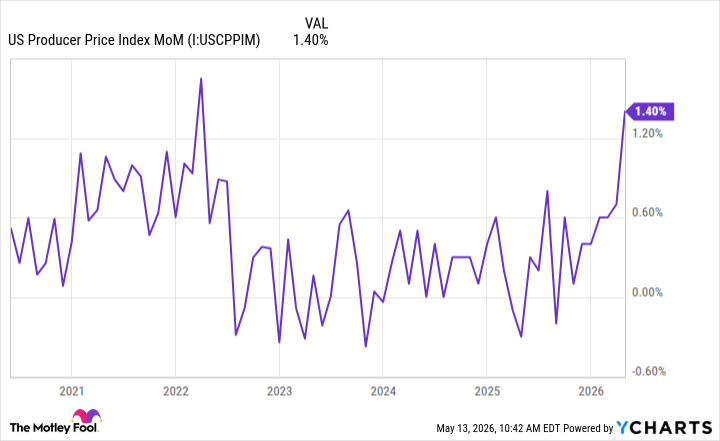
US Producer Price Index MoM data by YCharts
It's possible, although by no means a guarantee, that the increase in trade services margins is indicative of President Donald Trump's tariffs starting to have a greater impact on the economy.
In the PPI, trade service margins reflect the difference between what something is purchased at and what it is sold at, so if margins are increasing, that could be due to suppliers raising their selling prices to offset higher acquisition costs, which could result from tariffs.
However, the Cato Institute has previously pointed out that distributors could also use tariffs as an "excuse" to raise prices.
Following the report, people betting on the predictions platform Kalshi placed a 35% chance of the Federal Reserve raising interest rates before 2027. That percentage has more than doubled since late April.
Obviously, things can change in a hurry, but this report is certainly not supportive of the Fed cutting interest rates any time soon.