War in the modern era can be incredibly fast -- and incredibly expensive to participants. The Iran war among the United States, Israel, and Iran lasted just 39 days, start to finish, and cost the U.S. in particular a reported $25 billion.
The toll on other countries, which didn't directly participate in the war but did try to defend themselves from Iranian attacks during the war, is just beginning to become clear.
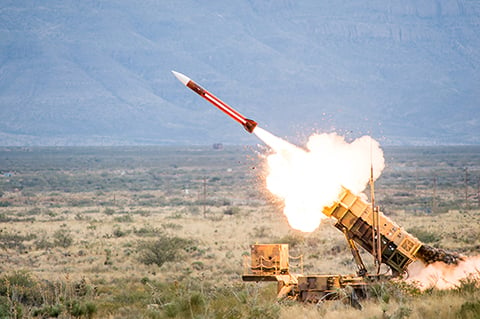
Image source: RTX.
Qatar needs Patriots
Take the Gulf nation of Qatar, for example. Home to the Al Udeid Air Base, America's largest military base in the Middle East, Qatar became a prime target for Iranian counterattacks during the war. It was forced to expend an enormous number of air defense missiles to protect itself against those counterattacks.
The bill for this is now coming due.
It's not known exactly how much ordnance Qatar fired to defend itself over the course of the war. Still, according to a recent U.S. State Department notification to Congress, the Qatari government has requested permission to purchase $4 billion worth of Patriot air-defense missiles to replenish its stockpile.
Specifically, Qatar will buy 200 Phased Array Tracking Radar to Intercept On Target (PATRIOT) Advanced Capability-2 (PAC-2) missiles and 300 PATRIOT Advanced Capability-3 (PAC-3) missiles, along with spare parts and contractor services. (PAC-2 missiles explode to destroy their targets in-flight with shrapnel; smaller PAC-3 missiles are hit-to-kill weapons that destroy targets -- usually ballistic missiles -- on impact.)
The State Department supports Qatar's request, advising Congress that "an emergency exists that requires the immediate sale to Qatar of the above defense articles and defense services is in the national security interests of the United States." The sale is therefore almost certain to go through.

NYSE: LMT
Key Data Points
What do investors need to know?
Lockheed Martin (LMT 1.05%) and RTX (RTX 0.35%) are both named as principal contractors on this arms deal, which makes sense. RTX builds the PAC-2 missile, as well as the fire-control radars and command-and-control stations for all Patriot missile systems. Lockheed, meanwhile, manufactures the PAC-3 missile. So even though Qatar is buying more PAC-3s than PAC-2s, it's actually possible RTX will win the (slight) majority of the $4 billion purchase price.
Whichever defense company benefits most, however, investors can anticipate that both companies will earn strong profits on this sale. Operating margins at RTX's Raytheon division averaged 11.4% in 2025, rising to 12.1% in Q1 2026. At Lockheed, the corresponding figures are 12.4%, rising to 12.9%, according to data from S&P Global Market Intelligence. So both companies are improving in this regard.
At an average cost of approximately $8 million per missile under this order, furthermore, versus approximately $4 million for pre-war orders, it seems likely both companies can expect profit margins to keep rising as Qatar faces its "emergency" -- and pays a steep price to resolve it.