Nvidia has been one of the biggest winners of the artificial intelligence (AI) revolution. However, several other companies, including some of Nvidia's competitors, are also capitalizing on AI. One of them is Advanced Micro Devices (AMD +0.22%). Over the past year, AMD has significantly outperformed Nvidia on equity markets. The former has gained 296% as of writing, compared to the latter's 63%. What's more, there are reasons to remain bullish on AMD's prospects, as some Wall Street analysts are.
An eye-popping price target
AMD's average price target, according to Yahoo! Finance, is currently $472.17, which implies an upside of about 5% from its current levels. That's not too impressive, but at least one analyst thinks much more highly of the semiconductor company. Robert W. Baird & Company's Tristan Gerra recently slapped a $625 price target on the stock, suggesting an upside of about 39%. While Gerra is arguably the most optimistic, many others have quite high price targets on AMD, along with "strong buy" recommendations. Do the company's prospects justify all this enthusiasm?
Image source: The Motley Fool.
Accelerating demand is fueling growth
One way to look at AMD's business is that the company plays second fiddle to Nvidia -- and by a wide margin -- in the GPU (Graphics Processing Unit) market, while also being second to Intel in the server CPU (Central Processing Unit) market. However, that doesn't even begin to tell the whole story. Despite lagging behind Intel, AMD has been gaining on its longtime competitor in recent years. In the first quarter, AMD grabbed a 33.2% share of the server CPU market, up 5% year over year.
What's driving these gains? Here are two factors. First, demand for AMD's EPYC processor is soaring, largely due to the shift to agentic AI. That's the next step beyond AI chatbots that only respond to prompts and generate text, images, or videos. AI agents can autonomously plan, organize, and execute. Agentic AI applications run on high-performance CPUs, which makes AMD's EPYC -- a leading CPU franchise on the market -- a hot commodity. As management said during the company's first quarter earnings conference call:
We delivered our fourth consecutive quarter of record server CPU revenue.
Second, Intel has encountered manufacturing issues that have disrupted its ability to meet demand.

NASDAQ: AMD
Key Data Points
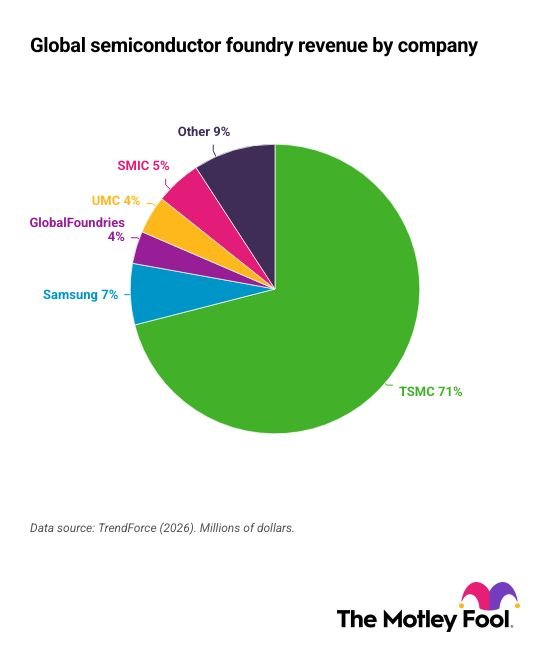
While Intel manufactures most of its products in-house (with limited outsourcing), AMD has adopted a different manufacturing strategy, relying mostly on Taiwan Semiconductor Manufacturing Company. This has helped AMD sidestep the problems Intel has run into in recent years. AMD's market share gains are reflected in its outstanding financial results. In the first quarter, the company's revenue increased by 38% year over year to $10.3 billion. Data center revenue growth was even more impressive, rising 57% year over year to $5.8 billion. On the bottom line, AMD posted adjusted earnings per share of $1.37, up 43% year over year.
There is more where that came from
Have AMD's shares risen too much, too fast? Is there only downside ahead for the stock? Not at all. The company expects accelerating demand ahead. AMD projects that the server CPU total addressable market will grow at a compound annual rate of more than 35% through 2030, reaching over $120 billion by then. One notable thing about this outlook is that AMD had given a more conservative one at its analyst day in November. But management was compelled to revise things, given what has transpired in the past six months.
That speaks volumes about the company's opportunities. And we haven't talked much about AMD's work in the GPU market. It won't catch up to Nvidia, but considering how fast both niches are growing, capturing a small slice of the GPU space is all that AMD needs -- along with its high-flying CPU business -- to keep posting excellent financial results. That's why the stock may not have peaked. AMD may or may not reach $625 within a year, but it is a terrific stock to buy and hold.