The stock market has been unstoppable over the past year, but investor sentiment may be turning.
Close to 44% of U.S. investors believe that stock prices will fall in the next six months, according to the most recent weekly survey from the American Association of Individual Investors, while only 32% think that stock prices will continue climbing.
With the S&P 500 (^GSPC -0.06%) soaring by more than 30% over the past year, is it time for investors to take their gains and get out of the market? Or is it wise to keep investing? Here's what you need to know.

Image source: Getty Images.
Is it safe to invest in the stock market right now?
Investor optimism has been fueling incredible stock market gains, especially in the tech and artificial intelligence (AI) spaces. But no bull run can last forever, so an eventual downturn is inevitable. The tricky part is gauging when it might happen.
In the short term, the market can be incredibly unpredictable. Even the experts sometimes get recession predictions wrong, and mistiming your sell-off can be risky.
For example, back in June 2023, analysts at Deutsche Bank forecast a "near 100%" chance of a recession in the next 12 months. That recession still hasn't materialized three years later, and since that prediction, the S&P 500 has earned total returns of nearly 76%.
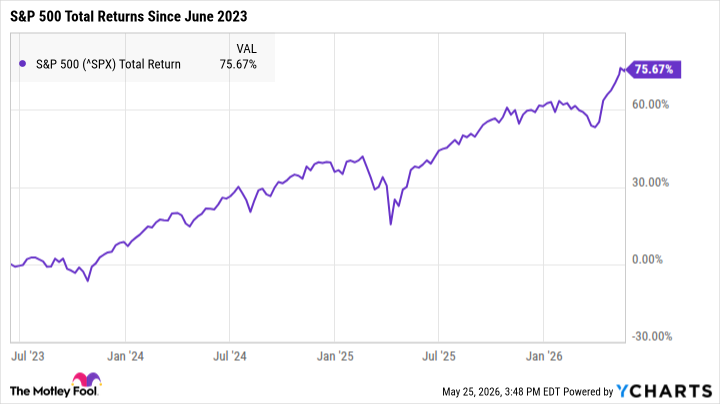
If you had sold your stocks three years ago out of concern that the market was going to crash, you could have missed out on lucrative potential earnings.
The past few years have proved time and again that the market can continue to surge against all odds. Despite stubbornly high inflation, the war in Iran, an elevated unemployment rate, and general discouragement among many Americans right now, the stock market has consistently reached new heights.
How to prepare for a potential recession
Again, there's no way to tell when the next market pullback might begin, how severe it might be, or how long it might last.
That said, it never hurts to prepare your investments for a downturn. Stocks could still have many months of growth ahead, but it's better to overprepare now than to be blindsided when the market turns for the worse.
Perhaps the best move you can make right now is to double-check that you're investing only in quality stocks from strong companies. A few of the core factors to look for include:
- Strong fundamentals: When a company is on solid financial ground and has a history of smart decision-making during pivotal moments, for example, it's much more likely to weather tough economic times. Companies built on hype and with little substance, on the other hand, may have a hard time rebounding from a recession or bear market.
- Industrywide growth potential: When deciding whether a stock is a long-term buy, it's also important to consider the broader market. Even if an individual company is healthy, if it's part of a dying industry with little long-term growth potential, it could struggle.
- A competitive advantage: If the industry itself is thriving and the company appears robust, a competitive advantage may be the most important selling point. A competitive advantage can be anything from lower costs to superior customer service to higher quality products, and the more competitive advantages a company has, the more likely it is to outperform similar stocks.
Once you have a portfolio full of recession-proof stocks, it's equally important to hold them for at least a few years -- or, ideally, decades. The longer you can give your investments to grow, the better your chances of pulling through a downturn.
Historically, the average S&P 500 bear market only lasts around nine months, according to research from Bespoke Investment Group. Meanwhile, the average bull market has lasted close to three years. By investing in quality stocks and holding those stocks for as long as you can, you can build long-term wealth regardless of what the short-term future looks like for the market.