Nvidia (NVDA +1.34%) has been the biggest beneficiary of the massive investments in artificial intelligence (AI) data center infrastructure over the past few years. Its chip systems have been widely deployed by hyperscalers, governments, and AI companies to support the training and deployment of AI models.
However, AI is now moving from data centers into edge applications, such as smartphones, drones, vehicles, robots, industrial automation, and healthcare. Edge AI devices can process AI workloads locally rather than sending them to the cloud, enabling them to make real-time decisions quickly. The good news for Nvidia stock investors is that the company is already minting money from the growth of edge AI applications.
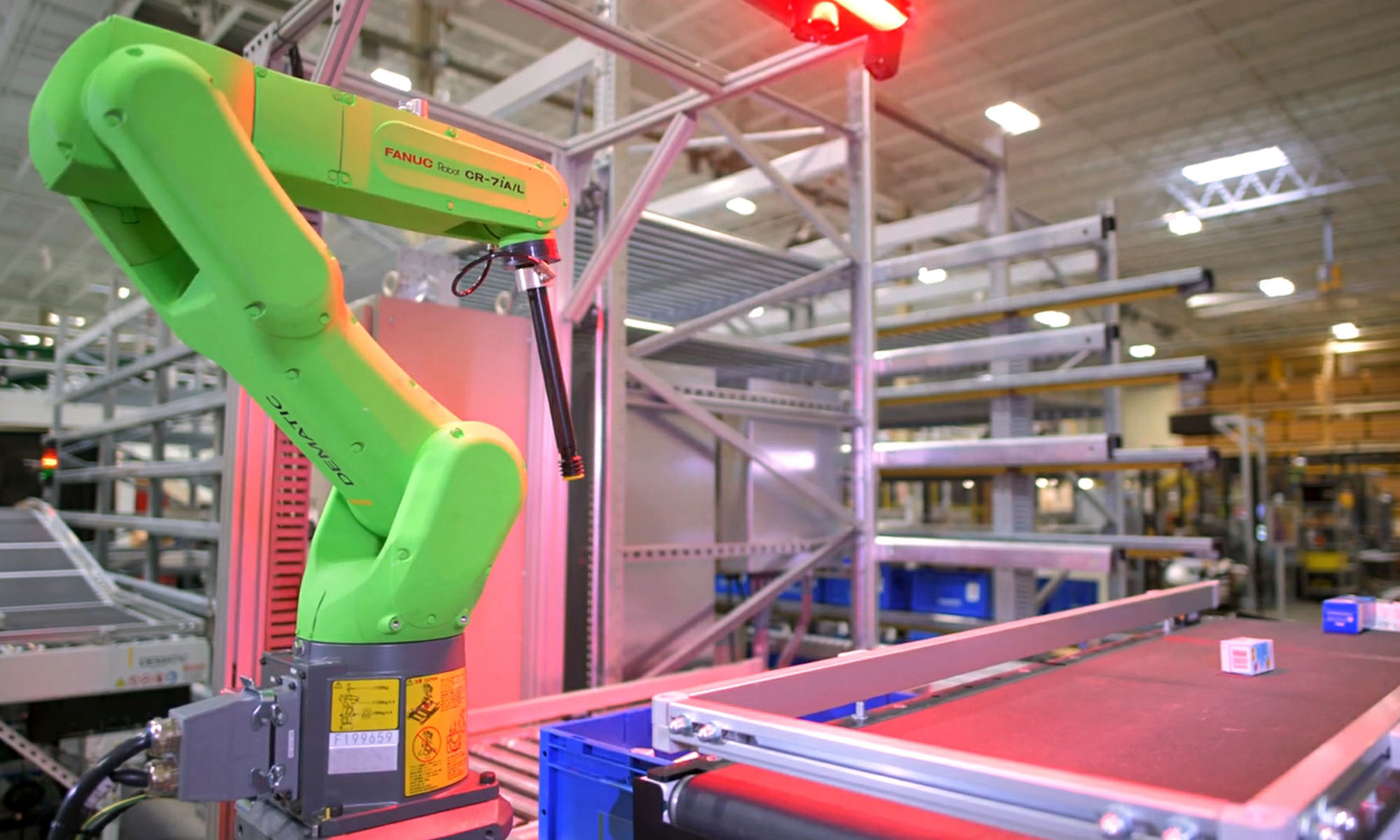
Image source: Nvidia.
Nvidia's physical AI business is growing at an impressive pace
Physical AI refers to the integration of AI into edge devices, such as cars and robots, enabling them to make real-time, autonomous decisions. Robotaxis, robotic arms in factories, and humanoid robots are examples of physical AI.

NASDAQ: NVDA
Key Data Points
Market research firm Counterpoint Research estimates that physical AI device shipments could reach 145 million units cumulatively between 2025 and 2035. The research firm adds that robots, autonomous vehicles, and drones will drive this market's growth. Nvidia has already started capitalizing on this opportunity.
The company noted on its latest earnings call that its physical AI revenue has exceeded $9 billion over the trailing twelve months. For comparison, Nvidia's physical AI revenue came in at $6 billion in fiscal 2026. So, the quarterly revenue run rate of Nvidia's physical AI business increased by 50%. Importantly, this segment is poised to grow at a stronger pace. That's because the company is partnering with key players in physical AI. As pointed out by CFO Colette Kress on the recent earnings call:
Our partnership with Uber will power the robotaxi fleet across nearly 30 cities and 4 continents by 2028. And in robotics, leading companies across a range of industrial, surgical, and humanoid applications are building on Nvidia's technology, to develop and deploy at scale.
CEO Jensen Huang also recently noted that $5 trillion will be spent on building factories across the globe. Major manufacturers such as TSMC, Pegatron, Wistron, Foxconn, and others are already using Nvidia's platform to build digital twins of factories before beginning actual construction, and importantly, they are integrating physical AI solutions to boost output.
Nvidia is also collaborating with General Motors to help the automaker build factories equipped with robots. The semiconductor specialist has also released foundation models and physical AI tools that will help developers train robots and autonomous vehicles.
Grand View Research projects that the physical AI market could generate $960 billion in annual revenue in 2033, up from just $81 billion last year. Nvidia is therefore making the right moves to become a key player in the fast-growing physical AI market in the long run.
It isn't too late to buy the stock
Nvidia's focus on expanding its addressable opportunity by entering new markets should help sustain its phenomenal growth. Physical AI isn't the only new space that Nvidia is targeting. Its decision to sell its Vera server central processing units (CPUs) as a stand-alone product is will help the company generate an additional $20 billion in revenue this year.
Nvidia has traditionally offered its server CPUs as part of its rack-scale server solutions that include other chips. However, the company couldn't ignore the stand-alone demand for these chips, and management believes that the decision to sell its Vera CPUs to customers has opened a potential $200 billion addressable market.
Not surprisingly, analysts have significantly raised their growth expectations.
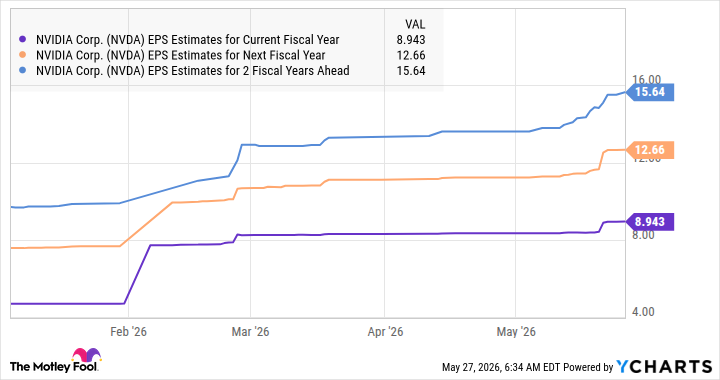
Data by YCharts
Nvidia reported $4.77 in earnings per share for fiscal 2026 (which ended in January this year). The consensus estimate of $15.64 in earnings per share for fiscal 2029 suggests that Nvidia's bottom line will grow at a compound annual growth rate (CAGR) of 48%. With shares trading at 33 times earnings, a discount to the tech-laden Nasdaq-100 index's earnings multiple of 35.6, this AI stock is a no-brainer buy right now.
The company is anticipating investments in AI infrastructure to reach an annual run rate of $3 trillion to $4 trillion by the end of the decade, which means that its core data center business is poised to keep growing nicely. Throw in additional catalysts, such as physical AI, and it is easy to see why buying and holding Nvidia for the long run makes sense.