The right investment can transform your finances, turning small regular contributions into hundreds of thousands of dollars or more over time.
Exchange-traded funds (ETFs) are low-maintenance investments that perform best when given decades of uninterrupted time to grow. Some ETFs track the broader market, while others aim to deliver above-average returns over time.
While all investors will have unique goals and preferences, this Vanguard ETF has a strong track record of beating the S&P 500 (^GSPC +0.59%). Over time, it could supercharge your earnings.

Image source: Getty Images.
A tech ETF that could be poised for substantial growth
The Vanguard Information Technology ETF (VGT +0.57%) covers the broader technology sector, with 316 holdings. Perhaps the biggest advantage of this fund is that it offers both diversification across tech and exposure to high-growth stocks and subsectors.
Close to 40% of the fund is devoted to semiconductor stocks, which have experienced explosive growth in recent years as part of the push for artificial intelligence (AI) advancement. Its top holdings include superstar performers like Nvidia, Apple, Microsoft, and Micron Technology, and if AI-related stocks continue to surge, this ETF could thrive.

NYSEMKT: VGT
Key Data Points
At the same time, because it includes more than 300 stocks across the tech space, this fund also offers greater diversification than many other tech ETFs. If one subsector stumbles, there are plenty of other stocks that can help prop up the fund and protect your investment.
Over the last 10 years, the Vanguard Information Technology ETF has earned total returns of more than 836%, as of this writing. The S&P 500, on the other hand, has delivered total returns of around 324% over that period.
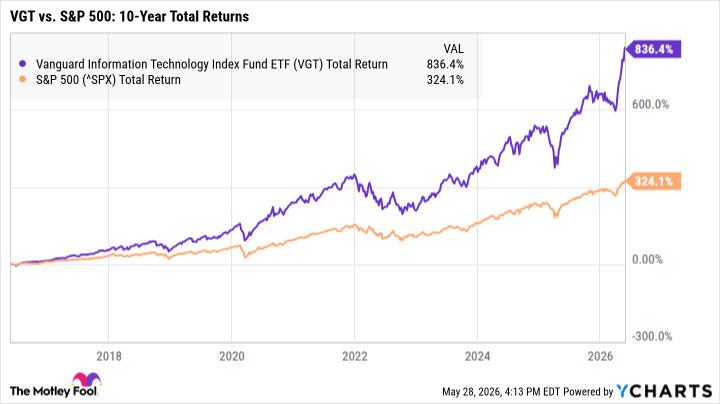
VGT Total Return Level data by YCharts
In other words, if a decade ago you'd invested $5,000 in either the Vanguard Information Technology ETF or an S&P 500 ETF, you'd have around $47,000 or $21,000, respectively, by today.
How much could you earn with this ETF?
Past performance doesn't predict future returns, so there's no way to know exactly how this ETF will fare over time. That said, it can sometimes be helpful to estimate returns just to get an idea of the earning potential of different investments.
Over the last decade, the Vanguard Information Technology ETF has earned an average annual return of just over 24%. Since its inception in 2004, however, its average annual return is just 14%. For context, the S&P 500 itself has historically earned an average annual return of around 10%.
Let's say this ETF could continue earning average annual returns of 24% or 14% going forward, and that you're investing $200 per month. Over time, here's approximately how that could accumulate:
| Number of Years | Total Portfolio Value: 24% Avg. Annual Return | Total Portfolio Value: 14% Avg. Annual Return | Total Portfolio Value: 10% Avg. Annual Return |
|---|---|---|---|
| 15 | $242,000 | $105,000 | $76,000 |
| 20 | $729,000 | $218,000 | $137,000 |
| 25 | $2,155,000 | $436,000 | $236,000 |
Data source: Author's calculations via investor.gov.
Again, there are no guarantees that this ETF will continue earning returns in line with its historic averages. However, even if it only earns slightly higher-than-average returns, you could still accumulate hundreds of thousands of dollars over time. The more you can afford to invest each month or the longer you can let your money grow, the more you could potentially earn.
Just be sure you're prepared for volatility and that the rest of your investments are well-diversified with stocks from other industries. While tech can be lucrative, a balanced portfolio is key to managing risk and returns.