Shares of Broadcom (AVGO +2.97%) jumped nearly 5% on Friday to close at an all-time high of $446.77, pushing the chip designer's market capitalization past $2.1 trillion as of this writing.
The timing of the move is notable. Broadcom reports its fiscal second-quarter results after the close on Wednesday, June 3 -- and after a fiscal first quarter in which its artificial intelligence (AI) business more than doubled, the market is betting the momentum ran straight through the spring.
Of course, no one can know which way the stock moves once the report lands. So, rather than guessing, the more useful question is whether Broadcom's business justifies its record-high price.

Image source: Getty Images.
An AI engine that keeps accelerating
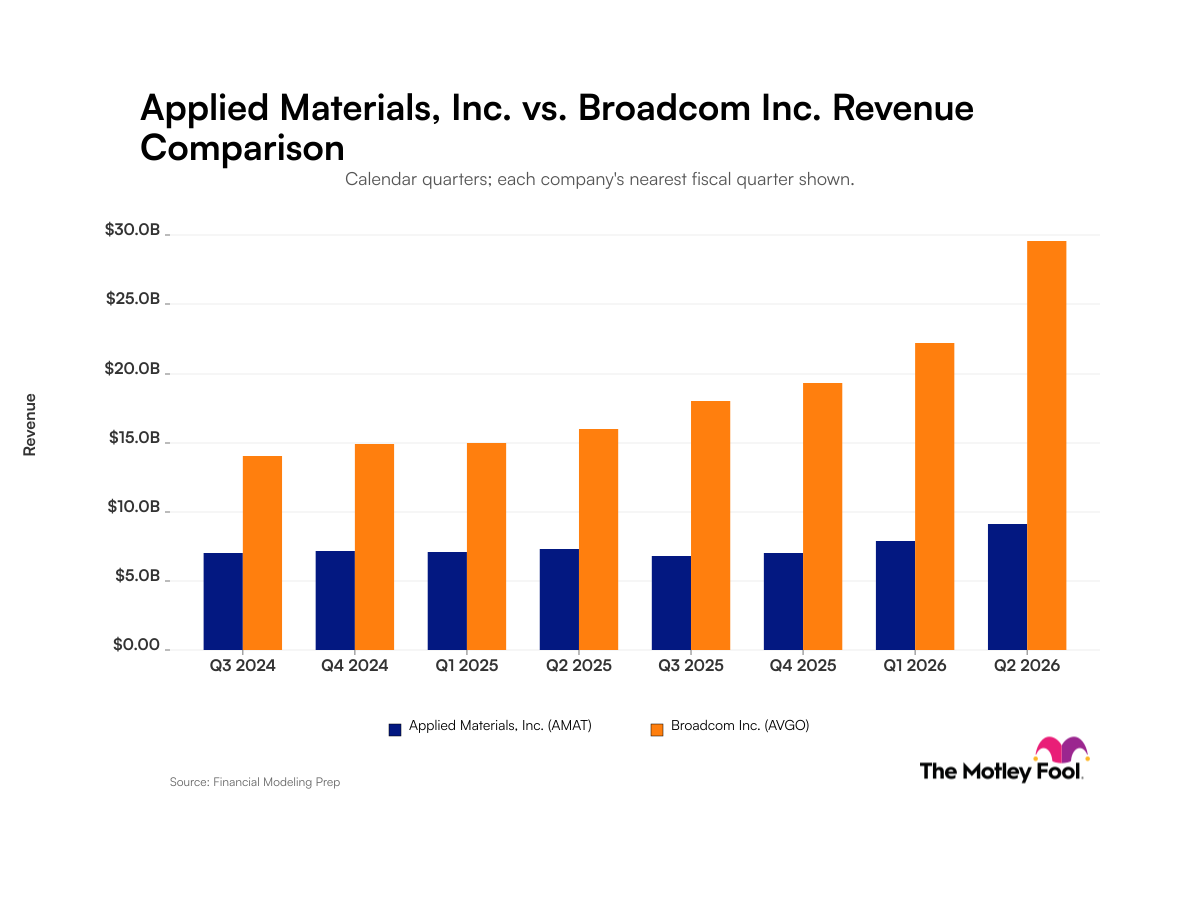
Broadcom's growth runs through one increasingly dominant story: the custom chips it designs for large AI customers. In its fiscal first quarter of 2026 (the period ended Feb. 1, 2026), AI revenue reached $8.4 billion, up 106% year over year and ahead of the company's own guidance. That lifted semiconductor solutions revenue to a record $12.5 billion, up 52%, and total revenue to $19.3 billion, up 29%.
AI revenue climbed from 63% in the fiscal third quarter of 2025 to 74% in fiscal Q4 to 106% in fiscal Q1, with management guiding for AI semiconductor revenue of $10.7 billion in the fiscal second quarter (ending May 3, 2026), implying 140% year-over-year growth. The custom accelerators at the heart of it, or the chips hyperscalers buy to lean less on AI chipmaker Nvidia's general-purpose processors, are the single biggest driver, and almost certainly the main line item investors will scrutinize most closely on June 3.
And management has dangled a far bigger number for 2027: a line of sight to AI revenue from chips alone exceeding $100 billion, with customers including Alphabet's Google, Meta Platforms, Anthropic, and OpenAI behind the forecast.
Going into the report, therefore, the bull case rests on those relationships holding up well.
"Our ability to assure supply in these times of constrained capacity in leading-edge wafers, in high bandwidth memory, and substrates ensures the durability of our partnerships," said Broadcom CEO Hock Tan in the company's fiscal first-quarter earnings call.
Meanwhile, Broadcom's scale throws off enormous cash. Free cash flow was $8.0 billion in fiscal Q1, or 41% of revenue, and non-GAAP (adjusted) net income grew 30% to $10.2 billion.
On the back of this strong cash flow and big profits, Broadcom returned $10.9 billion to shareholders during the quarter and authorized a fresh $10 billion buyback.

NASDAQ: AVGO
Key Data Points
A premium price for a premium business
Buying into this growth story, however, comes at a cost. At Friday's close, Broadcom stock trades at a price-to-earnings ratio of about 87.
Strip out the heavy, non-cash amortization tied to its VMware acquisition, and the adjusted figure is closer to 61 times -- still a rich multiple, and one that assumes the AI build-out runs hot for years.
Broadcom's top five end customers accounted for roughly 50% of revenue in fiscal Q1. And the AI chip business leans on a small circle of six major customers. For now, this is a major catalyst for the chipmaker, given how fast these customers are growing their cloud businesses. But this catalyst can also be a detractor if things go wrong. For instance, these same customers who fueled Broadcom's triple-digit growth last quarter could weigh on the company if they start pushing back on prices or slow spending if the payoff from AI infrastructure disappoints. Management's answer, for now, is that locking up scarce manufacturing capacity keeps them tied to Broadcom. But a few large orders moving the other way can swing a quarter quickly.
So, is Broadcom stock a buy ahead of its June 3 report?
The business is about as strong as they come, with accelerating growth, wide margins, and a clear multiyear runway for further strong top-line growth. But the stock is arguably now priced for most of that to go right. At 87 times earnings, there is little room for a soft quarter or any wobble in cloud spending.
Long-term investors who believe the shift to custom silicon is still early have a defensible reason to hold through the report and potentially add to their position on any meaningful weakness. But for anyone starting a position today, waiting for a pullback could make sense.