The recent confirmation that China would buy 200 737 model jets from Boeing (BA 1.18%) is a positive development in U.S./China trade relations and good news for Boeing. It helps reinforce the investment case for the stock. The key argument supporting buying the stock in 2026 is the considerable upside potential from executing its existing backlog and contracts.
Boeing's backlog
The recent agreement with China will contribute to Boeing's backlog. The existing backlog stood at a record $695 billion at the end of the first quarter. The figure represents the sum total of Boeing's estimated revenue from 2026 to deep into 2031.
Most of the backlog is in the commercial airplanes segment (BCA).
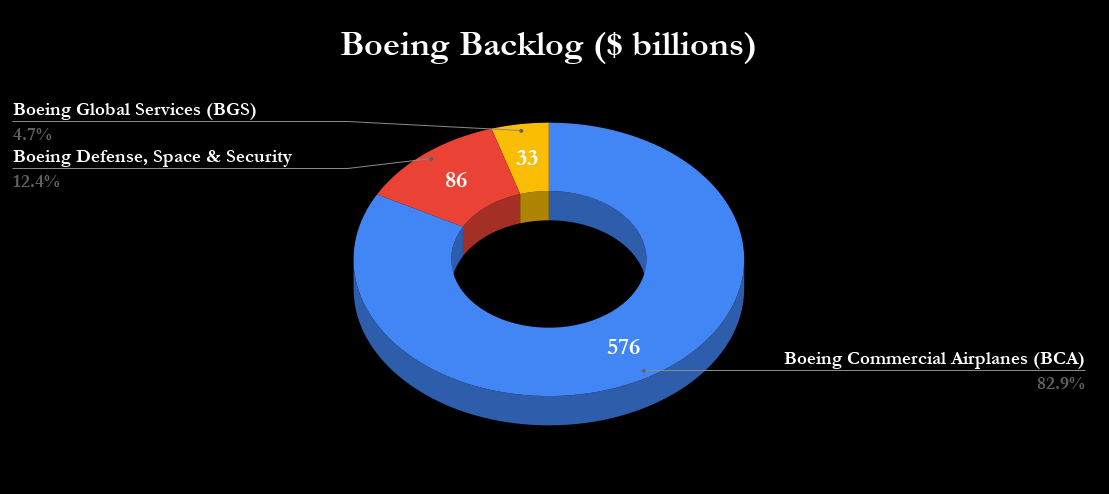
Data source: Boeing presentations. Chart by author.
Delivering on the backlog
No one doubts that Boeing has great growth prospects on account of its backlog and the ongoing recovery in commercial aerospace, but the question is whether it can deliver on them profitably. It's a valid question after years of high-profile groundings of the 737 MAX; manufacturing quality issues; Federal Aviation Administration (FAA) restrictions on Boeing's production and deliveries of the 737 MAX and 787 airplanes; multibillion-dollar charges on fixed-price development contracts at Boeing Defense, Space & Security (BDS); and certification delays on the new 777X.
These challenges are best seen in Boeing's free cash flow (FCF) generation over the last few years. I've previously discussed Boeing's cash flow and debt issues and how they impact strategic thinking.

NYSE: BA
Key Data Points
How to think about Boeing's cash flow
There are two ways to look at current matters, and management's guidance for FCF of $1 billion to $3 billion in 2026. The higher end of the range would put Boeing at 57.6 times FCF for 2026.
The cautious view is that the valuation reflects ongoing issues at Boeing, and until the company can demonstrate some improvement, that's how investors should value it.
The optimistic approach accepts CFO Jesus Malave's argument, delivered on the January earnings call, that if temporary impacts on Boeing's cash flow are stripped out, its FCF would be in the "high single-digit" billion-dollar range.

Image source: Boeing.
These impacts include the increased use of cash due to the delay in 777X certification, customer considerations due to prior delays on 737 MAX and 787 deliveries, $1 billion in cash used to support the Spirit AeroSystems integration, a "spike" in capital expenditures in 2026 and 2027 to support reestablishing production on the 737 and 787, and cash impact from previous BDS charges.
Is Boeing stock a buy?
Ultimately, the decision comes down to how much you believe these temporary factors really are "temporary," or whether they are part of an enduring set of issues that will continue to dog Boeing.

Image source: Getty Images.
On the positive side, CEO Kelly Ortberg (appointed in summer 2024) has increased Boeing's 737 delivery rate, and BDS is addressing its most challenging defense contracts. The investment in Spirit is expected to strengthen Boeing's supply chain, and increased deliveries of the 737 and 787 should improve FCF margins.
Boeing probably deserves the benefit of the doubt here, and its growing backlog and the recent China deal add more opportunity to execute, but it's understandable if more skeptical investors want to see more evidence of operational improvement before buying in.