Since the start of 2023, the Vanguard Information Technology ETF (VGT -2.99%) has outperformed the S&P 500 (^GSPC -1.21%) every year and has more than tripled overall, while the broad-market index has roughly doubled.
In 2026, energy was the best-performing sector for the first four months of the year, but tech moved back into the lead on May 29. At that point, tech had a 28.6% total return year to date, compared to 26.8% for energy and 11.3% for the S&P 500.
Here's what's driving the tech sector's returns, and why the Vanguard Information Technology ETF remains one of the best low-cost funds for growth investors to buy now.

Image source: Getty Images.
Semiconductors in the spotlight
The tech sector used to be dominated by systems software, applications software, and hardware and equipment companies. But the artificial intelligence (AI) boom triggered changing of the guard.
After several years of stellar gains, semiconductor and semiconductor materials and equipment companies now make up a remarkable 43.6% of the Vanguard Tech ETF -- and roughly 17% of the value of the entire S&P 500. The semiconductor industry alone is now more valuable than healthcare and industrials combined.
VGT Vanguard Information Technology ETF
NYSEMKT · As of 4:00 PM ET 10/22/26
Nvidia (NVDA -4.40%) has been a big factor in the tech sector's outperformance, going from a market cap of a few hundred billion dollars at the end of 2022 to over $5 trillion today. Broadcom is now firmly in the $2 trillion club, while Micron Technology joined the $1 trillion club in late May, and Advanced Micro Devices and Intel are within striking distance. Those five semiconductor stocks account for 30% of the Vanguard Information Technology ETF, and they're now worth more combined than the combined values of Apple and Microsoft. At the end of 2022, the sum of those five chip giants' market caps was less than $1 trillion.
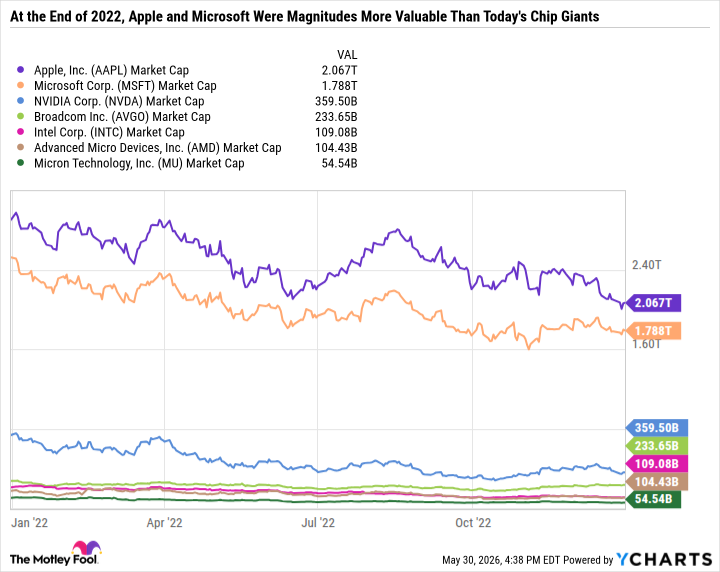
AAPL Market Cap data by YCharts.
An earnings-driven growth story
Semiconductor stocks have more than made up for the relative underperformance of software stocks. But recent earnings reports from companies like Snowflake have rekindled investor optimism about software-as-a-service (SaaS) stocks. Simply buying and holding the Vanguard Information Technology ETF would be a simple yet highly effective way to get exposure to the entire tech sector, regardless of what's driving its growth.
While some tech stock valuations are overextended, the sector as a whole has been backing up its share price outperformance with impressive earnings growth. Nvidia, for example, continues to grow its top and bottom lines at a breakneck pace. And its latest $80 billion stock repurchase program will accelerate its earnings-per-share growth by reducing its outstanding share count. Broadcom is guiding for $100 billion in AI chip sales in its fiscal 2027, and that doesn't even account for its booming AI networking business. Meanwhile, Microsoft sports a forward price-earnings ratio of 26.8, which is incredibly reasonable for a leading tech stock with double-digit earnings growth and high margins. And memory chip powerhouse Micron is trading at just 16.5 times forward earnings.
An ETF to anchor a growth stock portfolio
The tech sector remains an impeccable long-term investment because there are so many ways for the players in it to unlock growth. Just in the last decade, themes like consumer electronics, the rise in mobile phone capabilities, SaaS, cloud computing, and AI have been key drivers of the sector's growth.
True, it looks overvalued based on traditional valuation metrics. But that narrative has existed pretty much every year.
Until the sector's earnings growth slows, there's every reason to believe the Vanguard Tech ETF can continue outperforming the S&P 500. And given that the Vanguard Information Technology ETF has an expense ratio of just 0.09% compared to 0.03% for the Vanguard S&P 500 ETF, investors incur only 60 cents in extra fees annually for every $1,000 invested, making it a no-brainer buy for risk-tolerant investors.