The highly anticipated SpaceX initial public offering (IPO) is right around the corner. The company plans to raise $75 billion at a nearly $1.77 trillion valuation, making it the largest IPO in history. What's more, Anthropic is now expected to IPO ahead of OpenAI, with both artificial intelligence (AI) giants expected to go public later this year.
But some investors may be concerned that these high-profile companies are overvalued. Or at least, would prefer to evaluate them on public markets rather than dive in headfirst right away.
New rules by the Nasdaq-100 (which tracks the 100 largest non-financial companies on the Nasdaq exchange) will expedite the inclusion of megacap companies into the indexes. That means some index funds and passively managed exchange-traded funds (ETFs) could soon be buying SpaceX, Anthropic, and OpenAI in droves.
Here's why the Vanguard Value ETF (VTV +0.48%) is a great way to invest in industry-leading companies while avoiding SpaceX, Anthropic, and OpenAI.

Image source: Getty Images.
The perfect ETF for owning the value side of the market
With 309 holdings, the Vanguard Value ETF essentially filters the S&P 500 by excluding growth-focused companies. It doesn't hold high-profile growth stocks like Nvidia, Alphabet, Apple, Microsoft, Amazon, Broadcom, Tesla, Meta Platforms, or Eli Lilly. You can find those names in the Vanguard Growth ETF (VUG -0.36%).

NYSEMKT: VTV
Key Data Points
While the Vanguard Total Stock Market ETF and Vanguard Growth ETF will almost certainly be buying SpaceX, Anthropic, and OpenAI like clockwork, the Vanguard Value ETF won't. Which makes it a great buy for risk-averse investors looking for broader market exposure. The fund's top holdings include companies like JPMorgan Chase, Berkshire Hathaway, and ExxonMobil. But Micron Technology and Intel are also in the fund's top 10 holdings because they were labeled as value stocks before their recent run-ups.
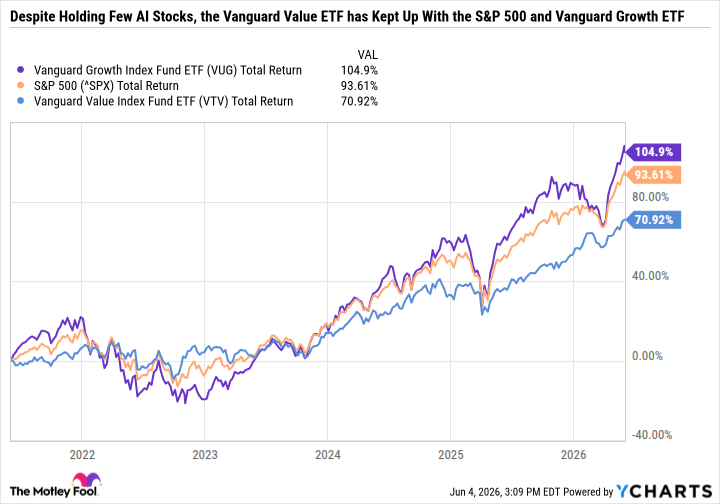
Compared to the Vanguard S&P 500 ETF, the Vanguard Value ETF has more exposure to financials, industrials, healthcare, energy, consumer staples, utilities, real estate, and materials, and less exposure to the technology, communications, and consumer discretionary sectors. As a result, the Vanguard Value ETF has largely missed out on the AI boom that has been fueling the major indexes' gains. But the fund has still produced solid results for long-term investors by holding a diversified portfolio of top companies with growing earnings.
Data by YCharts.
A simple way to avoid buying megacap IPOs
The Vanguard Value ETF has the same 0.03% expense ratio as the Vanguard S&P 500 ETF. This is the lowest expense ratio offered by any ETF or index fund. So investors are getting a basket of value stocks at the lowest possible fee structure.
Another reason to buy the Vanguard Value ETF is to avoid duplicating holdings. Investors who already own their desired maximum allocation to megacap growth stocks may not want to buy a growth-focused ETF or index fund that would add to those positions. For example, an investor with Nvidia and Alphabet as core holdings may be looking to deploy new capital into value-focused sectors.
In sum, the Vanguard Value ETF is a good tool for investors looking for a basket of stocks that aligns with their risk tolerance and portfolio goals. And with a 1.9% dividend yield compared to 1% for the Vanguard S&P 500 ETF, investors are getting close to double the passive income, which may appeal to folks supplementing income in retirement.
Add it all up, and the Vanguard Value ETF is a good buy in general, but especially for investors looking for an ultra-low-cost ETF that won't be impacted by this year's slate of blockbuster IPOs.