The SpaceX (SPCX -0.45%) IPO has sucked all the liquidity out of the rest of the space economy stock boom. AST SpaceMobile (ASTS +1.82%) -- a satellite internet start-up that was once up 2,000% over the last three years -- has fallen 38% from its all-time high to $82.
Yet, when you look at some metrics, AST SpaceMobile may be ahead of SpaceX in deploying satellites to create a constellation of direct-to-device internet capability, which could have an addressable market in the hundreds of billions. Does that make the stock a buy-the-dip, contrarian play after the SpaceX IPO?

NASDAQ: ASTS
Key Data Points
The first to direct-to-device internet?
Starlink is the revolutionary high-speed satellite internet service developed by SpaceX. Launched with its own rockets, the constellation now has thousands of satellites in orbit and serves over 10 million customers worldwide. Started just a few years ago, the Starlink segment generates over $11 billion in annual revenue and is growing 50% year over year.
Today, AST SpaceMobile is nowhere near this level of financial performance, with trailing-12-month revenue of just $85 million. However, it is well on its way to ramping up what may jump ahead of SpaceX's Starlink satellite business in terms of customer value. See, there is one expensive problem with SpaceX's satellite internet business, and that is the fact that customers need antennas in order to connect to the internet.
AST SpaceMobile's massive satellites claim the capabilities -- which have proven strong so far in testing -- to directly connect the internet to existing computing devices, such as smartphones. This could be the next step in satellite internet disruption, opening an opportunity for the hundreds of billions of dollars spent annually on mobile internet services worldwide to switch to satellite internet.
Image source: Getty Images.
Heavy spending and rocket launch relationships
Building a satellite internet constellation comes with risks, especially if you don't have your own rockets like SpaceX. You can see this in AST SpaceMobile's current financials and recent launch mishaps.
Free cash flow was a negative $1.37 billion over the last 12 months, a figure that has worsened as AST SpaceMobile manufactures more of its massive satellites and pays to have them launched into orbit. One of Blue Origin's recently launched satellites was misplaced in orbit and will no longer operate properly within the constellation.
This highlights the big risk with AST SpaceMobile today. It wants to aggressively launch satellites into orbit this year to enable its constellation to be fully operational in the United States and a few other countries. At the same time, there are always delays in the rocket business, along with the risk that launches do not go as planned.
AST SpaceMobile has a cash balance of $3 billion, which will enable it to burn cash for a few years before turning a profit, but eventually it will have to start generating significant revenue to offset these capital investments and create value for shareholders.
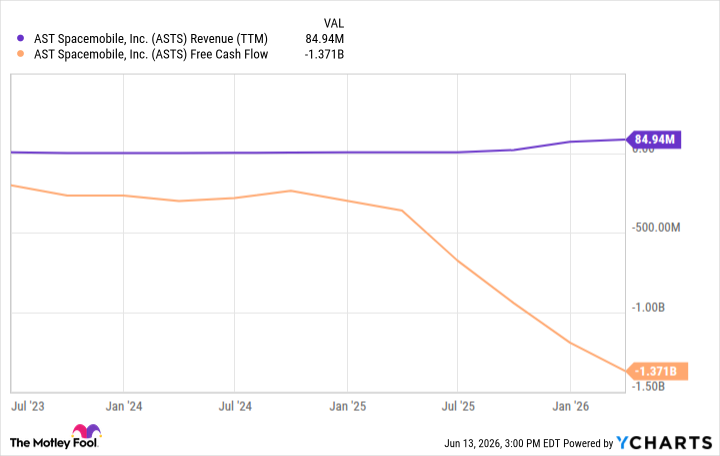
ASTS Revenue (TTM) data by YCharts
Should you buy the dip on AST SpaceMobile stock?
AST SpaceMobile's stock is valued solely on its potential today. There is no doubt tons of potential if it can take the lead in satellite internet innovation, given what Starlink's revenue stands at today.
But that is all AST SpaceMobile has today: potential. There is a long journey from launching a few satellites into orbit to full-on competing with SpaceX, a company that just raised $75 billion in an IPO with one of the most aggressive CEOs in the world, Elon Musk. Investors shouldn't discount the fact that SpaceX could soon develop the same direct-to-device capabilities as AST SpaceMobile, which it could quickly launch into orbit with its own rockets.
Right now, AST SpaceMobile's market cap is $32 billion, while its revenue is under $100 million. This fact alone -- plus its competition with one of the most successful businesses in the world -- should keep investors away from buying the dip.