Space is hard -- and it's a place where good news can turn into bad news in a hurry.
Two weeks ago, Blue Origin, the space pioneer established and run by Amazon.com founder Jeff Bezos, was on cloud nine. NASA had just announced that, as part of its Project Artemis program to return humans to the moon, Blue Origin would launch not one but two separate flights of its Blue Moon Mark 1 (MK1) uncrewed lunar lander to deposit moon rovers on the moon.
This was on top of Blue Origin being chosen to conduct NASA's Moon Base I mission -- the first step of Phase One of NASA's entire project to build a moon base -- by landing a third MK1 on Shackleton Connecting Ridge at the lunar South Pole. It was in addition to the company's win last September of another MK1 contract, valued at $190 million, to deposit a third rover (the Volatiles Investigating Polar Exploration Rover, or "VIPER") on the moon in 2027.
That's four MK1 moon landing contracts altogether.
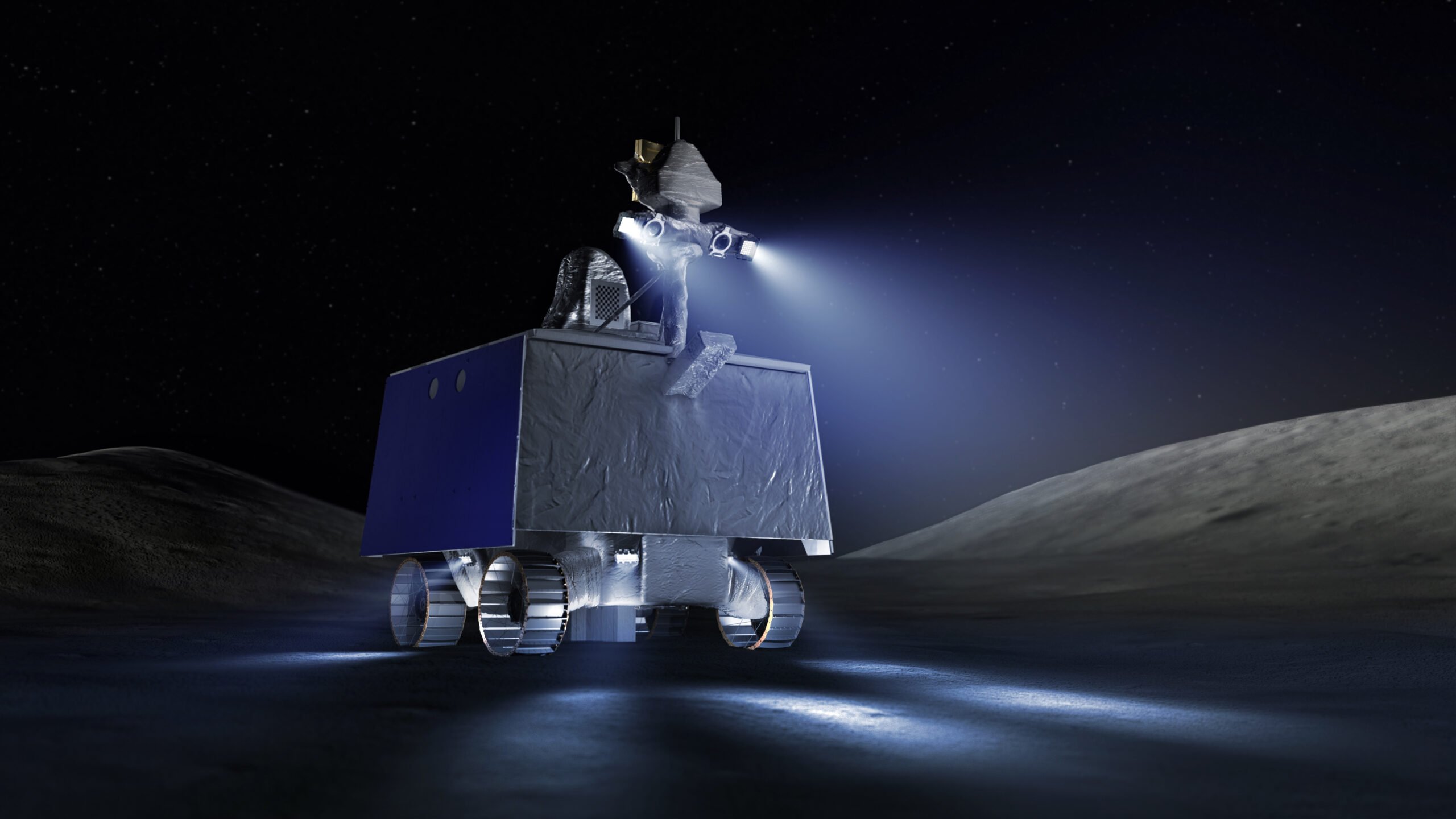
NASA's VIPER rover will be delivered to the moon by Blue Origin. Image source: NASA.
The total value of these contracts is a bit unclear, but NASA priced the two rover-delivery missions at $188 million, with an option to conduct other missions worth $280.4 million. (No specific price was stated for the Moon Base I mission.)
Arguably more important than the money alone, though, NASA had effectively made Blue Origin the centerpiece of a moon base project expected to eventually spawn more than $30 billion in contract awards.
But then disaster struck.

Image source: Getty Images.
Red fireball over Blue Origin
Just two days after NASA announced the three latest lunar lander missions it expects Blue Origin to conduct, the company's premier space vehicle, New Glenn, exploded during a routine engine test in Florida.
Blue Origin's four NASA contract wins set up the company for years of success. For one thing, four MK1 landings on the moon -- versus zero for SpaceX -- would provide valuable experience for Blue Origin as it prepares for its first-ever human landing in an upgraded Blue Moon lander dubbed the MK2. This would give the company an advantage over SpaceX in future contract bidding for both crewed and uncrewed landings on the moon.
Of course, for Blue Origin to gain this experience, it needs two things: a rocket that is safe to operate and a pad from which to launch it. And now both are a problem.
Blue Origin has launched New Glenn rockets only three times so far. The first launch went off without a hitch. The second both launched and landed on a barge at sea. But Blue Origin's third (and most recent) New Glenn launch, in May, suffered an anomaly that prevented its second stage from putting an AST SpaceMobile satellite into orbit, dooming the satellite and casting doubt on the reliability of New Glenn's second stage.
And here's the thing: Last month's New Glenn explosion appears to have originated in the rocket's first stage. So now the reliability of both stages of the rocket is in question.
Even worse, the explosion damaged Blue Origin's only New Glenn launch pad, Launch Complex 36 at Cape Canaveral. It destroyed one lightning tower, may have damaged another, damaged the main tower that supports the rocket, and severely damaged the transporter erector that carries the rocket to the pad.
All of this is expected to take months, at minimum, to repair. And until it's repaired, Blue Origin cannot launch New Glenn rockets -- even if it fixes the problems with the rocket itself.
What this means for Blue Origin, for NASA, for SpaceX -- and for everyone in space
Suffice it to say, this throws a serious monkey wrench into NASA's plans for the moon base. Delays in getting Launch Complex 36 operational, combined with delays in getting New Glenn flyable, will almost certainly postpone NASA's plans for the VIPER launch, and perhaps for Moon Base I and the two other rover launches as well.
There's some hope that Space Exploration Technologies (SPCX -4.21%) might pick up the slack, if its Falcon Heavy rocket or Starship can be configured to carry Blue Origin's MK1 landers. That would be a suboptimal solution for Blue Origin, of course, reversing the advantage it thought it had over SpaceX -- but it just might be the best solution NASA can come up with.
Stay tuned.
Bad as this news may be for everyone else, it could end up being good news for SpaceX and all its new shareholders, now that the SpaceX IPO is complete.