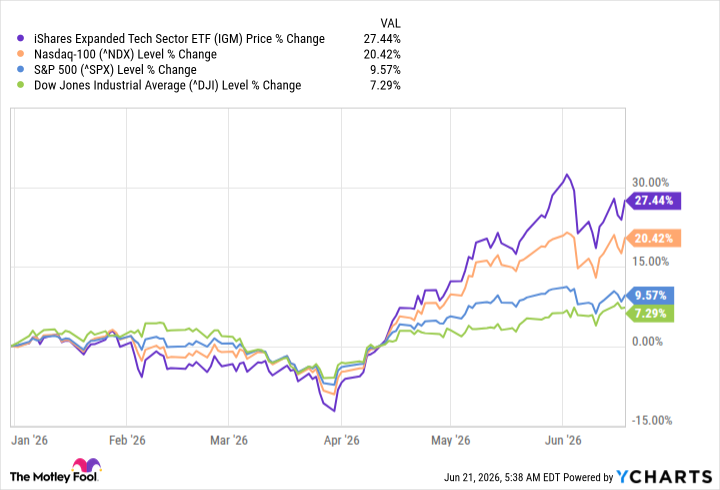
During the first half of 2026, stock market investors had to navigate geopolitical tensions between the U.S. and Iran, soaring oil prices, and a subsequent spike in inflation. Despite some initial volatility, the S&P 500, the Nasdaq-100, and the Dow Jones Industrial Average have still returned between 7% and 20% since Jan. 1.
However, had you bought the iShares Expanded Tech Sector ETF (IGM +0.71%) at the start of this year instead, you would have earned a much higher return of 27%.
This exchange-traded fund (ETF) holds 296 stocks across 12 sectors of the technology industry. It has large positions in many of the trillion-dollar giants that typically drive the broader market higher, and in fact, the fund has almost one-third of its total assets parked in just four of those stocks. Read on.

Image source: Getty Images.
Diverse exposure to the technology industry
Developing artificial intelligence (AI) software requires a substantial amount of computing power, so demand for data center chips and other hardware components is skyrocketing. Therefore, although the iShares Expanded Tech Sector ETF invests across a dozen different areas of the technology industry, it's no surprise the fund has allocated over 35% of its assets to semiconductor companies.
That said, the interactive media, systems software, and application software segments have a combined 31% weighting in this ETF, so, as far as tech-heavy portfolios go, this one is quite diversified.
That is also reflected in the fund's top 10 positions, which include a mix of companies that make semiconductors, consumer electronics, software, social media platforms, and more.
|
Stock |
iShares ETF Portfolio Weighting |
|---|---|
|
1. Nvidia (NVDA -0.52%) |
8.32% |
|
2. Broadcom (AVGO +0.39%) |
8.21% |
|
8.19% | |
|
4. Apple (AAPL -1.11%) |
8.09% |
|
5. Microsoft (MSFT +2.38%) |
7.55% |
|
6. Micron Technology (MU -0.66%) |
5.33% |
|
7. Meta Platforms (META -0.31%) |
4.23% |
|
8. Advanced Micro Devices (AMD -2.03%) |
3.79% |
|
9. Intel Corporation (INTC -2.22%) |
2.74% |
|
10. Applied Material (AMAT -0.50%) |
2.12% |
Data source: iShares. Portfolio weightings are accurate as of June 18, 2026, and are subject to change.
But I want to key in on the top four positions specifically, not only because of their significant combined weighting of 32.8%, but also because of the unique roles they are playing in the AI revolution.
Nvidia supplies the world's best graphics processing units (GPUs) for data centers, which are the main chips used in AI training and inference workloads. It will start shipping its Vera Rubin systems in the second half of this year, which are slated to reduce inference token costs by up to 90% compared to the company's current Blackwell systems. In other words, Vera Rubin will make AI significantly cheaper to use, which could spur additional demand for chips.
Broadcom has become one of Nvidia's top competitors. It supplies AI accelerators, which are a customizable alternative to GPUs. Companies like Alphabet and Anthropic have ordered billions of dollars' worth of these chips, which are better suited to some of their specific AI workloads than out-of-the-box GPUs.
Alphabet rents computing capacity and ready-made large language models to other enterprises via its Google Cloud platform, a practice that has become very lucrative. However, Alphabet has also embedded AI features into Google Search, resulting in increased usage and accelerating revenue growth.
Finally, Apple continues to install custom processors and other hardware components into its latest iPhones, iPads, and Mac computers, so they can run its Apple Intelligence suite of AI features and software applications. With more than 2.5 billion active devices worldwide, this company could become the biggest distributor of AI to consumers.

NYSEMKT: IGM
Key Data Points
The iShares ETF consistently beats the market
The iShares Expanded Tech Sector ETF has delivered a compound annual return of 12.5% since its 2001 inception, so it has handily outperformed the S&P 500, which returned an average of 8.4% over the same period. Therefore, its strong result in 2026 certainty isn't a one-off.
Over the past 25 years, this ETF has successfully navigated many technological revolutions spurred by the internet, e-commerce, personal computers, smartphones, enterprise software, cloud computing, and more. As a result, while the ETF is drawing most of its upside from the AI boom today, history suggests it will still perform well once this theme slows. Other technologies, such as autonomous vehicles, robotics, or even quantum computing, could take over to become the dominant source of returns in the future.
As a result, this ETF could be a great addition to any diversified portfolio of other funds and individual stocks, especially one that doesn't already have a high degree of exposure to the technology industry.