Nvidia (NVDA +2.39%) may have once made many millionaires. If you had invested $1,000 in the company in its early days of trading and held on, today you would have more than $5 million. Most of the gains happened over the past few years, as the artificial intelligence (AI) boom took shape -- Nvidia makes the key chips that power crucial AI tasks, like the training of AI models, and has built out expertise in a wide range of related products.
All of this supercharged earnings growth, sending it to record levels, and as a result, investors rushed to get in on the stock. And those who recognized Nvidia's potential in its earlier days scored a gigantic win.
Now, however, after Nvidia's incredible run, climbing more than 800% over just the past five years, you may wonder if the stock still is a millionaire-maker. Let's find out.

Image source: Getty Images.
Nvidia's growth story
We'll start by talking about Nvidia's story so far. The chip designer wasn't always an AI specialist. After all, Nvidia was founded more than 30 years ago, well before the days of AI. The company's graphics processing units (GPUs) then mainly served the video games market, but in more recent years, Nvidia broadened the usage of its chips by creating the parallel computing platform CUDA. That eventually opened the door to use in the AI market -- and Nvidia, seeing the opportunity, got involved early, designing GPUs specifically to suit the needs of AI customers.
All of this worked out well for Nvidia, as we can see through its earnings reports in recent years. The company reported more than $215 billion in revenue in the latest full year and continued to see earnings roar higher in the latest quarter. In that period, revenue rose 85% to $81 billion, and net income advanced more than 200% to $58 billion.
The stock price has soared throughout most of the AI boom, but in recent months, Nvidia stock hasn't been much of a performer.
NVDA Nvidia
NASDAQ · As of 4:00 PM ET 10/26/26

This hasn't been due to any bad news in the AI market or news concerning Nvidia in particular. Instead, general worries have weighed on AI stocks. Last year, investors questioned the sustainability of their high valuations. Valuation has come down quite a bit since, but another concern has lingered: Some investors question whether the future AI revenue opportunity justifies the current levels of AI spending. Even though companies from Nvidia to cloud service providers like Microsoft and Amazon have spoken of soaring AI demand, and AI revenue is climbing at these and other companies, the concern has periodically weighed on Nvidia and other AI players. Particularly, stocks that have skyrocketed in recent years.
Starting from lower price and market cap levels
Now, let's return to our question: Against this backdrop and at this point in the AI story, is Nvidia still a millionaire-maker stock? It's important to remember that it was easier for Nvidia to generate millions when the stock price and market value started out from much lower levels.
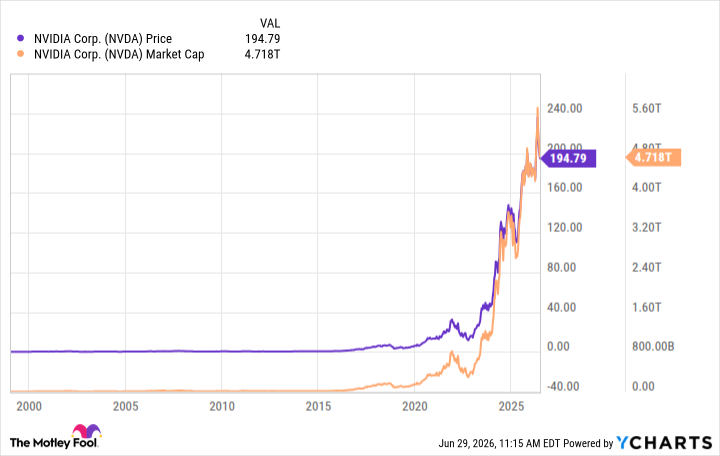
Today, with Nvidia's market cap at more than $4.5 trillion, it's difficult for the company to double or triple in size. This makes enormous gains in a short period of time much more difficult.
So, with a $1,000 investment in Nvidia, it seems impossible to reach millionaire status. Of course, with an enormous investment in the company, you could potentially become a millionaire -- but it's very risky to make one big investment and count on that stock to produce wealth.
Instead, it's a safer idea to invest in a broad range of quality stocks. And you're likely to be more successful this way, too. Using this strategy, Nvidia could help you along the road to wealth, as the stock still has room to run during the AI boom and beyond. Nvidia holds the leading position in the GPU market, and this should continue thanks to the company's focus on innovation. Meanwhile, the stock, trading at 21x forward earnings estimates, is dirt cheap right now, making it an excellent buy.
So, even though Nvidia may not be a millionaire-maker on its own, it still could offer your portfolio a huge lift over time.